
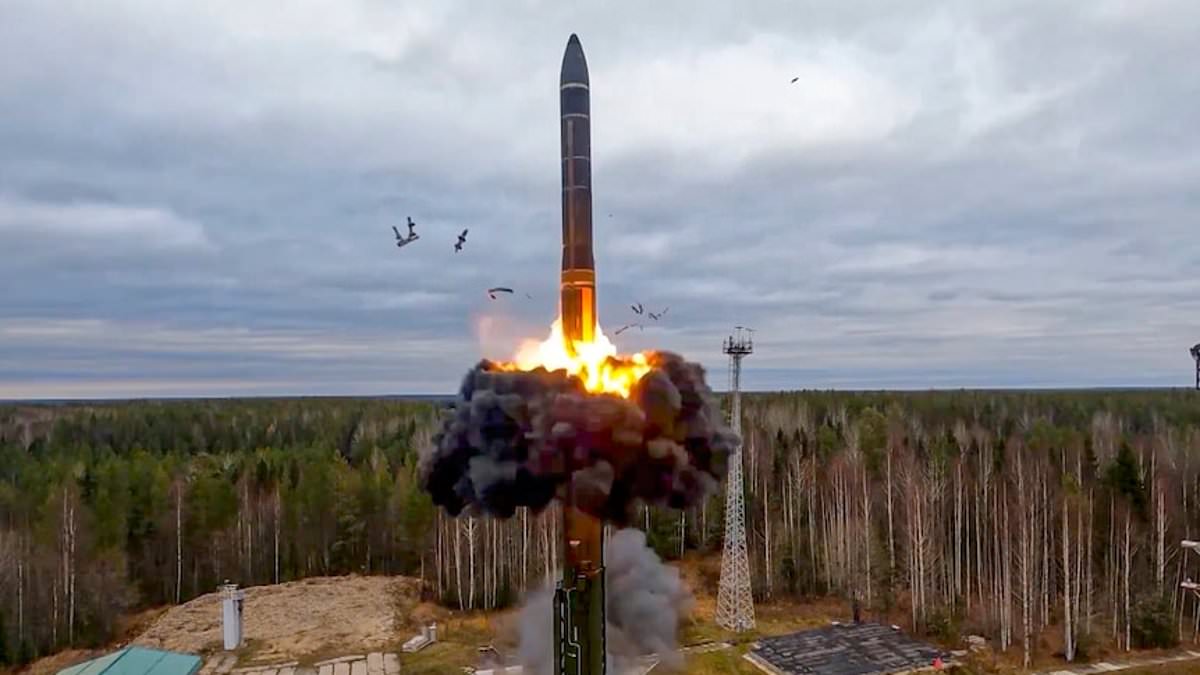
An invisible electronic battle is raging at the centre of the Russia-Ukraine war.Moscow and Kyiv are attacking and shielding communication signals on an unprecedented scale, developing technology that the US and other Western militaries are scrambling to match.Earlier this year, two Russian ballistic missiles bolted at hypersonic speeds towards an important government site in Ukraine's capital city.They then hurtled into the 1,367-mile-long Dnipro River after being intercepted by a radio signal.Around that time, navigation apps on several phones in Kyiv showed users as located in Peru - an effect of the GPS spoofing used by Night Watch, an elite Ukrainian jamming unit that says it downed the missiles with its Lima system.The Pentagon is investing heavily in new technology to match the capability of Lima, whose installations are deployed across Ukraine to interfere with the navigation and control systems of Russian missiles, guided bombs and drones. 'This is a new era of spectrum warfare,' Lt. Col. Matt Sherburne, the US Army’s chief for electronic warfare capabilities development, told the Wall Street Journal.While electronic warfare is not novel, it fell out of focus in the West following the end of the Cold War - then came Vladimir Putin's invasion of Ukraine. The moment a Ukrainian kamikaze robot strikes a Russian vehicle after being air-dropped by a drone miles behind enemy lines Smoke rises in the city during a Russian missile strike, amid Russia's attack on Ukraine, in Kyiv, Ukraine September 8 Pictured: The launch of a Russian hypersonic missileMass drone assaults have become the dominant mode of attack on the front lines.Both sides are now fighting it out in a constant game of cat and mouse, utilising AI to jam and avoid each other's onslaughts.Across the world, electronic warfare has become the governing principle of the battlefield.America began its operation to kidnap former President Nicolás Maduro by using electronic warfare to prevent the ability of the Venezuelans to see and communicate. Meanwhile, the conflict in Iran saw the first deployment of the US’s newest signal-jamming aircraft, the EA-37B Compass Call.Also called spectrum warfare, EW depends on locating or disrupting the frequencies that enemies are using, or hiding signals from foreign interference. Signals are blasted out to drown out, confuse or replace an adversary’s communications.Ukraine’s Night Watch division uses its Lima system to blast signals over a 120-mile range that reroute drones, missiles and guided bombs, said a major in the unit, known by his call sign Alchemist. The unit used Lima to redirect the ballistic missiles that crashed into the Dnipro, filling the air with spoof satellite navigation signals and causing the Russian weapons to veer off course.The system has become an increasingly important layer of Kyiv's air defence architecture as Moscow intensifies long-range strikes and the military faces persistent shortages of expensive interceptor missiles. Last November, Night Watch proved its effectiveness when the unit intercepted a hypersonic Kinzhal missile, once dubbed invincible by Putin. Night Watch officers described how Lima projected a false navigation signal at the missile, prompting it to change direction and break up under the pressure of its own extreme speed.Kyiv won’t disclose how often EW, rather than in-flight failure, is responsible for downing missiles and drones. It can be difficult to tell the difference and sometimes, electronic interference can unintentionally divert a target to civilian areas. Lima can also sometimes interfere with Ukraine's own drone campaigns.Despite the drawbacks, there is no denying the importance of electronic warfare.According to one officer for Ukraine’s Unmanned Systems Forces, Lima thwarts 70 per cent to 95 per cent of radio-controlled drones detected in the sector where his team operates.Phantom Defence, a Ukrainian manufacturer, claims that over the past year of operation, its systems detected more than 11,500 Russian drones, of which around 65 per cent were successfully neutralised.And Kyiv's government, police, armed forces, and national guard are purchasing vast amounts, underscoring the success. Ukrainian company December1 now sells thousands of its front-line and long-distance units a month, up from dozens in 2024.December1 was manufacturing roughly 400 Damba systems a month in July 2025. That figure has since risen to roughly 1,000 and could reach 2,000, the CEO told Business Insider. The vulnerability of radio signals has long been exploited in conflict, going back to the start of the 20th century when the British Royal Navy experimented with radio jamming and intercepting enemy communication.Throughout the Second World War, the UK and Germany jammed and spoofed aerial navigation signals in what Winston Churchill called the battle of the beams. But as military communications and radar innovated during the Cold War, so did the technology to disrupt them. Remain of Kh-47M2 Kinzhal missile at an exhibition showing remains of missiles and drones that Russia used to attack Kyiv on May 12, 2023 in Kyiv, Ukraine Fragments of a downed Russian missile lie on the ground on May 16, 2023 in Kyiv, Ukraine Dmytro Chubenko, spokesperson of the Kharkiv prosecutor, and his assistant cover a Russian Shahid drone shot down by air defence forces in a field intended for the storage of Russian missiles in Kharkiv, on April 30, 2025During post-Cold War conflicts, however, the Pentagon ceased advancing its electronic warfare capability when it faced lower-tech adversaries in Afghanistan and Iraq.According to US officials, Putin's invasion of Ukraine has been a wake-up call.When Joshua Ransford served as a US Marine in Iraq, he didn't focus too much on electronic warfare because America's adversaries had such little capability in this field. But when he joined the international legion of Ukraine’s armed forces in 2022, it became clear that he was entering a very different kind of battlefield.In his first days of fighting, Moscow jammed his GPS signals and radio frequencies, rendering much of his equipment obsolete. Russia flew drones that could locate Ukrainian positions by detecting their electronic emissions, including radio.'It really sucked,' Ransford told the Journal.In today's networked world, jammers have more targets than ever, from mobile phones and satellite navigation systems to a range of new guided weapons and drones, as well as traditional radio and radar. A Ukrainian serviceman, Oleh, looks for his wife, Yevheniia, and her mother at the site of their private house hit by a Russian drone strike, amid Russia's attack on Ukraine, in Kyiv, Ukraine, September 30 A Russian Navy frigate fires a Zircon (Tsirkon) hypersonic anti-ship missile during drills conducted in the eastern part of the Mediterranean Sea, in this still image from video released on December 3, 2024According to Bill LaPlante, who was the Biden administration’s top procurement official, electronic warfare was one of the Pentagon’s top three procurement priorities by 2022, along with long-range munitions and affordable technology, for combating drones and missiles.Beijing is also expanding its capabilities, with military experts saying it has established electronic warfare units on an archipelago of man-made islands in the South China Sea.As NATO boosts spending, spectrum warfare has become one of the most lucrative fields for Western defence businesses. Desired items include pods tethered to naval vessels and jets that replicate the electronic signature of the vehicles they trail and act as a decoy for incoming missiles and torpedoes.Other technology includes drones that detect an enemy's electronic emissions and equipment that alters radar pulses to confuse the adversary.The race to develop technology which can avoid the jammers is similarly intense.Ships sometimes communicate with other vessels via lasers that can’t be intercepted.Moscow and Kyiv are using fiber-optic cables to connect drones directly to their operators. Meanwhile, both sides have artificial intelligence-enabled drones that can lock onto and obliterate targets without requiring a feed to an operator.Nevertheless, lasers only work over small distances and in opportune weather. Fiber-optic drones don't travel as fast and are less maneuverable. AI also have a long way to go before drones can reliably navigate terrain over long distances on their own, according to Vito Tomasi, a managing director at German drone maker Quantum Systems.As war rages on, Night Watch is pedaling hard to stay ahead.When the unit is able to retrieve a downed target by interfering with the incoming weapon's guidance system, personnel often scour the wreckage to figure out new ways to jam them.At the end of 2024, Night Watch found out that Russian drones and missiles were using Chinese-made components known as Controlled Reception Pattern Antennas, which have the ability to detect where jamming signals are beamed from and, in fractions of a second, use complex algorithms to avoid them. 'It was a big problem for us,' an officer known by the call sign Frenchy told the Journal.Following the discovery, Night Watch and Cascade Systems, the company that makes Lima, worked tirelessly for three months to find a solution. The outcome was Lima Quant, whose own mathematical algorithms work out ways to overcome such an antenna.But in response, Putin's army doubled the number of antennas from four to eight, then to 16, and now to 32, each time reacting to new Lima innovations.Electronic warfare isn’t a perfect stand-in for Patriot interceptors, hence Russia’s success in piercing Kyiv’s air defences with ballistic missiles this year.But it comes at a fraction of the price and is readily available.Unlike many other tactical jammers, Lima can cover huge areas of territory, protecting critical infrastructure. Each unit costs up to 3 million hryvnia (£51,000) to produce, depending on the iteration, according to Cascade Systems. The company estimates that it takes 30 to 100 units to protect a major city - around £4million.That's about the cost of a single Patriot PAC-3 missile.The Pentagon is taking notes, according to Col. Josh Koslov, the US Air Force’s director of non-kinetic operations. 'If you are not winning in the spectrum,' he said, 'you are going to lose the war.'
Elite Ukrainian 'Night Watch' unit 'intercepts Russian hypersonic missiles using radio signals and diverts them into river'
Full Article
Original Source
Read the full article at Dailymail →KhanList aggregates and links to publicly available news content. We do not host full articles from third-party sources. Always verify important information with original sources.