
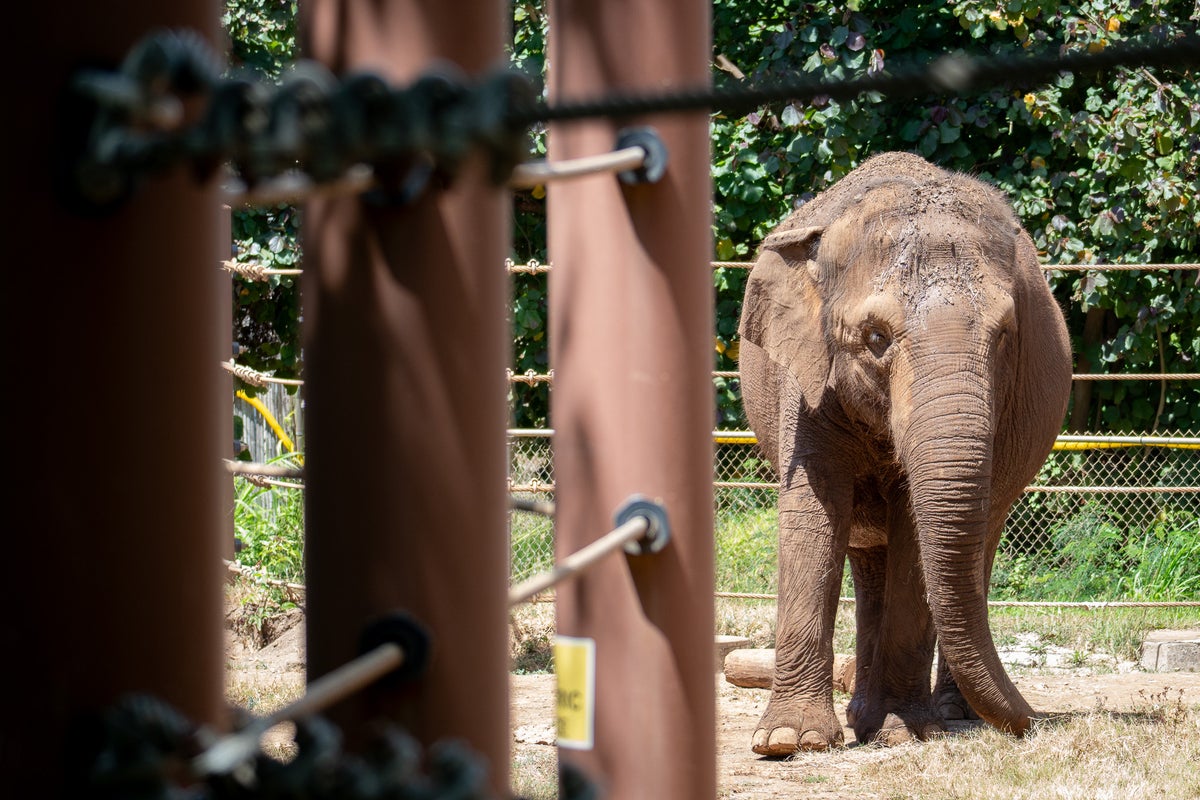
Two elephants at a Hawaii zoo have a legal right to “liberty” and should be freed, an animal rights group argues in a case that could expand legal protections for animals.The Nonhuman Rights Project, a nonprofit animal rights organization, is asking Hawaii’s Supreme Court to allow Mari, 51, and Vaigai, 41, two Asian elephants at the Honolulu Zoo, to be transferred to an accredited sanctuary.Like humans, animals are autonomous beings whose intelligence and complex social relationships should entitle them to legal protections against unlawful confinement, the group says. The state’s high court heard arguments Monday in the case, which does not seek the elephants’ immediate release. Instead, the organization is asking for permission to bring their confinement before a lower court for an evidentiary hearing, where experts could argue that keeping the animals at the zoo violates their right to liberty.The case centers on whether elephants can be considered “persons” under Hawaii’s habeas corpus law. Habeas corpus is a legal procedure used to challenge someone’s detention and determine whether it is lawful. The project says the legal protection should extend to the elephants, while the City and County of Honolulu say the law does not apply to animals.The Nonhuman Rights Project wants Mari and Vaigai, two Asian elephants at the Honolulu Zoo, moved to an accredited sanctuary, arguing that keeping them at the zoo violates their right to liberty (Craig Fujii/Civil Beat/2026)Mari and Vaigai have spent decades at the Honolulu Zoo, arriving in 1982 and 1992, respectively. The animal rights group argues their 1.5-acre enclosure is too small to meet their natural needs and deprives them of the space, social interactions and environmental conditions they would experience in the wild.The group’s petition also alleges the elephants are kept on a hard dirt floor that can harm their joints, with inadequate shade and water features deep enough for them to bathe. It argues the animals would be better suited to an accredited sanctuary, where they could have substantially more room to roam.“The world’s foremost elephant scientists have established that Mari and Vaigai are autonomous,” attorney Jake Davis, representing the project, told the court. “Autonomy is the foundation of the right to liberty. Habeas corpus exists to protect an individual’s right to liberty …We are suggesting that autonomy in this case is sufficient for the recognition of the right [to liberty],” Davis continued.The City and County of Honolulu, which is opposing the petition, says that extending legal personhood to animals would amount to a major change in the law that should be decided by lawmakers rather than the courts.Deputy Corporation Counsel Patricia Sendao said the organization’s request would fundamentally alter Hawaii’s legal framework for animal welfare.“This court looks backwards towards historical precedent for grounding and then, if necessary, will take incremental steps forward,” Sendao said, comparing the evolution of the law to the slow development of a coral reef. “But what is asked for here by NhRP is … a sweeping pronouncement that fundamentally alters our laws regarding animal welfare.”The project first filed its petition in 2023. A circuit court dismissed the case in 2024, and Hawaii’s Intermediate Court of Appeals upheld that decision earlier this year, finding that elephants do not qualify as “persons” under the state’s habeas corpus statute.The elephants have lived at the zoo for decades, but the group says their 1.5-acre enclosure is too small to meet their needs (City and County of Honolulu)The state Supreme Court agreed to hear the appeal in June. Monday’s arguments took place before about 500 students from 11 Oahu schools at Punahou School in Honolulu as part of the judiciary’s Courts in the Community educational program.During the hearing, justices questioned whether recognizing elephants’ right to challenge their confinement could lead to similar legal claims involving other animals.“There’s a lot of animals that have autonomy,” Associate Justice Sabrina McKenna said. “Don’t octopuses have autonomy? Are you going to at least limit it to mammals? Are you talking about reptiles, amphibians, insects? … The courts could be inundated with these requests if we were to recognize this. We would have to set some sort of reasonable parameters,” McKenna said.The decision could affect how animals are treated in zoos and other places where they’re kept in captivity. Supporters say a win for Mari and Vaigai would be a big step toward recognizing animal rights, while opponents worry it could have broader consequences for zoos and conservation programs.The justices did not issue a ruling Monday and are expected to make a decision at a later date.
Elephants have the right to ‘liberty’ group argues in quest to free animals from Hawaii zoo
Full Article
Original Source
Read the full article at Independent →KhanList aggregates and links to publicly available news content. We do not host full articles from third-party sources. Always verify important information with original sources.