
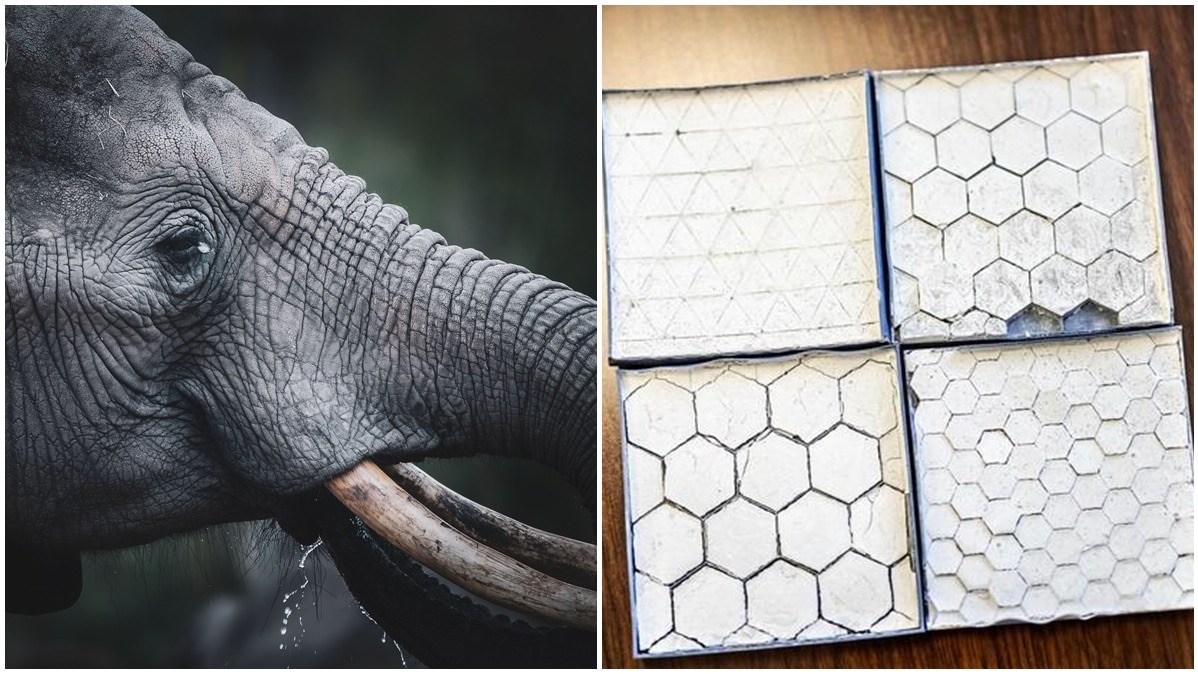
Scientists have taken a cue from elephants to develop a material that may hold the key to fighting extreme heat which is becoming frequent as the planet continues to warm.Elephants have helped find a solution to a global problem. (Photo: EurekAlert)Elephants may have offered an unlikely solution to one of the biggest challenges in a warming world: keeping buildings cool without relying entirely on air conditioners.Researchers at the University of Pennsylvania have developed a cement-based tile inspired by the cracked skin of African elephants.The material captures water, spreads it across a building's surface and allows it to evaporate slowly, pulling heat away in the process. A baby elephant is pictured beside its mother. (Photo: AP) “Wrinkles,” said Dorit Aviv, an associate professor of architecture at Penn’s Weitzman School of Design. “Elephants have a network of cracks in their skin that trap water. When they spray themselves, that water stays put and evaporates slowly, cooling them over time.” The study, published in Advanced Materials, noted that the tiles kept the temperature beneath them at about 32°C during infrared heating and periodic watering.By comparison, the temperature beneath cracked commercial stucco reached about 42°C, while non-cracked stucco climbed to about 52°C. Bird's eye view of densely packed buildings in Udaipur. (Photo: Pexels) HOW ELEPHANTS INSPIRED SWEATING BUILDINGSThe researchers were tackling a simple problem; water sprayed onto conventional building surfaces often runs away before it can evaporate and provide meaningful cooling.Their solution was to deliberately engineer cracks into the material.The tiles combine ordinary Portland cement with diatomaceous earth, a porous material made from the fossilised remains of algae. Architects have designed a cement-based tile that captures and slowly evaporates water. (Photo: UPenn) As the material dries, carefully controlled stresses create a predictable network of cracks rather than random fractures.“In conventional construction, cracks signal weakness, the beginning of a material’s decline,” said Shu Yang, another researcher involved in the process. “But by engineering where and how they form, we made networks of tiny channels that act like capillaries capable of pulling water across the surface and holding it in place.”Microscopic pores absorb water in less than 0.05 seconds, while the crack network redistributes it across the surface, even on slopes.Furthermore, the researchers found that the hexagonal pattern could sustain cooling for up to 20 hours.COULD AC BE REPLACED?The system has no fans, compressors or other moving parts. Silhouette of a city is seen with the Sun in the background, illustrating urban heat. (Photo: Pexels) Instead, it cools the building's outer surface through evaporation rather than mechanically moving heat from indoors to outdoors.“In the United States, we spend roughly 90% of our time indoors, and buildings consume about 40% of primary energy—nearly half of that for heating, cooling, and ventilation,” Yang said.She added that a bio-inspired cooling facade could lower surface temperatures by about 6-11°C compared with traditional stucco.For Indian cities facing increasingly severe summer heat, such passive cooling could be relevant, although the technology has not yet been demonstrated as a commercial building-scale cooling system. Associate professor of architecture Dorit Aviv and Shu Yang the Joseph Bordogna Professor of Engineering. (Photo: UPenn) The material can already be applied to large panels using hopper guns, suggesting a possible path to larger-scale production.The researchers ultimately envision automated systems that use weather forecasts to deliver only the water needed for cooling.“Extreme heat is already the deadliest climate-related hazard, and we’ve spent decades trying to seal buildings off from the environment,” Aviv said. “If we can design materials that work with natural processes instead of against them, we can start to rethink how cities stay livable.”- EndsPublished On: Aug 20, 2026 17:19 IST
Elephant skin, cement and water: Recipe to make buildings stay cool
Full Article
Original Source
Read the full article at Indiatoday →KhanList aggregates and links to publicly available news content. We do not host full articles from third-party sources. Always verify important information with original sources.