
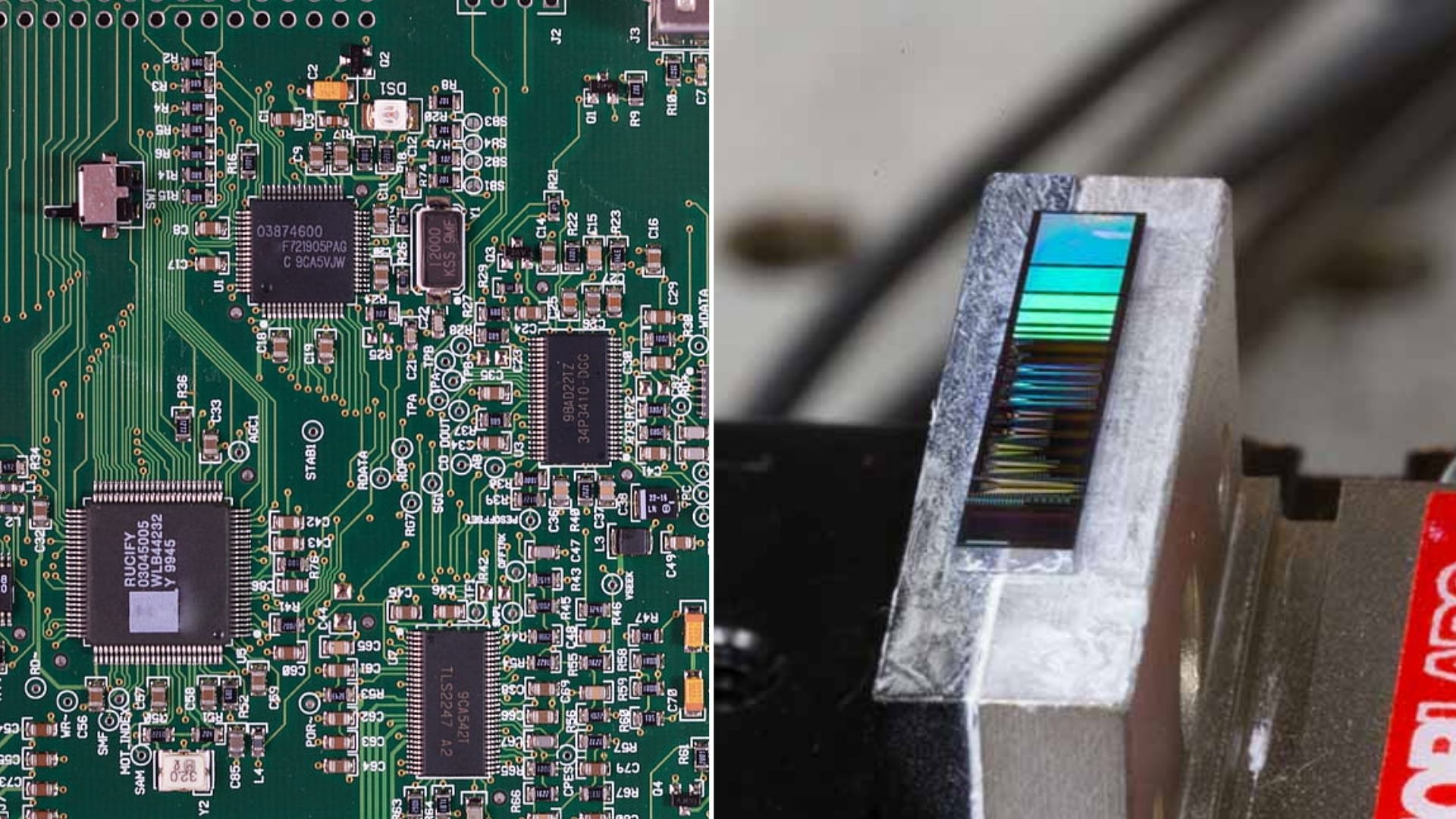
For decades, electronic chips have powered almost every digital device around us, from smartphones and computers to the servers running artificial intelligence. But as the amount of data moving through modern computers continues to grow, researchers and chipmakers are increasingly looking at a different way to move and process information. Light. That is where photonic chips come in. Instead of relying primarily on electrical signals, they use photons and tiny optical components to manipulate light. The two technologies are not necessarily competitors, however. Increasingly, researchers are looking at ways to combine electronics and photonics in the same computing systems. How electronic chips work Electronic chips are built around semiconductor devices, most importantly transistors. Silicon is widely used because its electrical properties can be precisely controlled, allowing manufacturers to build billions of tiny switches into a single integrated circuit. These transistors switch electrical signals on and off to perform calculations, store and manipulate information, and control other hardware. This approach is extraordinarily mature and remains the foundation of modern computing. The problem is that moving huge quantities of information electrically can consume significant power and generate heat. This becomes increasingly important in data centers, where processors and accelerators must constantly exchange enormous amounts of data. That is one reason engineers are exploring light as an alternative for moving information. How photonic chips work Photonic chips, also called photonic integrated circuits, use light instead of electrical signals for some or all of their functions. Rather than transistors alone, these chips can contain components such as lasers, waveguides, modulators, filters, and photodetectors. Waveguides direct light around the chip, while modulators can encode information onto optical signals. One important point is that photonic chips do not necessarily eliminate electronics. Many systems still need electronic circuits to control the optical components, convert electrical signals into optical ones, and convert them back again. This is why silicon photonics is becoming particularly interesting. It combines optical components with the manufacturing advantages of silicon-based electronics. Why use light instead of electricity? The biggest advantage of photonics is data movement. Light can carry enormous amounts of information, and optical connections can offer high bandwidth over relatively long distances. This makes photonics particularly attractive for connecting processors, memory, and networking equipment inside increasingly demanding data centers. Intel, for example, is developing integrated photonics to move optical connections closer to computing hardware. Photonic systems can also reduce energy consumption for certain high-speed connections. NIST researchers describe the combination of electronics and photonics as a way to bring together the scalability of digital computing with the high bandwidth of optical signals. For AI systems, where enormous volumes of data must move between processors, that distinction could become increasingly important. Why not make everything photonic? Because electronics remain exceptionally good at many forms of computation. Photonic circuits have their own engineering challenges. Generating, detecting, and controlling light requires specialized components, and integrating lasers with silicon can be difficult because silicon itself is not an efficient light-producing material. NIST researchers, for example, have been developing ways to integrate specialized semiconductor laser materials with silicon wafers. Photonics also does not automatically make every calculation faster or more efficient. Its biggest advantage today is often in moving information, rather than replacing the transistor as the universal building block of computing. The future could combine both Rather than electronics disappearing, the more likely future is a closer partnership between the two technologies. Electronic circuits can handle dense logic, control, and computation, while photonic components can move huge amounts of information between different parts of a computing system. NIST and industry researchers are already working on integrating photonics directly with CMOS electronics for high-speed communications and computing architectures. In simple terms, electronic chips are exceptionally good at processing information, while photonic chips can be exceptionally good at moving it with light. The most powerful systems of the future may therefore use both, letting electrons and photons do the jobs each is best suited for. Get the latest in engineering, tech, space & science - delivered daily to your inbox.Kaif Shaikh is a journalist and writer passionate about turning complex information into clear, impactful stories. His writing covers technology, sustainability, geopolitics, and occasionally fiction. A graduate in Journalism and Mass Communication, his work has appeared in the Times of India and beyond. After a near-fatal experience, Kaif began seeing both stories and silences differently. Outside work, he juggles far too many projects and passions, but always makes time to read, reflect, and hold onto the thread of wonder.
Electronic vs photonic chips: Two different ways to move and process data explained
Full Article
Original Source
Read the full article at Interestingengineering →KhanList aggregates and links to publicly available news content. We do not host full articles from third-party sources. Always verify important information with original sources.