
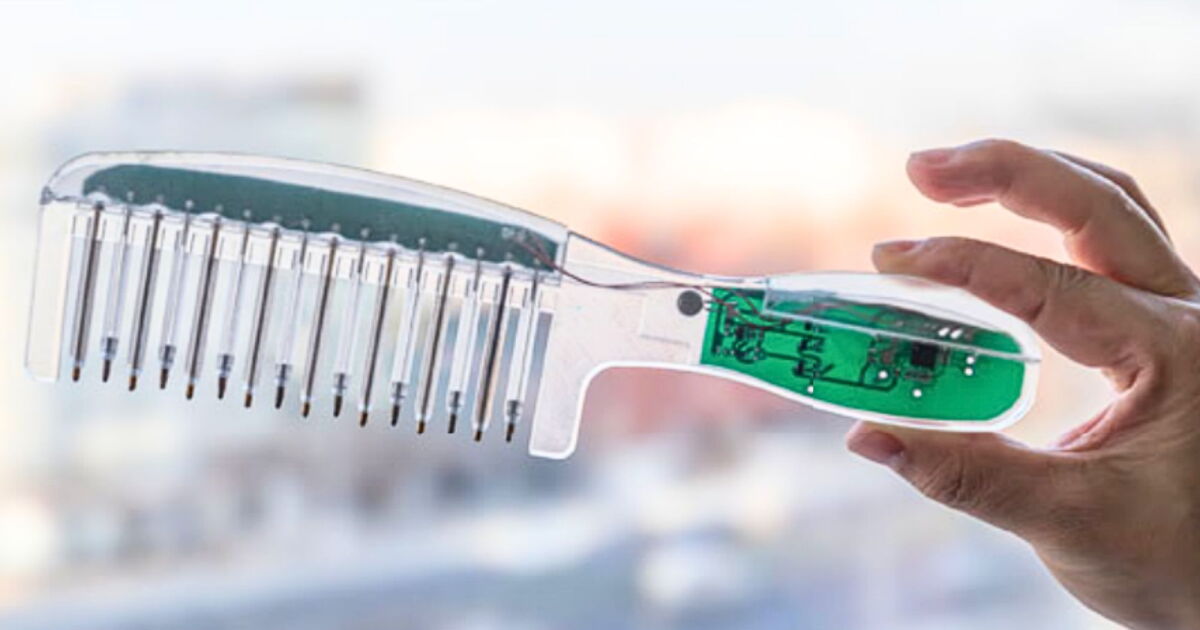
A comb is an optimistic tool to buy when your hairline is retreating. So researchers in China gave the humble grooming implement a more useful job than rearranging the stragglers by encouraging regrowth among the remaining follicles with a series of electrical pulses and genetic treatments.Their experimental device – dubbed Detangle – restored hair coverage across almost all of a treated patch on mice within a month, outperforming minoxidil in the same experiment.Before you clear some space beside your wild new piezoelectric toothbrush, the important word to note above is “mice.” Human scalps have yet to receive their turn beneath Detangle's stimulating teeth.Led by scientists from Beihang University, the team designed Detangle to tackle a condition called androgenetic alopecia; the typical progressive pattern of hair loss that affects men and women.In some follicles, the hormone dihydrotestosterone (DHT) can slowly shrink growth, where each cycle produces finer, shorter hairs. Topical treatments can hold back the tide, but getting therapeutic substances through the skin remains a challenge. Swallowing medications is one way to get around this, at the risk of exposing other tissues to unwanted effects.Detangle aims to improve the safer delivery-from-above method using an alternating series of electrodes and reservoirs that dispense therapeutic molecules through a mechanism resembling a ballpoint pen.Positioned at different heights, the electrodes force the skin to furrow while delivering charged pulses that help move the drug into deeper tissue and inside cells. As a bonus, the electrical stimulation also encourages pathways involved in hair growth. Detangle system promotes hair growth through deep delivery of regulatory molecules into hair follicle cells.(Liu et al., Nature Communications, 2026) For the experiment, the researchers loaded the pen-like reservoirs with a pair of complementary genetic treatments. One was a small ring of DNA carrying instructions for a protein that promotes blood vessel formation. The other was a short segment of RNA that interfered with the creation of an enzyme involved in DHT production.In male mice whose back fur had been removed, daily testosterone applications created an animal model of androgen-related hair loss. Use of Detangle every three days came close to returning hair coverage by day 28, compared with roughly 70 percent return in mice that underwent a topical minoxidil dose each day. Tissue analyses also confirmed there were notable improvements in follicle activity and local circulation.As reassuring as signs of safety were in the tiny bald test subjects, human tolerability, lasting benefits, and the demands of repeated treatment remain open questions.Still, this is a busy time in the science world for hopeful follicle rescuers. Earlier this year, mouse experiments led by Japanese researchers successfully created fully functional hair follicles in the lab for the first time. The hair not only grew like the stuff on our head – it cycled through the typical periods of growth, giving researchers a new tool for clinically assessing hair loss therapies that don’t rely on mice.The interest in treating hair loss extends beyond bathroom vanity. A meta-analysis published last year associated pattern hair loss with greater depressive symptoms, social anxiety, and stress.Separately, the 2025 Alopecia + Me study linked stigma and perceptions of illness with psychological burden in alopecia areata, a different, autoimmune form of hair loss.While neither finding means everyone needs a full head of hair to be happy, they do emphasise why effective treatments can often matter to individuals beyond appearances.Detangle's name was reportedly inspired by Disney's Tangled. Rapunzel-level results remain firmly in fairy-tale territory, but giving a comb a second job could yet prove a useful plot twist.The research was published in Nature Communications.Source: Phys.org
Electric comb could give thinning hair a chance to bounce back
Full Article
Original Source
Read the full article at Newatlas →KhanList aggregates and links to publicly available news content. We do not host full articles from third-party sources. Always verify important information with original sources.