
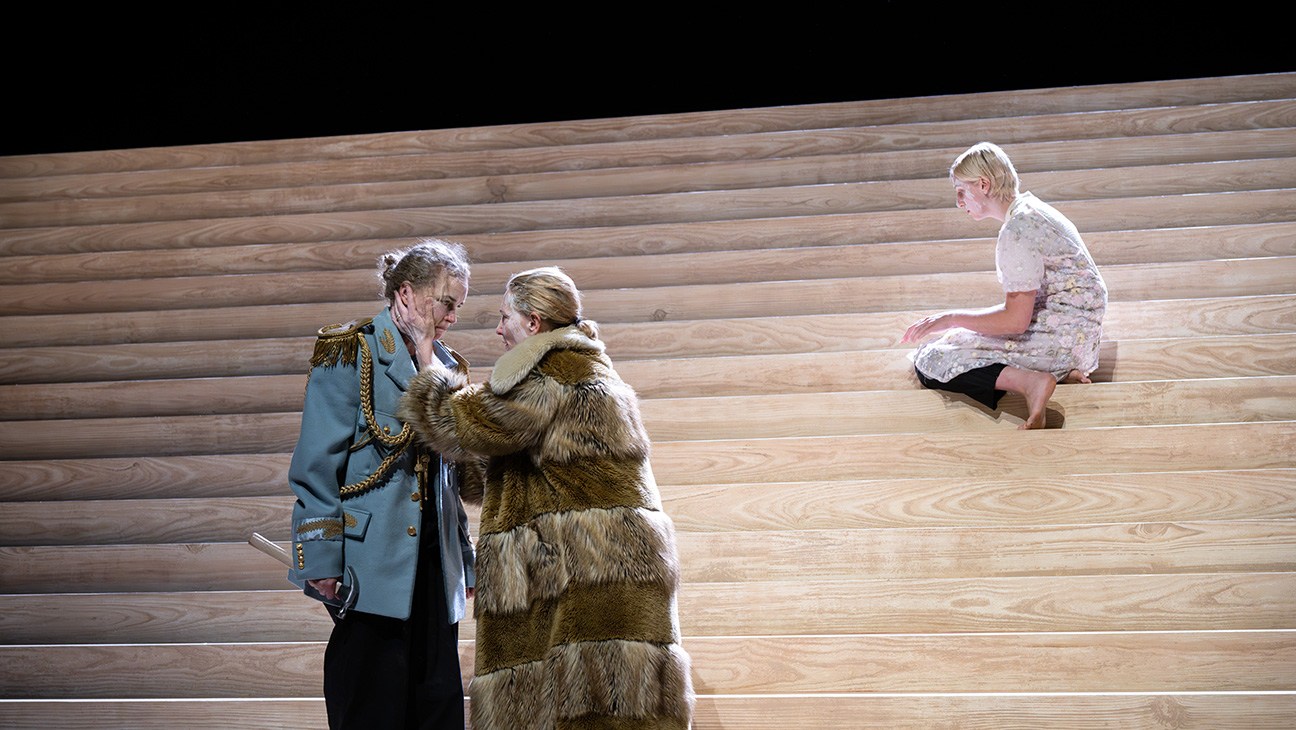
A proposition that intrigues and entices on so many levels — premise, sources, director, stars — lives up to its promise, and then some. Electra/Persona is bold, dazzling, challenging for both actors and audience. And in Cate Blanchett and Nina Hoss, it confirms an acting partnership that needs to be teased and tested again and again. Rather than affectation, the title can be taken literally: writer and director Benedict Andrews (who directed Gillian Anderson in A Streetcar Named Desire in both London and New York) is offering potted riffs on Sophocles and Bergman, Greek tragedy and modern cinematic psychodrama. He has said in interviews that the evening is not a double-bill, but “one hinged work”; either way, it’s two roughly one-hour acts, with a short intermission. The join, of course, is that it is while performing as Electra on stage that the fictional actress in Persona (played on screen by Liv Ullmann) stops speaking completely, prompting the action of the film. The result here is a form of investigation, mining for similarities, or resonances, between play and film, the characters and their dynamics. Bergman’s scenario famously reaches the deeply ambiguous point at which the personalities of the actress Elisabet Vogler and her nurse, Alma, seem to merge. Andrews extends the conceit to Electra and her mother Clytemnestra, underlining the fact that they have far more in common with each other than they think. At the same time, guilt and confusion, particularly over a woman’s lack of feeling for her child, pass in waves between the two pieces. Pairing also applies to the casting. Each evening the two leads each take a pair of roles: either Electra and Elisabet, or Clytemnestra and Alma. Two other actors occasionally share the stage: Ella Lily Hyland (best known as the psychopathic hitwoman in Netflix’s Black Doves) is Electra’s sister Chrysothemis and Elisabet’s doctor; Patrick Robinson makes briefer appearances as Clytemnestra’s lover Aegisthus and Elisabet’s unnamed husband. Magda Willi’s set design is gorgeous in its simplicity: Wooden steps span the width of the stage, stretching upwards from the front row to high at the rear. It’s rare for this huge auditorium to feel so intimate, while at the same time conveying a sense of dark psychological space. At the start of the play, there is nothing on stage other than a hammer, sitting ominously beneath a spotlight; in the second, a video screen drops into the action. On opening night, it was Hoss kicking things off as Electra. In black T-shirt and slacks, she first chalks her face before clawing her way up the steps, with a bellowing, rafter-breaking expression of grief and incipient madness. Electra describes herself as “a poor hungry wolf” and Hoss really makes her seem like one — mangy, pathetic and desperate. Electra is fixated on vengeance for the murder of her father Agamenonon, by Clytemnestra and Aegisthus. “If what they have done means nothing, then nothing means anything” she wails, a notion that will resonate in the second half, when Elisabet’s silent “absence” tosses so much meaning into Alma’s susceptible and vulnerable subconscious. When Chrysothemis arrives (also chalked but, unlike the leads, in a pristine white T-shirt) she accuses Electra of being “all talk,” another cute bridge to the other piece, while in turn Electra chides that “You don’t get to play nurse”. Now, the classical angst gives way to something more like a surreal family sitcom, with a fabulous immediacy about it that becomes heightened when Blanchett’s Clytemnestra enters the action — sardonic and sly, bemoaning the “holy stench of grief” but eager to appease her daughter, lest she herself be murdered. Clytemnestra’s ploy is to stress their common ground, her own grief over Agamemnon’s sacrifice of her other daughter, Iphigenia, so that the gods would approve his invasion of Troy: “I’ve been you, night after night.” She suggests a game of dress-up, a re-enactment of her murder of Agamemnon, with Electra playing her dead dad. It’s hilarious, yet an odd way to build bridges, and it does not end well. During intermission, the audience stays in their seats and the actors on stage, as the crew clean up the fake blood and discarded costumes and the performers remove the chalk from their faces. A large screen descends into the center of the stage, where it will remain. A handheld camera is also introduced, which the actors will use to project their own images onto the screen — a homage to and sensible use of Bergman’s famous single close-ups and two-shots. First it will be Hoss handling the camera as Elisabet, filming her face while hidden beneath the large fur coat that had belonged to Agamemnon. While Blanchett’s Alma whitters on — star-struck small talk gradually turning to something more personal and revealing — Elisabet listens and absorbs. In near constant close-up, Hoss is working in micro-expressions to variously convey curiosity, shock, sadness, disinterest, puzzlement. Her minimalist expression is matched by Hildur Gudnadóttir’s almost subliminal composition and sound design that now represents a beating heart, now thundering clouds. The doctor has suggested that, for Elisabet, silence might be an attempt to find some kind of truth. It could equally be an escape from her guilt over the hatred she has for her child — mirroring Clytemnestra’s revelation of dreaming of the newborn Electra as a terrifying snake, and Alma’s of having had an abortion — or another exercise in role-playing. Andrews is open to all these possibilities; his version is as mysterious and open-ended as Bergman’s. As you’d expect from a room where just one person is doing the talking, the temperature drops a little in the second half, a calculated risk that mostly pays off while demanding an enormous amount from its leads. Thankfully, Blanchett and Hoss are sensational. They worked superbly together in Todd Fields’ 2022 film Tar, as the malignantly egotistical conductor and her long-suffering partner, the pair a sort of yin and yang to their adopted daughter. The actresses can look strikingly similar, something that is heightened when they essentially direct each other in their shared close-ups. It makes perfect sense for them to play the women in these pieces, in opposition but connected by grief, guilt and dependency. In Electra, they run the gamut from tragic to tragicomic to almost Beckettian dark comedy; in fact, someone should sign them up immediately for Waiting for Godot. In Persona, each offers a different kind of masterclass: from Blanchett, in how to sustain an hour-long monologue, while essaying the gradual splintering of a personality; from Hoss (who was also terrifically good in Andrews’ The Cherry Orchard in London and New York), in silent acting and the art of listening. While film actors are far more attuned to the close-up than theater actors, when is anyone ever required to sustain this for an hour? Audiences seeing Electra/Persona once might wish to return another night, when the roles are exchanged. Blanchett and Hoss may be up there with the great stage collaborations of Gielgud and Richardson, McKellen and Stewart. More please. Venue: Lyttelton Theatre, LondonCast: Cate Blanchett, Nina Hoss, Ella Lily Hyland, Patrick RobinsonPlaywright: Benedict Andrews, after Sophocles and Ingmar BergmanDirector: Benedict AndrewsSet designer: Magda WilliCostume designer: Merle HenselLighting designer: Jon ClarkMusic: Hildur GudnadóttirSound designer: Brendan AanesVideo designer: Ash J WoodwardPresented by The National Theatre
‘Electra/Persona’ Theater Review: Cate Blanchett and Nina Hoss Are Magnificent in Benedict Andrews’ Ambitious Double Bill
Full Article
Original Source
Read the full article at Hollywoodreporter →KhanList aggregates and links to publicly available news content. We do not host full articles from third-party sources. Always verify important information with original sources.