
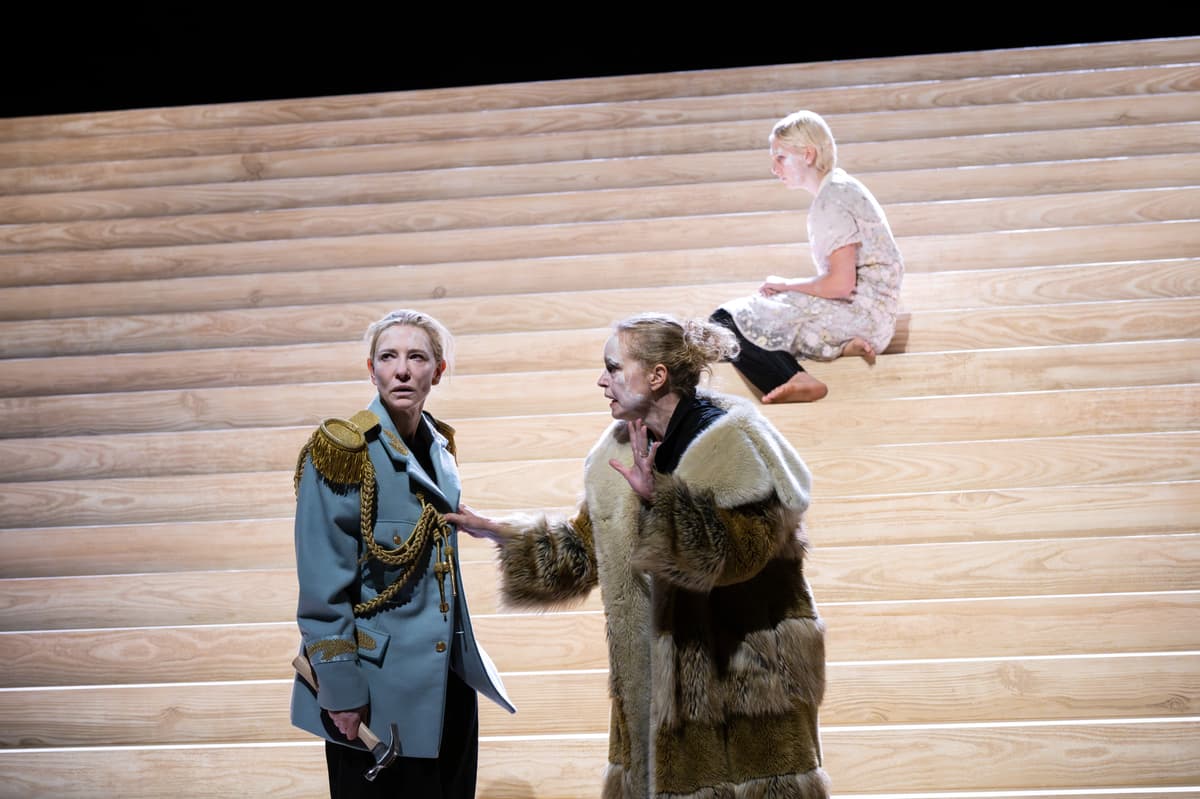
Oscar-winner Cate Blanchett and her Tár co-star Nina Hoss give raw and fine-grained performances in a mashup that refuses to mesh here. The first half of Benedict Andrews’ show is a modern-argot interpretation of the rage and grief Agamemnon’s daughter feels toward Clytemnestra, the mother who murdered him. The second adapts Ingmar Bergman’s determinedly enigmatic 1966 film where the personalities of a famous, dumbstruck actress and her chatterbox nurse begin to merge.At each performance Blanchett and Hoss choose which of the paired roles they will play with the toss of a coin. Beyond this tension-ratcheting gimmick, it’s hard to see what connects the two stories. Both are loosely about a woman compelled and repelled by her mirror image. By this logic, you could pair either with a stage version of Ab Fab, but that wouldn’t have quite the same aura of intellectual clout.It’s staged on a flight of steps by designer Magda Willi, echoing the tiers of the theatre stalls. Both leads are mostly barefoot, bare-faced and in black rehearsal gear throughout. For the version of Sophocles an ominous claw-hammer sits centre stage, and the two smear their faces and arms with chalk, a reference to the masking of Greek drama. Vestiges of this remain after they’ve cleaned themselves in front of us for the second act, where an invasive video camera and a screen supplant the hammer. They are supported by an eloquent Ella Lily Hyland, and Patrick Robinson in two vestigial male roles. Clouds billow. Blood is spilled and spat.Cate Blanchett (Alma) and Nina Hoss (Elisabeth) in Electra/Persona at the National TheatreMonika RittershausI’d happily have spent the entire 125-minute running time watching an extended version of Andrews’ take on Electra, not least because the miring moral compromises of the Trojan War clearly chime with our world today. (See also: Nolan’s Odyssey, Simon Stone’s updated Oresteia, and Ava Pickett’s forthcoming Bloodsport, about Helen of Troy). Indeed, I’d watch Electra twice, to see Blanchett and Hoss in each role.On opening night, the former played the imperious mother, the latter her raging, distressed daughter. We all know how good Blanchett can be, particularly in roles that require her to be bad. Her Clytemnestra here has a vulpine, glittering grin and a sinewy sensuality – undulating down a carpet of discarded family clothes to welcome her husband to his doom.Hoss is a mainstay of the German stage and screen, known to English-speaking audiences for Tár, Nia DaCosta’s film Hedda and Homeland, and to London theatregoers for an astonishing Cherry Orchard, mounted at Donmar by Andrews. She’s a gutsy, compelling presence, powerfully communicating the maelstrom of emotion that leaves Electra rank-smelling and unable to eat. One thing the disparate halves of this evening do share is a visceral, skin-crawling disgust – of bodies and death, sex and motherhood, the viscous fluids of being human. The beating of blood is the signature of Hildur Guðnadóttir’s score.Nina Hoss (Clytemnestra) and Cate Blanchett (Electra) in Electra Persona at the National TheatreMonika RittershausBut where Electra is primal, Persona is wilfully elusive. Hoss, on opening night, was the inexplicably mute star Elisabeth, convalescing on a Scandinavian island, and Blanchett her blathering carer Alma. Elisabeth spends much of her time staring at the camera, sometimes under a coat, and the fractional emotions flickering across Hoss’s face were spellbinding to watch. Blanchett’s Alma, meanwhile, shared with the audience a past sexual encounter with a friend and two boys that felt almost indecently intimate.But Persona resists interpretation and the one-sided nature of the narrative becomes hypnotically lulling, then wearing. The use of a probing, chasing lens onstage and backstage has become an overused technique (it’s impossible to move in theatreland without tripping over “some c*** with a camera” as the stage version of Inside No 9 put it). The allocation of role by coin-toss has been done before, too, in Robert Icke’s staging of Mary Stuart.None of which takes away from the quality of the acting from Blanchett and Hoss. Or their bold, shared willingness to give themselves over to radical directors. Hoss has worked many times with Thomas Ostermeier, who directed Blanchett in a stupendous Seagull at the Barbican in 2025. Both have worked before with Andrews, who is one of three auteurs from Blanchett’s native Australia shaking up international theatre. His previous shows in London have been revelatory. This one is a misstep.
Electra/Persona at the National Theatre review: Strong performances can't save this misstep
Full Article
Original Source
Read the full article at Standard →KhanList aggregates and links to publicly available news content. We do not host full articles from third-party sources. Always verify important information with original sources.