
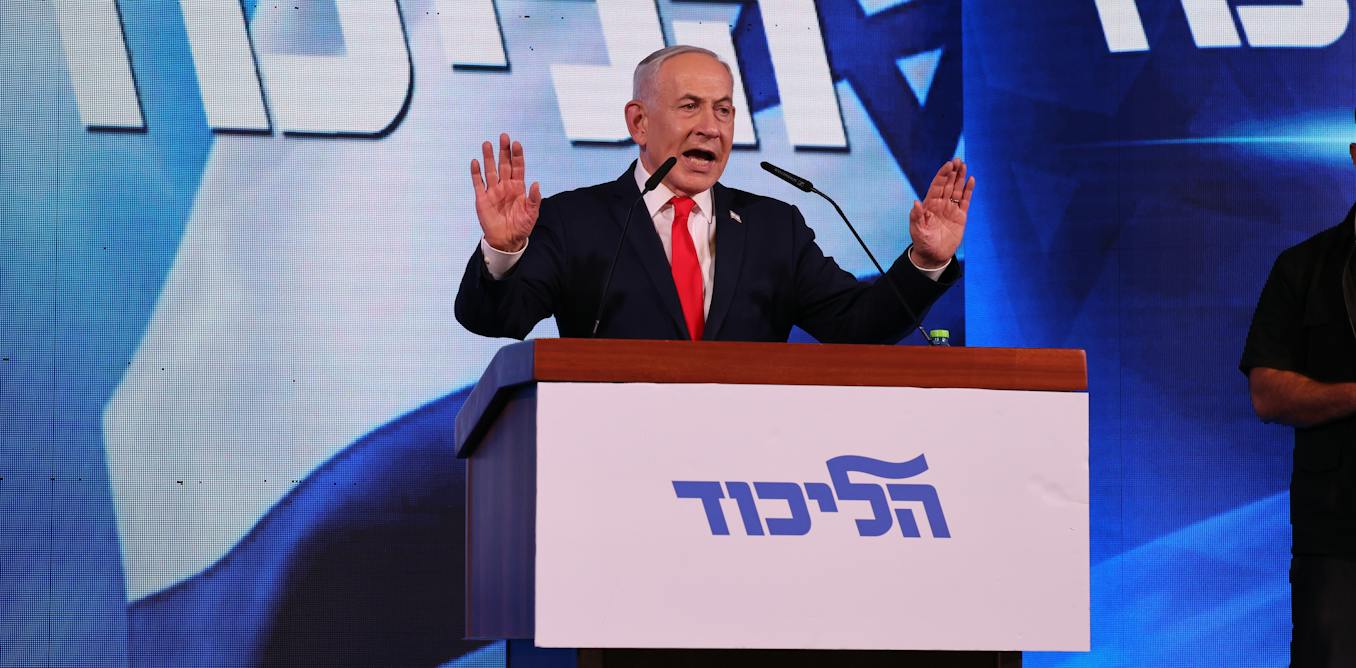
Tens of thousands of Israeli expats flew home to vote in Tuesday’s election – most of them, according to media reports, hoping for a result which would end Benjamin Netanyahu’s prime ministership. It looks as if they will be disappointed. We’ll know more when all votes are counted and seats allocated. But an apparent deadlock in the new Israeli Knesset is likely to mean that Netanyahu stays on as caretaker prime minister – for the time being at least. At 77.7%, according to Israel’s Central Elections Committee, it was the highest turnout in the country’s history and the results have reflected a considerable loss of support for Netanyahu and his coalition partners, who lost between ten and 13 seats at last count. But Netnyahu’s party, Likud, will still have the highest number of seats in the Knesset and the “change” bloc centred around challenger Gadi Eisenkot has no clear way to unseat him, as things stand. The main reason for the deadlock, according to Roi Zur of the University of Essex and Eitan Tzelgov from the University of East Anglia, is that both of the dominant blocs have currently ruled out involving either of the two Arab parties in a coalition. The Arab parties achieved their best-ever election result, based on a turnout estimated at nearly 80%. The two parties, which represent Arab voters who make up 20% of Israel’s electorate, are on course to win 19 seats in the Knesset. But there is what Zur and Tzelgot call a “firewall” in operation in Israel where the mainstream Jewish parties will not work with the representatives that their Arab compatriots have elected. You can make up your own mind how this reflects the quality of democracy in Israel. There will now be weeks of talks while the two main blocs try to break the deadlock, during which Netanyahu will probably stay on as caretaker PM. If Netanyahu restarts strikes against Iran, as is widely anticipated, it may inspire a rally-round-the-flag reaction in Israel which will further strengthen the prime minister’s position, our experts conclude. Read more: Deadlock ahead for Israel as election fails to deliver an alternative to Netanyahu coalition So who are Israeli’s Arab parties and what do they want? As James Sunderland of the University of Cambridge notes, the smaller of the two, Ra'am, was briefly part of a coalition led by Naftali Bennett. But his government collapsed in 2022 after 18 months. Since then, the Hamas attack of October 2023 has hardened the position of mainstream Israeli parties against Ra'am and its Joint List counterpart. Both parties have made strenuous efforts to demonstrate that they would seek to govern for all Israelis – Ra'am leader Mansour Abbas has even appointed Jewish-Israeli Yoav Segalovitz to the number two spot in his party and its nominee for national security minister. Read more: Two small Arab parties may decide Israel’s election Conspicuous by its absence from the election campaign was any mention of Palestinian statehood, writes Amnon Aran of City St George’s, University of London. Both of the major blocs are adamantly opposed to a two-state solution. Netanyahu has always been clear on this and Eisenkot, who lost his son and two nephews during fighting in Gaza, is of the same mind. So whoever eventually forms a governing coalition, there’s very little cause of optimism for the Palestinian people. Read more: Israeli election: why nobody has been talking about Palestinian statehood Student List triumphs in Serbia In startling contrast to Israel, the election in Serbia at the weekend resulted in a resounding win for the Student List, which ousted the 12-year government of Aleksandar Vučić’s pro-Russian Serbian Progressive Party. It’s a remarkable story, writes Gavin Brent Sullivan and Tereza Capelos, whose research included conducting focus groups with members of the student protest movement as it pressed for reform. Supporters of the ‘Student List’ celebrate in Belgrade, Serbia, after parliamentary elections on October 25. Andrej Cukic / EPA They conclude that the Student List victory “should give hope to any group opposing a corrupt, authoritarian regime”. Now comes the hard part: unifying a disparate group of opposition politicians and activists with no experience of governing. Read more: ‘We changed the system’: how Serbian students ended Alexander Vučić’s 12 years in power This will present a serious challenge, writes Eric Gordy of University College London. Beyond tackling corruption and taking steps to improve the quality of Serbian democracy, the Student List has little in the way of an agreed policy platform. Moreover, the movement is only really unified in its opposition to the Vučić regime and will need to overcome deep ideological divisions in order to govern successfully, Gordy writes. Read more: Serbia’s leaderless student movement has won a historic election – but what happens next? Americans prepare a report card for Trump Next Tuesday, Americans go to the polls for the midterm elections, which this year are being billed as a report card on the first two years of Donald Trump’s second term. As you’d expect, once the votes are in we’ll be bringing you fresh perspectives and expert analysis as to what they mean for the rest of Trump’s presidency. The midterm elections looks set to be a report card for the Trump administration. SOPA Images Limited/Alamy Live News We’ve already heard that the Democrats are outdoing the Republicans both in the opinion polls and in terms of fundraising. And the past few weeks have not improved their chances as the inflation rate continued its upward trend, driven by increasing fuel prices. This matters in the US. While conventional wisdom says that US voters are traditionally less interested in what the US does on the world stage than the cost of living, Andrew Payne believes for this election, foreign policy and the cost of living are intimately entwined. Polls suggest that the majority of voters are well aware that rising prices have been mainly due to Trump’s tariffs policy and the war in Iran. It could cost the Republicans dearly, writes Payne. Read more: Why Donald Trump’s foreign policy could cost Republicans in the midterm elections
Election special: deadlock in Israel, regime change in Serbia, US midterms
Full Article
Original Source
Read the full article at Theconversation →KhanList aggregates and links to publicly available news content. We do not host full articles from third-party sources. Always verify important information with original sources.