
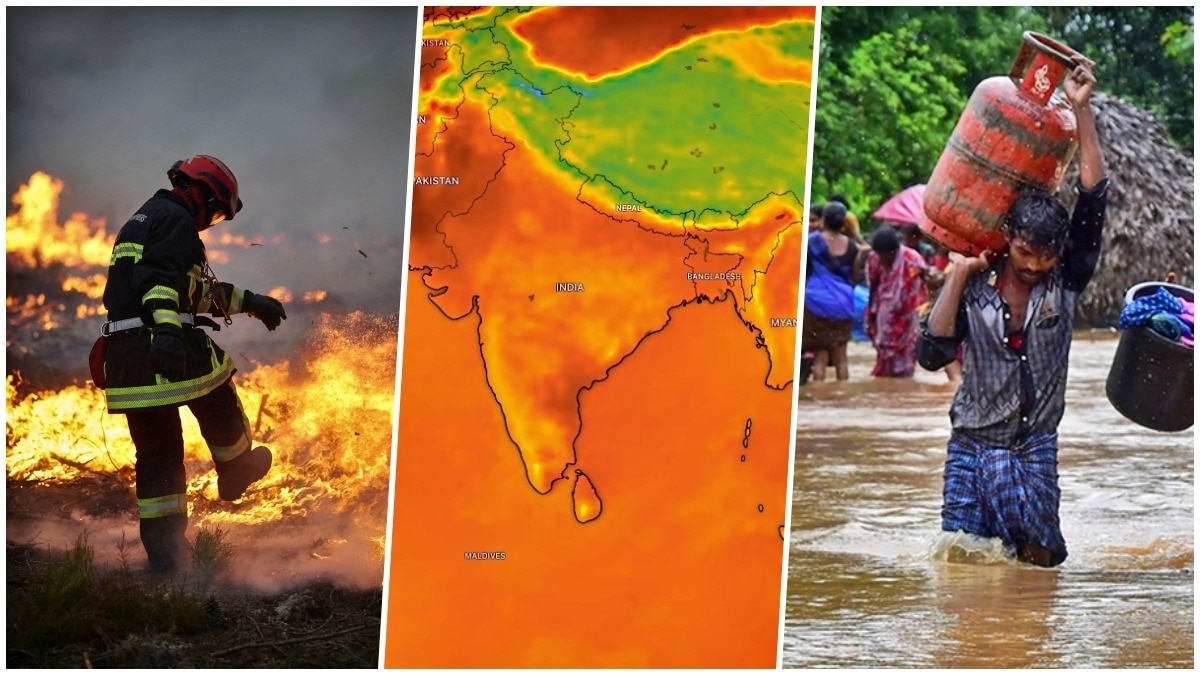
El Nino has arrived in the tropical Pacific, and it's strengthening much faster than many early forecasts suggested.The climate phenomenon, caused by unusually warm waters in the central and eastern Pacific and changes in the winds above them, is already altering rainfall and temperature patterns.The World Meteorological Organisation (WMO) expects it to become a strong event in August-October, while US forecasters say there is a more than 90% chance of a very strong El Nino in the Northern Hemisphere autumn and winter.There is a high chance that November-December will produce an event stronger than any recorded since 1950. The effects of the event, as history has shown, can be far from uniform. A man near a damaged house in an area hit by flash floods in Indonesia. (Photo: Reuters) El Nino can bring drought to one region and flooding to another, and at the same time, not every extreme event occurring during an El Nino can be attributed to it. So what has been going on since El Nino arrived, and how much can be blamed on a warming Pacific Ocean?ASIA BATTLES HEATIndonesia is among the clearest examples of what regions are facing.El Nino has suppressed rainfall over the country's region, drying vegetation and increasing fire risk.Nearly 95,000 hectares were damaged by wildfires in July, according to Indonesian authorities cited by news agency Reuters. Workers spray water to extinguish a fire in an area affected by wildfire in Indonesia. (Photo: Reuters) The consequences extend across Southeast Asia and Australia, where El Nino typically brings hotter and drier conditions.That threatens crops, water supplies and electricity generation, while raising wildfire risks.Australia's last El Nino, in 2023-24, produced its driest three-month period on record.India faces a particularly significant consequence too; a weaker southwest monsoon.In the world's most populous country, June ended with a nearly 40% rainfall deficit. July saw repeated low-pressure systems that helped India's rainfall recover, but the overall rain deficits remain; as of August 19, the rainfall deficit since the monsoon arrival on June 4 remains at 12%. A commuter helps another woman after she falls due to the force of floodwaters in Ahmedabad, Gujarat. (Photo: Reuters) But at the same time, the rain, when it does arrive, is experienced in short, intense bursts instead of a steady spell. This has caused floods in numerous regions, making the season far more chaotic.The Indian Meteorological Department (IMD) has further warned that the strengthening El Nino raises the risk of a weaker finish to the monsoon.The threat is also reaching food markets. Vietnam and Indonesia together produce about half of the world's robusta coffee, and heat and dryness could cut yields.India and Thailand face reduced rainfall and lower sugar output, while Brazil can see excessive rain affecting sugar harvesting.AFRICA AND AMERICAS FACE CONSEQUENCESEl Nino can produce severe drought across southern Africa, while parts of the Greater Horn of Africa can become wetter.WMO's August-October outlook forecasts above-normal rainfall in the Greater Horn, raising the risk of flooding even as other African regions face dryness. A woman collects water from a truck as dry taps have become an issue in Johannesburg, South Africa. (Photo: Reuters) The food-security consequences could naturally be enormous.Estimates show that at least 49 million additional people could be pushed into acute food insecurity across 45 vulnerable countries by the end of 2027.Its largest projected increases are in Central America, southern and eastern Africa, Asia and the Pacific.In Peru and Ecuador, El Nino typically brings heavier rain.Aligning with the trend, Peru has already experienced El Nino-linked flooding and landslides, while the warming Pacific is also weakening the cold, nutrient-rich upwelling that supports South America's fisheries. A bus stands in the flooded street in an area affected by heavy rains, in Lima, Peru. (Photo: Reuters) Across Central America and the Caribbean, drought risk is rising.In contrast, wetter conditions are more likely in the southern United States and southeastern South America.IS EUROPE FACING EL NINO CONSEQUENCES?Europe's extreme summer heatwaves were widely reported across the globe, but should not simply be blamed on El Nino.WMO expects above-normal temperatures across much of Europe, but its rainfall outlook has lower confidence there, and El Nino's European influence is indirect. People take cover and use hand fans to cool down amid the heatwave in Britain. (Photo: Reuters) Human-caused global warming and regional weather patterns are the major factors that have been blamed for the extreme heat Europe has faced this year.What makes the current event especially concerning is that its strongest phase is still ahead.WMO expects Pacific sea-surface temperature anomalies to exceed 2.9°C in key monitoring regions, while El Nino is expected to peak between September and December. A map showing the warming Pacific Ocean during El Nino. (Photo: Tidbits) Its effects could continue into 2027 as disrupted growing seasons translate into smaller harvests, higher food prices and greater pressure on vulnerable populations.And with unusually warm oceans already surrounding the planet, this El Nino is arriving on top of a warming climate, potentially making its heat, drought, wildfire and rainfall impacts harder to handle.- EndsPublished On: Aug 20, 2026 15:00 IST
El Nino yet to fully arrive. It has already done enough damage
Full Article
Original Source
Read the full article at Indiatoday →KhanList aggregates and links to publicly available news content. We do not host full articles from third-party sources. Always verify important information with original sources.