
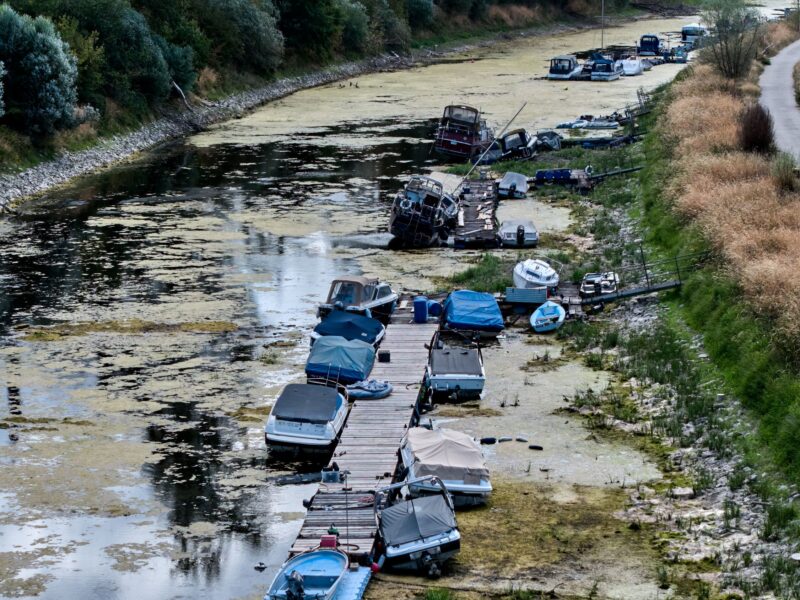
Falling water levels due to hot, dry conditions are stranding boats, stifling commerce and exposing wonders including wooly mammoth bones and a Roman bridge.(CN) — Europe was buckling up for more extreme weather Monday as fires continue to burn swaths of the continent, drought threatens major rivers and another heat wave arrives in France and the U.K.The EU’s climate monitor, the Copernicus Climate Change Service, reported Monday that global ocean temperatures last month were the warmest ever measured in July, further proof a strong El Niño has formed in the equatorial Pacific Ocean.The National Oceanic and Atmospheric Administration also confirmed Monday that “atmospheric circulation anomalies” over the eastern and central Pacific Ocean were consistent with El Niño conditions.“El Niño is present,” NOAA said in its bulletin. “El Niño will strengthen through the end of the year, with a 97% chance it will persist through early spring 2027.”El Niño weather patterns are associated with warmer temperatures and extreme weather events, increasing the likelihood of catastrophic hurricanes, droughts, storms and flash floods. This year’s record ocean temperature for July signals a strong or even super-strong El Niño is arriving.Experts are urging people and governments to take heed of this one.The name El Niño has been traced back to Peruvian fishermen and sailors who noticed a warm current, associated with reduced fish catches, and named it El Niño (“the Christ Child”). The warm current became noticeable around Christmas. In contrast, a La Niña event is characterized by unusually cool ocean surface temperatures in the same region and an intensification of the prevailing east to west surface winds.The two cycles seesaw back and forth, varying in strength and duration. Scientists are concerned climate change is intensifying this naturally-occurring phenomenon too.Along with the seas, last month saw near-record air temperatures, Copernicus said. July was the joint second-warmest July on record, tied with 2024 and behind only 2023, with an average surface air temperature 1.47 degrees Celsius (2.64 degrees Fahrenheit) hotter than the baseline pre-industrial era, Copernicus said.With the onset of this El Niño, Europe has already gotten clobbered with devastating drought, heat waves and wildfires this summer. The current drought comes on top of a string of hot and dry years across much of Europe.The Zollburg Pfalzgrafenstein toll castle is seen in the middle of the Rhine river with low water levels, in Kaub, Germany, Monday, Aug. 10, 2026. (AP Photo/Michael Probst)“July 2026 was the third consecutive month of exceptional heat in western Europe, bringing the combined temperature for June and July to a new record for the region,” said Samantha Burgess, a top Copernicus climate scientist.France’s national weather agency Météo-France is warning about temperatures approaching 104 F from Tuesday onward in southeastern France. And in the U.K., an amber heat health alert for most of England will be in place beginning Tuesday as temperatures are forecast to climb to 96.8 F later this week.Most major rivers on the continent, including the Loire, the Rhine, the Danube, the Po and Vistula, are at low or extremely low levels.Barge and ship traffic has ground to a slow pace in many rivers, jeopardizing Hungary’s Paks nuclear power plant last week. Factories reliant on barged heavy goods, such as chemical giant BASF and iron mills, have been forced to cut production.Low river levels have left boats stranded and revealed archaeological gems, including a Roman-era bridge and wooly mammoth bones in Bulgaria, sunken Nazi warships in Serbia and unexploded World War II artillery in Budapest.Spain and Greece were battling wildfires Monday. Copernicus’ European Forest Fires Information System data shows 1.3 million acres have burned in this year, above 2025’s then-record of 1.14 million acres. The long-term average, calculated through Aug. 5, is 487,600 acres.The system shows 1,586 fires have been detected this year, slightly fewer than last year’s 1,606 but more than double the long-term average of 686 fires, through Aug. 5.Western Europe has been hit with a string of heat waves since May and extreme temperature alerts remain in effect in many countries.The average temperature for June–July for western Europe was the highest on record at 21.62 C (70-91 F) or 2.79 C (5.02 F) above average, surpassing the previous record from 2022 and reflecting the exceptional persistence of heat since the beginning of summer, Copernicus said.Courthouse News reporter Cain Burdeau is based in the European Union.Subscribe to our free newslettersOur weekly newsletter Closing Arguments offers the latest about ongoing trials, major litigation and rulings in courthouses around the U.S. and the world, while the monthly Under the Lights dishes the legal dirt from Hollywood, sports, Big Tech and the arts.Additional Reads
El Niño roars to life as Europe’s lifeline rivers sink to record lows
Full Article
Original Source
Read the full article at Courthousenews →KhanList aggregates and links to publicly available news content. We do not host full articles from third-party sources. Always verify important information with original sources.