
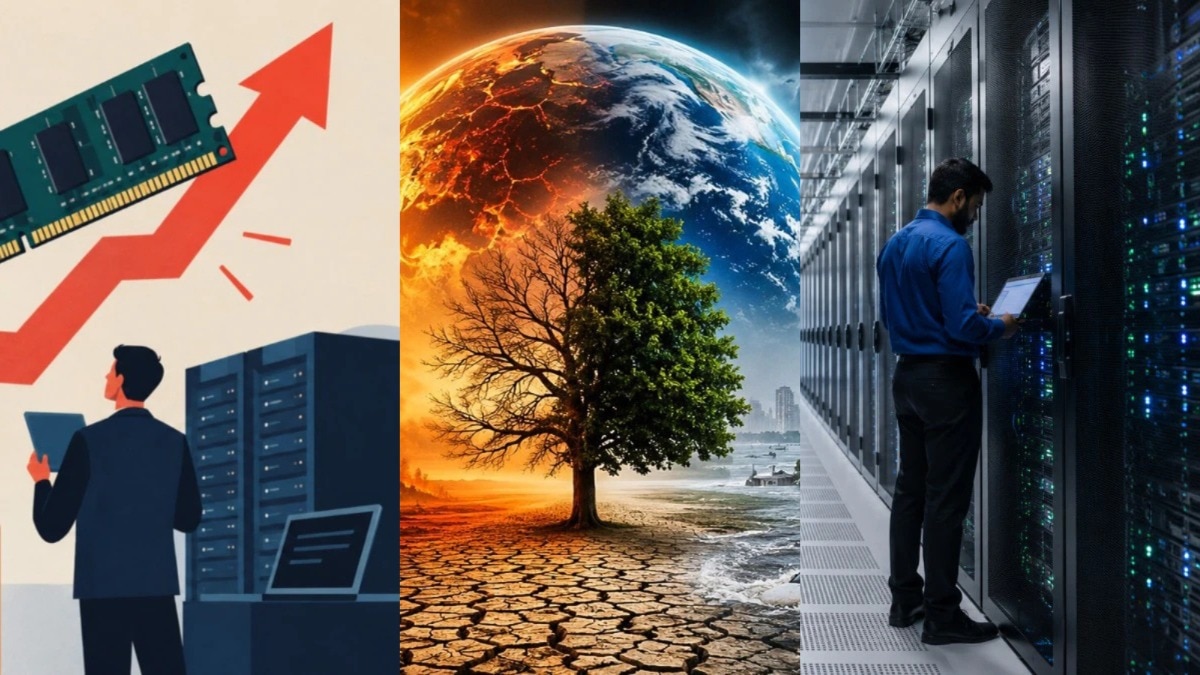
If you feel that the world is increasingly getting more expensive, and chaotic, you are not hallucinating. It is getting more expensive, and is set to get more expensive once effects of El Nino and other inflationary forces, including RAM prices, kick in.Of late, we all are waking up to headlines that announce a price increase in one thing or other. Or sometimes the prices are up and there are no headlines. We only realise we are paying more when we calculate our monthly budget. It is as if prices are rising on a daily basis, but still in the manner that would seem as if we are the frogs in a water that is gently heating up. We feel something but not yet enough to jump. Just to give you a few examples, here are a few headlines from the last few weeks:— Official milk prices rise by Rs 9 (around 10 per cent) in Mumbai— Egg prices have increased by around 10-50 per cent in the last six months. This tracks well with my own experience. I would earlier pay around Rs 120-130 for 10 eggs from this specific brand on Blinkit until June end. Now, I am paying around Rs 160 on the average for the same.— Sugar prices in India have increased by around 15-20 per cent in just few months These are fundamental food items, because increase in their cost also raises the prices of other food items that depend on them, such as sweets, dairy products, bakery goods and so on and so forth.But these are also just three food items. So, you might wonder, what is the big hullabaloo about it all? In fact, this piece is not about the prices of milk, eggs and sugar. It is about a world that is getting more expensive, in ways where we have started to feel it in our daily life. The bad news is, it might just be the beginning of a very very stormy phase. The idea that something is wrong was even hinted at by PM Narendra Modi on Thursday, although he couched the fears in words that ought to comfort citizens. In a post on X, he wrote: “Today, the world is passing through a phase of great upheaval. In many parts of the world, situations of conflict persist. Food, fuel or supply chains — uncertainty is affecting every sector.”The PM is probably reading the tea leaves and preparing the nation so we can survive the storm better. Prices of food items and many other essential goods are increasing across the world. According to Trading Economics, a website that tracks commodity prices, wheat prices on a global scale have seen an increase of around 45 per cent in the last one year. Rice has risen by over 31 per cent. Soybean has seen a price hike of over 27 per cent. Corn, similarly, by over 27 per cent. And so on and so forth.If one takes a couple of steps back and tries to survey the bigger picture, the sight doesn’t look very reassuring. Of late — although this could also be partly because of my glass-half-empty inclinations — I wake up with a dread that today could be the trigger that kicks off the doom and gloom. The world is in the middle of several significant changes. Of them all, the three I feel are the ones that may start a period where our daily life will be increasingly expensive.Supersized El Nino threatens food supplyThe first one is El Nino. The world is already in the middle of a supersized El Nino, a weather phenomenon that impacts climate and rain on a global scale. Such a strong El Nino that is now forming in 2026 has not been seen for over 1000 years. The strongest yet in recorded history was El Nino of 1877-88, which sparked widespread food shortage, crop failures and famines, including the Great Famine of India that likely killed almost 10 million Indians. Big Tech companies are spending so much on AI data centers that it may overheat money markets. The effects of the current El Nino are evident on the rain pattern. For example, this monsoon India has so far seen a deficit of 13 per cent, although the micro picture is more alarming. What is the story in India is also the story in the other parts of the world, and the El Nino is still showing no sign of weakening. Its full effect on food supply and prices across the world will only get clear in another four to five months when it would be the time to reap whatever farmers could sow. But chances are, as the UN warns, it may push over 50 million people across the world into famine-like conditions by the end of 2027.Irrespective of how well the governments manage the food security and prices, the coming months are likely to see a price rise in everything edible, whether it is your daily white bread and jam or your 12-course tasting menu in a five-star hotel.Shall we blame Sam Altman and Dario Amodei?Surprisingly, food prices are not the only worry that is facing the world. I believe an equally potent inflationary force is at work through the prices of IT components. With companies like OpenAI, Nvidia, Amazon, Anthropic and others scooping up almost all supply of RAM, storage, and chip-manufacturing capacity, prices of everything tech are going up. At a consumer level we see this in the prices we are now paying for our laptops and phones, which are on average easily up to 20 to 30 per cent higher compared to last year. At an enterprise level, all companies whether they are IT companies or just a local grocery store using 2 computers, are seeing a rise in operating cost.With operating costs higher, most companies — whether IT or otherwise — will either have to absorb the impact through thinner margins or will have to increase prices of their services and goods. Sridhar Vembu, the co-founder and chief scientist of Zoho, captured the sentiment well recently when he wrote on X, “Memory prices, along with AI token prices have made business very difficult. We have held back from raising prices but it is becoming hard.”Hyperscalers throw caution to the windAnd the final nail in the coffin, the one that shuts the dream of an affordable daily life shut, may come from the unprecedented AI spending itself. It is a fair estimate, based on what Big Tech like Google, Amazon, and Meta have announced that AI companies are going to spend upwards of over $1 trillion in just 2026 to build AI infrastructure. So unprecedented and heavy is this spending that just a couple of days ago Bank of England governor Andrew Bailey issued a warning that comes close to sounding something like a global money market meltdown.“The issue is not simply that investors are borrowing more, but that leverage is interacting with high valuations and market concentration, in particular the increasing cross-investmentbetween AI companies and hyperscalers (Amazon, Meta, Microsoft and others), in a way that could amplify a future market correction,” he wrote in a letter to the G20 finance ministers. “I remain concerned therefore that a large shock or combination of shocks could concurrently trigger multiple vulnerabilities.”While economists and money market experts would be better equipped to parse the letter Bailey wrote, increasingly there is a chatter that AI spending could lead to more inflation and then consequently higher interest rates at global level. We are seeing some of it already in South Korea, the country where RAM and storage makers like Samsung and Sk Hynix are heating up the economy. In the last two months, the regulators in Korea have increased interest rates by 0.50 per cent to “tackle a problem with a small hoe before a big shovel is needed.”It is entirely possible that in the coming months the governments across the world, including in India, will “manage” the situation and soften the blows if a crisis comes. After all, governments across the world have become increasingly good at “managing” big problems in the last two decades, especially after the 2008 meltdown. That is how the world, and India, has so far managed the oil shock from the US-Iran war. Or the job trouble and unemployment that AI seems to have brought. So, probably the perfect storm, which is still forming, of El Nino, RAM crisis, and overheated money markets too shall pass.But it is undeniable that even if things don’t fall apart and the centre does hold, we are in for a turbulent ride. And I believe the feeling is shared by many, including geopolitics analyst Velina Tchakarova, who wrote on X on Wednesday: “For all newcomers: This is a global multi-system rupture, not merely a financial crisis like 2008. Monetary, fiscal, industrial, security, energy, food, logistics, electoral, and social systems all begin to transmit stress into one another faster than all actors can absorb it.”- EndsPublished On: Sep 3, 2026 18:24 IST
El Nino, RAM, and AI are creating a perfect storm, 2026 may get more expensive
Full Article
Original Source
Read the full article at Indiatoday →KhanList aggregates and links to publicly available news content. We do not host full articles from third-party sources. Always verify important information with original sources.