
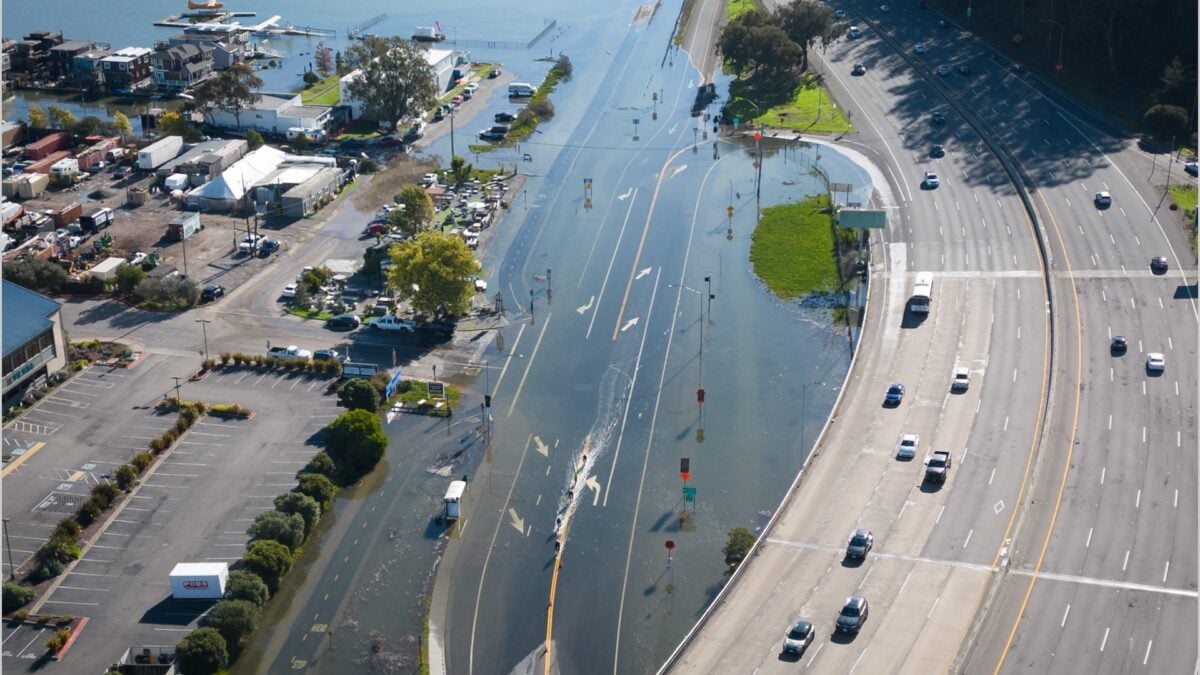
It only took half an hour. High tide floodwaters transformed stretches of dry asphalt along Marin County’s Shoreline Highway just north of San Francisco into two-foot-deep tide pools this Tuesday—coastal hazards that the National Weather Service warns will persist across the Bay Area this month into Halloween. In a genuinely haunting preview of the havoc that warm expanding water from El Niño’s Kelvin waves is predicted to wreak during the weeks of America’s Thanksgiving and Christmas holidays, Northern California is now coping with tidal flooding from San Pablo Bay down to Monterey. San Francisco’s NPR station KQED and other local news affiliates have published drone footage of paddleboarders and kayakers navigating commuter roads beneath Highway 101 in Sausalito, but the scope of the problem has been less cute elsewhere. High tide in the Bay Area this Monday cleared its record for the highest ever recorded in the month of October. Motorists have found themselves trapped in low-lying coastal neighborhoods. Coastal fire departments are warning that California’s quintessential electric vehicles are at risk of runaway battery fires if saltwater short-circuits their battery packs. And farther down the California coast in Newport Beach, just south of Los Angeles, city officials are now doling out free sandbags in advance of the coming fall and winter surges. The flooding or (worse) levee breaches anticipated along stretches of California State Route 37 near San Pablo Bay alone could cascade into recurring $1.5 million-per-day economic damages, according to a new report by UC Davis landscape ecologist Fraser Shilling. “We face the risk—though not the certainty—of catastrophic flooding in a variety of coastal towns this winter,” Shilling, the director of the UC Davis Road Ecology Center, said in a press statement Monday. “My center and others have been sounding the alarm on this issue for over a decade.” King tides in waiting To put the foreboding heights of this week’s floods into context, the Bay Area’s current flooding was only caused by so-called spring tides, roughly twice-monthly high tides produced predictably by the lunar cycle. According to research oceanographer Sean Vitousek with the U.S. Geological Survey’s marine science center in Santa Cruz, tide gauges from this routine tide alone reached roughly one foot above normal during this week’s flooding. As Vitousek told The San Francisco Standard, powerful storms this season, alongside the year’s highest, or “king,” tides along these coasts, will “definitely” produce “even worse impacts.” “If you get large wave events coincident with the high tides, you’re in for a lot of damage,” Vitousek said. Based on Shilling’s analysis at UC Davis, those events could be once-in-a-century storms, “roughly 2 to 3 feet above current levels” during this year’s historic El Niño winter. Shilling has mapped six regions of the state he fears will soon be at risk from catastrophic flooding, including San Francisco International Airport, the low-lying beaches and roads of San Luis Obispo County, and stretches of U.S. Route 101 through Corte Madera and Humboldt Bay. The problem, he said, has been made worse by government inaction. “Catastrophes will start unrolling without significant state and federal government response,” Shilling predicted. Short circuit too The lithium-ion batteries powering all those Cybertrucks and other electric vehicles dotting the Palo Alto landscape don’t mix well with saltwater—it short-circuits their cells, which can set off a self-sustaining fire known as thermal runaway. And the consequences that this basic chemistry holds for California’s coastal communities during this El Niño season, with its promise of historic floods, could prove to be devastating, according to volunteer fire captain, mechanical engineer, and fire department consultant Patrick Durham. Durham noted that the problem proves similarly true for smaller devices powered by lithium-ion batteries, like cordless power drills, leaf blowers, and personal electronics. EVs, however, given the size of their battery, are particularly dangerous, even more so given that EV owners tend not to think about ocean water’s unique corrosive effects on the compartments that protect these batteries. “If it’s been submerged in water it’s bad,” as Durham told the Los Angeles Times. “If it’s been submerged in salt water, it’s really bad.”
El Niño Is Already Flooding California’s Coasts—and the Year’s Highest Tides Haven’t Arrived
Full Article
Original Source
Read the full article at Gizmodo →KhanList aggregates and links to publicly available news content. We do not host full articles from third-party sources. Always verify important information with original sources.