
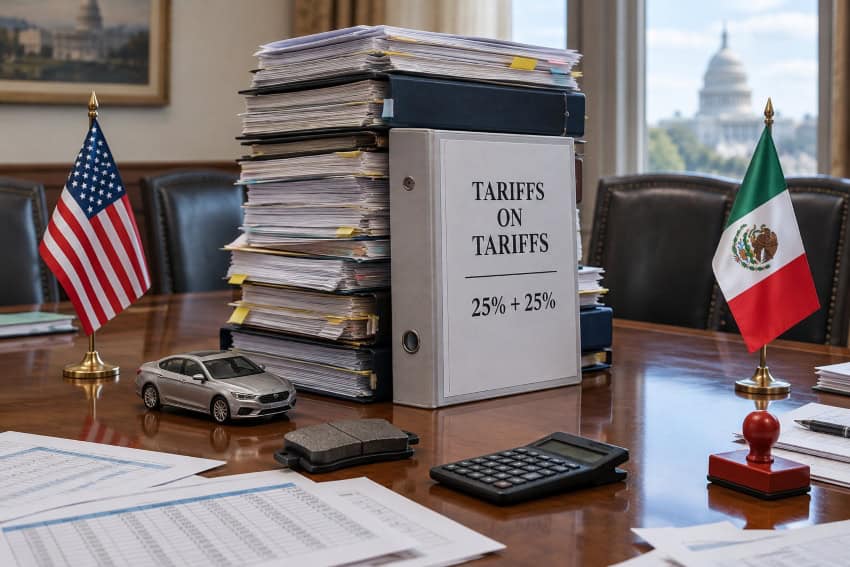
All stories in El Jalapeño are satire and not real news. Check out the original article here. WASHINGTON, District of Columbia — Bilateral trade talks between the United States and Mexico came to a sudden halt Thursday after U.S. Commerce Secretary Howard Lutnick submitted a revised 400-page framework requiring Mexico to pay a 25% duty on existing 25% tariffs, alongside a surcharge on the bilateral trade talks themselves. According to sources familiar with the negotiations, the impasse arose when U.S. officials clarified that “tariff relief” was a procedural misunderstanding, proposing instead a compound tariff architecture in which every imported vehicle, steel beam or aluminum bracket would incur levies not only on its material value, but on the accumulated administrative cost of discussing those levies. Trade talks to reduce U.S. tariffs on steel, aluminum, and autos have stalled. Could more tariffs be the solution? (Carlos Aranda/Unsplash) Under the proposed U.S. structure, if a Mexican-assembled automobile crosses the border into Texas, it will be subject to a baseline auto tariff, an additional fee for utilizing the border bridge, and a 12.5% “consultation duty” designed to cover the U.S. Department of Commerce’s operational expenses during the hours spent resisting tariff reductions. “Our stance has always been entirely reasonable,” said a senior U.S. official speaking on the condition of anonymity to discuss sensitive diplomatic friction. “Mexico asked for tariff cuts. We offered to cut the paper on which the tariffs are printed, but the ink used to print that paper remains subject to a 50% national security surcharge. If we do not tax the negotiations, we risk incentivizing future diplomacy, which could destabilize key domestic industries that rely heavily on trade deadlock.” Mexican negotiators reportedly spent three hours attempting to calculate the effective compound tax rate on a single domestic brake pad before realizing the total duty exceeded the market value of the vehicle containing it. The Mexican delegation subsequently offered to suspend its own automotive parts tariffs for five years, only to be informed that concessions were subject to a 10% entry levy upon arrival at Washington Dulles International Airport. Despite the procedural logjam, both governments publicly denied that negotiations had broken down. In a Thursday afternoon address to federal deputies, Ebrard maintained an unflappable optimism, assuring lawmakers that Mexico remains uniquely positioned to enjoy the most sophisticated, multi-tiered tariff relationship in the Western Hemisphere. “We are making extraordinary, unprecedented progress toward defining the precise parameters of our disagreement,” noted a member of Mexico’s negotiating team. “Our position remains strong, our position remains favorable, and we fully expect that by Friday, we will have secured a formal agreement specifying the exact date on which we will resume failing to agree.” At press time, U.S. officials were reportedly reviewing a proposal to implement a 5% ad valorem tariff on all future press releases issued by the Mexican Ministry of Economy that contain the word “constructive.” Check out our Jalapeño archive here. Got an idea for a Jalapeño article? Email us with your suggestions!
El Jalapeño: US demands tariffs on top of tariffs in escalating Mexico trade negotiations
Full Article
Original Source
Read the full article at Mexiconewsdaily →KhanList aggregates and links to publicly available news content. We do not host full articles from third-party sources. Always verify important information with original sources.