
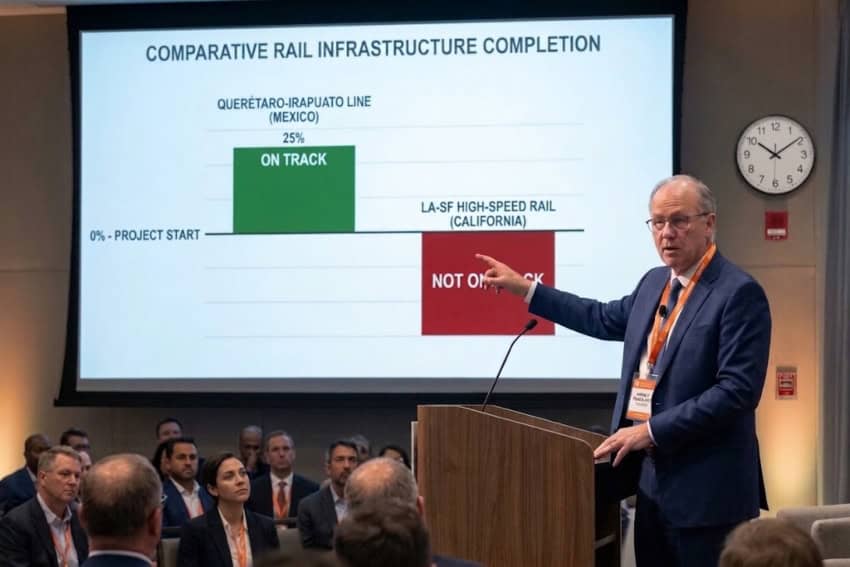
All stories in El Jalapeño are satire and not real news. Check out the original article here. MEXICO CITY — Construction on the 102-kilometer Querétaro-Irapuato passenger rail line reached 25% completion this week, just 12 months after breaking ground, creating a stark contrast with California’s Los Angeles-to-San Francisco high-speed rail network, which transit analysts confirmed is currently sitting at -25% complete. According to data released by Mexico’s Agency for Trains and Integrated Public Transportation (ATTRAPI), crews in the industrial Bajío region have laid physical track, initiated 10 viaducts and begun assembly on railcars in Hidalgo. Meanwhile, across the northern border, project metrics indicate California has managed to regress 25% below its starting line after spending 16 years, US $11 billion and thousands of billable hours untangling lawsuits over land rights that no longer exist. The Querétaro-Irapuato train line will eventually connect with the Mexico City-Querétaro train line, which is likewise progressing positively towards completion. (Presidencia) “When Mexican crews complete 25% of a project, it means a quarter of the actual track is ready for trains,” said Arthur Pendelton, a senior fellow at the Institute for Infrastructure Comparison in Sacramento. “When California logs -25%, it means we have spent enough time in environmental mediation to un-build the preliminary ideas we drafted during the George W. Bush administration.” The Mexican route forms part of a federal initiative to build 2,500 kilometers of operational track by 2030. Transportation planners in Washington have struggled to interpret the data, noting that under standard U.S. transit models, laying 25% of a line in one year without first commissioning a seven-year feasibility study on environmental noise disruption violates accepted notions of government practice. “In our system, progress is measured in metric tons of paperwork generated per mile,” Pendelton added, gesturing to a chart showing California’s progress line sloping downward into negative territory. “If you actually pour concrete and build a bridge, you lose the ability to commission a follow-up impact study on the visual aesthetics of the concrete. From a regulatory perspective, Mexico is moving backward by moving forward.” At press time, California high-speed rail officials announced plans to spend US $2.4 billion to hire an external consulting firm to investigate how Mexico achieved positive momentum on its construction timeline. Check out our Jalapeño archive here. Got an idea for a Jalapeño article? Email us with your suggestions!
El Jalapeño: California high-speed rail project reaches -25% completion as Mexico line hits 25%
Full Article
Original Source
Read the full article at Mexiconewsdaily →KhanList aggregates and links to publicly available news content. We do not host full articles from third-party sources. Always verify important information with original sources.