
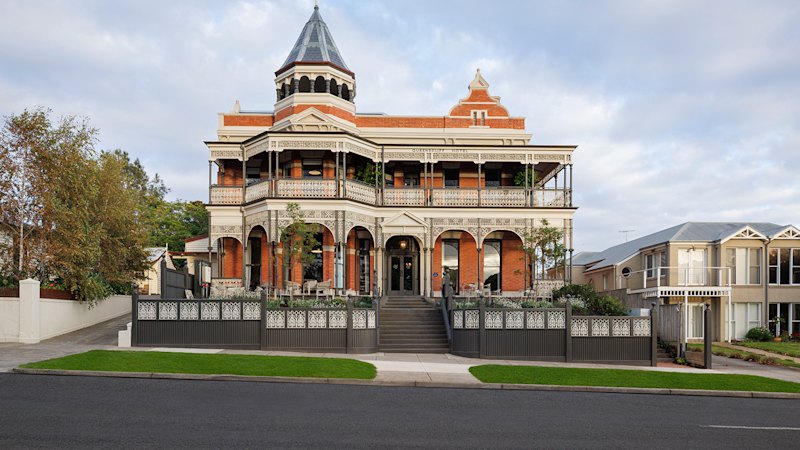
November 14, 2026 — 5:00amRetirement for some is about putting your feet up and slowing down, but not for Rob and Tammy Charter. They had other ideas about how they wanted to spend post-work life.The couple bought a grade A state-listed building – the Queenscliff Hotel – in sore need of a renovation and set about restoring the illustrious heritage-listed landmark at the head of Port Phillip Bay, about 105 kilometres drive from central Melbourne.The Queenscliff Hotel has been given a new lease on life. Dianna Snape“We’d renovated a few homes over the years, but this one came with significant challenges,” says Rob, recalling the fungus entrenched on the walls from the leaking roof whose roots were taking over the structure. “You could say we were either brave or mad.”Often known as Miettas, the hotel was a bastion of fine dining during the 1980s and ’90s run by hospitality pioneers and cultural patrons – sisters Mietta and Patricia O’Donnell. A century earlier, the Queen Anne-style building was a drawcard for Melburnians arriving in the seaside outpost either by ferry or train from the Big Smoke.Miettas, the formal dining area for 40 people, was also reimagined with one foot in the past and another in the present.Dianna SnapeBut after Mietta’s passing in 2001, the Queenscliff landmark gradually fell out of favour until the Charters took it over and employed Molecule Studio, in collaboration with heritage practice RBA Architects, to give it a makeover.The building was in a fairly sorry state, they said, but the couple saw the joy of bringing life back to the Victorian landmark.Architect Roger Beeston and his team restored the exterior of the hotel, with its polygonal tower, which has a viewing platform to see over Port Phillip Bay. Molecule worked on the interiors and redesigned the faux 1990s Victorian addition.“In the 1990s, there was a trend to emulate the past,” says Anja de Spa, director of Molecule, who worked closely with her life and business partner, architect Richard Fleming. The en suites in the guest bedrooms were problematic – like walking into a dark closet rather than a spacious light-filled bathroom that guests expect from today’s accommodation.Another strategic move by Molecule was to create an entirely new conservatory at the rear, replacing a two-storey timber structure with low doors to the rear courtyard.Instead, there’s now a light-filled space, known as The Conservatory, offering a more casual dining experience. “We took our design cues from the greenhouses that were starting to become popular in south-west London in the late 19th century, but obviously applied a contemporary spin,” says De Spa, pointing out the steel gable end that frames the new pavilion.Molecule was to create an entirely new conservatory at the rear.Dianna SnapeMiettas, the formal dining area for 40 people, was also reimagined with one foot in the past and another in the present. While the ferns and vines that had taken hold of the walls have long gone, there’s still the memory of the greenhouse. Rich foliage is captured in the new wallpaper by Milton & King. New pendant and wall lights by South Drawn complement the original chandelier, which remains as it was when the Victorians came down for dinner in formal attire.Other areas, such as the guest’s sitting room – once used as the parlour for taking tea – have also been restored and reworked with a fine sensibility. A wallpaper mural, a trompe l’oeil tapestry depicting a royal palace, adds an eclectic touch, and some of the original furniture has been combined with contemporary pieces, such as a floor lamp designed by Philippe Starck.The past has been strongly protected, even when the guest suites were enlarged, reducing their number from 16 to 12. “We retained all the original doors (permanently closed) and only signposted each suite with a brass plate and light,” says de Spa, who was conscious of every contemporary insertion that was made.Molecule Studio worked on the interiors and redesigned the faux 1990s Victorian addition.Dianna SnapeThe fairly basic wrought-iron Victorian bedheads that greeted guests in the 1990s have been replaced with sumptuous padded bedheads and built-in marble side tables.For guests, the transformation is encountered immediately on arrival at the brass and leather reception counter. Opening up the vista to the rear courtyard and increasing the interior light allows the beauty of the hotel’s original features, like the leadlight in the arched doors, to shine.Sadly, Mietta is not around to see the results, but, no doubt, she would be pleased to see the hotel regain its polish and finesse, and once again become a destination for the finer things in life.The Business Briefing newsletter delivers major stories, exclusive coverage and expert opinion. Sign up to get it every weekday morning.From our partners
‘Either brave or mad’: A bastion of fine dining gets a sorely needed facelift
Full Article
Original Source
Read the full article at Smh →KhanList aggregates and links to publicly available news content. We do not host full articles from third-party sources. Always verify important information with original sources.