
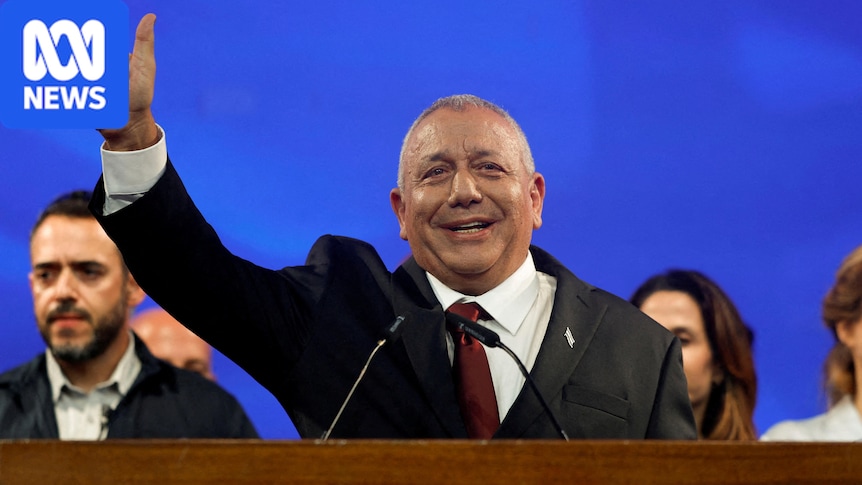
Former Israeli military chief Gadi Eisenkot has now been asked to try to form a new coalition government, meeting Israel's President Isaac Herzog in Jerusalem on Sunday to receive his invite to start negotiations. But his pathway to power is not entirely easy, and the next few weeks could involve some creative political arithmetic and manoeuvring to get over the line. So, what are the options from here? The starting pointThe reason Gadi Eisenkot has been tapped for the first shot at forming a coalition is because of what happened late last week.Gadi Eisenkot, leader of the Yashar party, has been Benjamin Netanyahu's main opponent in the election. (Reuters: Shir Torem)The president sat down with representatives of each of the political parties that won seats at the election, and asked them to endorse either Mr Eisenkot or the incumbent Benjamin Netanyahu — given the two men are the leaders of the two largest parties in the next Knesset.All of the anti-Netanyahu parties from across the political spectrum, including the two Arab-Israeli or Palestinian-Israeli parties, backed Mr Eisenkot:Yashar (Eisenkot's own party) — 21 seatsTogether — 12 seatsThe Democrats — 8 seatsYisrael Beiteinu — 7 seatsThe United Arab List — 8 seatsThe Joint List — 11 seatsThat's a total of 67 seats in the 120-seat Knesset backing the main rival to Benjamin Netanyahu.The prime minister only secured votes from most of his current coalition:Likud (Netanyahu's own party) — 27 seatsOtzma Yehudit — 7 seatsReligious Zionism — 6 seatsShas — 6 seatsThat's a total of 46 seats in the Knesset.The other ultra-Orthodox Jewish party, United Torah Judaism (UTJ), did not back either candidate with their seven seats — despite spending most of the last four years backing in Mr Netanyahu.Here's why that doesn't mean Eisenkot will be the next PMGetting the endorsements to start negotiations is important, as it puts Mr Eisenkot in the box seat to form a new government and end Mr Netanyahu's time at the top.At the moment, they are united by a common goal of giving the current prime minister the boot.But convincing them to put aside longstanding grievances and policy differences could be difficult, and loyalty to principle also isn't guaranteed.Mr Eisenkot is in a prime position to form a new government and end Mr Netanyahu's leadership. (Reuters: Clodagh Kilcoyne)Scenario one: Minority governmentIsraeli media is speculating Gadi Eisenkot could try to press ahead with forming a minority government, which would include all of the Jewish anti-Netanyahu parties:YasharTogetherThe DemocratsYisrael BeiteinuThat's a total of 48 seats out of the 120 on offer in the Knesset.The only way that could work is if the two Arab-Israeli parties, the United Arab List and the Joint List, agreed to effectively green-light the government's agenda on the floor of the Knesset — promising not to block things like budget legislation.There's an immediate problem with this approach — the leader of Yisrael Beiteinu, Avigdor Liberman wants a majority government.His opposition to working with the Arab-Israeli parties goes as far as relying on them working outside of a formal coalition.As a result, he is reportedly looking at trying to entice the ultra-orthodox parties of UTJ and Shas to join forces with the rest of the "change" camp.Mr Liberman could change his tune. But at this point, he seems to be digging his heels in.Scenario two: Majority Jewish governmentThis would be a coalition of all of the Jewish parties that are critics of Benjamin Netanyahu, and the two ultra-Orthodox parties who've helped to prop up his right-wing government over the past four years:YasharTogetherThe DemocratsYisrael BeiteinuUnited Torah JudaismShasThat's a total of 61 seats — the barest of majorities.While this would effectively kill off the fierce and at times racist arguments being put forward about the Arab-Israeli vote, it brings its own problems.Mr Eisenkot and other members of the so-called "change" camp have all campaigned on wanting to force men from the growing ultra-orthodox community, known as the Haredi, to complete compulsory military service.This has been one of the most controversial issues of the past three years, since Hamas's deadly attacks against Israel on October 7, 2023 — the pressure on the Israel Defense Forces as it fights on multiple fronts.In 2024, the Israeli Supreme Court tore up the sweeping exemptions from service afforded to Haredi men — effectively ending the principle that they should be given permission to avoid being drafted because they are students of the Jewish faith, and work to safeguard the future of the religion.UTJ and Shas had been demanding the Netanyahu government reimpose the exemptions.Even Avigdor Liberman, the man now reportedly talking to them, campaigned on ending "draft dodging".If this scenario were to become reality, it would demonstrate a commitment to the principle of ousting Mr Netanyahu over loyalty to pre-election policy platforms.It could also be a calculation that anti-Arab sentiment in the Israeli community is more toxic than anti-Haredi views.Scenario three: Majority Jewish-Arab governmentThis would be a coalition of the anti-Netanyahu Jewish parties, and the two Arab-Israeli parties:YasharTogetherThe DemocratsYisrael BeiteinuThe Joint ListThe United Arab ListThat would be a total of 67 seats — the strongest majority possible on the current numbers without Mr Netanyahu's Likud. More on that below.But the only way this would happen is if the strident opposition to the Arab-Israeli parties is parked in favour of toppling Mr Netanyahu.It is also a government that would come under attack from the prime minister and right-wing forces in Israel given the ongoing allegations of foreign interference in the election prompting a surge in support for those parties.Scenario four: 'Unity' governmentThis is something Benjamin Netanyahu has started pushing more and more in the last week or so — encouraging Gadi Eisenkot to work across the aisle with him to form a broad, Jewish-Israeli coalition.It would look something like this:LikudYasharTogetherThe DemocratsYisrael BeiteinuThat gets total of 75 seats in the Knesset — a considerable majority.The problem here is that Mr Eisenkot and the other "change" camp parties have spent the past few years insisting Mr Netanyahu is the embodiment of everything wrong with the government and needs to go.Mr Eisenkot has also ruled it out, even as Mr Netanyahu continues to insist it is the way forward.This scenario also does not include the far-right Otzma Yehudit, led by national security minister Itamar Ben-Gvir, and Religious Zionism, led by finance minister Bezalel Smotrich.They are seen as even more problematic than Mr Netanyahu by members of the "change" camp.Scenario five: No deal and new electionsGadi Eisenkot has at least 28 days to form a new coalition.Mr Herzog can give Mr Eisenkot more time to form a government. (Reuters: Bernadett Szabo)President Isaac Herzog can extend that by another 14 days of he thinks there's a chance at a deal, and it just needs a bit more time.At the end of that process, he can ask another candidate to have a go.But if that also fails, Israel would be on track for another election sometime early in the new year.Same too if one of the other scenarios play out, and the government collapses — a fresh vote could be ordered.
Eisenkot is trying to form government in Israel. Here are five ways it could go
Full Article
Original Source
Read the full article at Abc →KhanList aggregates and links to publicly available news content. We do not host full articles from third-party sources. Always verify important information with original sources.