
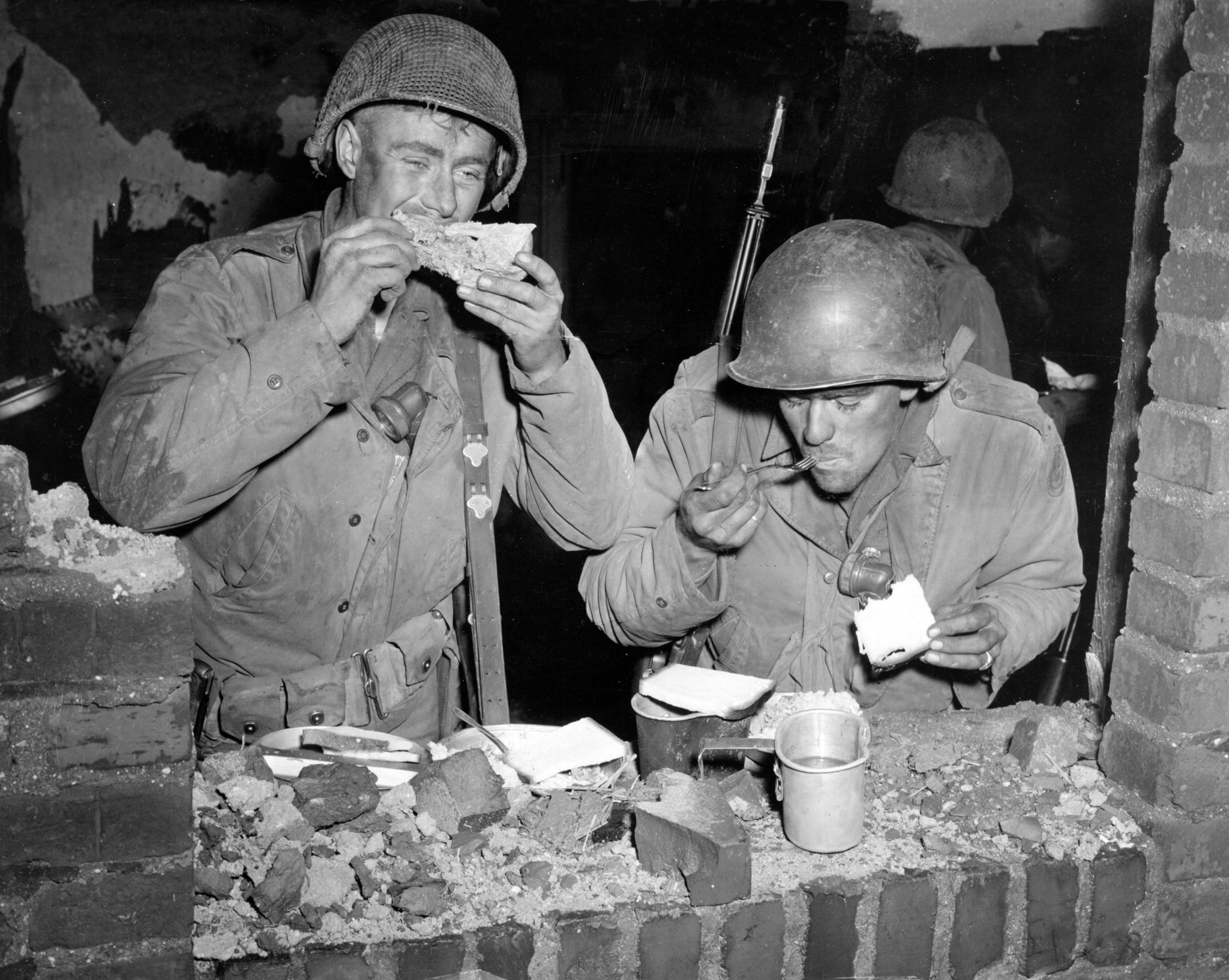
It was a miracle of deliverance — of sorts. In 1944, Gen. Dwight D. Eisenhower might have — briefly — usurped Gen. George C. Marshall’s title of “the organizer of victory” when he put out the order to get Thanksgiving turkey dinners with all the trimmings to nearly two million troops fighting to liberate Europe from Nazi domination. It was a logistical feat that, with albeit some exceptions, the Army’s Quartermaster Corps and Transportation Corps met with gusto. On Thanksgiving Day, nearly every G.I. stationed in Europe received an estimated 1.5 pounds of turkey per serving, plus stuffing, mashed potatoes, string beans, corn, cranberry sauce, celery, hot rolls and pumpkin pie. After weeks, if not months or years, surviving on dreary fare of cold K-rations and C-rations, the high command saw the effort to ply the troops with a turkey dinner as a necessary morale booster. The typical “treat” of gum and cigarettes certainly could not compete with pumpkin pie. The Army and the War Food Administration began planning Thanksgiving dinners in June 1944, while mass purchases of turkeys for shipment to Europe began the following month. In October 1944, the refrigerated cargo ship SS Great Republic was loaded up with 1,604 tons (3,208,000 pounds) of frozen turkeys and left New York harbor for the French port of Le Havre, where the Transportation Corps took charge of getting the food to the front by truck, train and whatever else was available. Once the food was delivered, the cooking was done on the gasoline-powered M-1937 Field Range, which was a major upgrade over the old wood- or coal-fired stoves that had been used by the Army. The M-1937s could boil, roast, bake and fry, and turn out stews, coffee, bacon, baked goods, pies, and, on Nov. 23, 1944, cook up thousands of turkey dinners. The stoves also came with five-gallon mermite cans — insulated containers to keep food warm or cold — to take food forward to where the stoves couldn’t go. In a broadcast to the U.S. on Thanksgiving Day, Eisenhower hailed the effort to bring turkey dinners to the front and added that “There is just one way to gain the peace we want. Each of us must work with ever-increasing devotion and effectiveness up to the day the enemy capitulates.” For troops fighting in the tactical nightmare that was the Hürtgen Forest, the taste of turkey was a welcome reprieve. Launched in mid-September within Lt. Gen. Courtney Hodges’ campaign to cross the Rur River and capture its vital dams, units of the First Army were bogged down in fierce combat against a solidly dug-in German enemy that had left the 28th Infantry Division “combat ineffective.” War correspondent Ernest Hemingway wrote that German artillery turned the trees into weapons in the Hürtgen Forest, calling the campaign “Passchendaele with tree bursts.” “The woods were close-planted fir trees,” he wrote, “and the shell-bursts tore and smashed them, and the splinters from the tree bursts were like javelins in the half-light of the forest.” Yet for the depleted divisions that had been badly chewed up in November during the fighting, troops did their best to rotate to the rear for a meal before returning to the front lines. Brig. Gen. Andrew McNamara, the First Army Quartermaster, would later state that “Every man in First Army had a fine Turkey dinner on that day.” At the front in the Hurtgen sector, Army Lt. Charles Scheffel of the 1st Infantry Division would later recall the surreal sense of having a Thanksgiving dinner brought near his position: “The artillery was still going, but for a few minutes, we could almost pretend we were home.”
Eisenhower’s deliverance: Turkey with fixin’s for troops in WWII
Full Article
Original Source
Read the full article at Militarytimes →KhanList aggregates and links to publicly available news content. We do not host full articles from third-party sources. Always verify important information with original sources.