
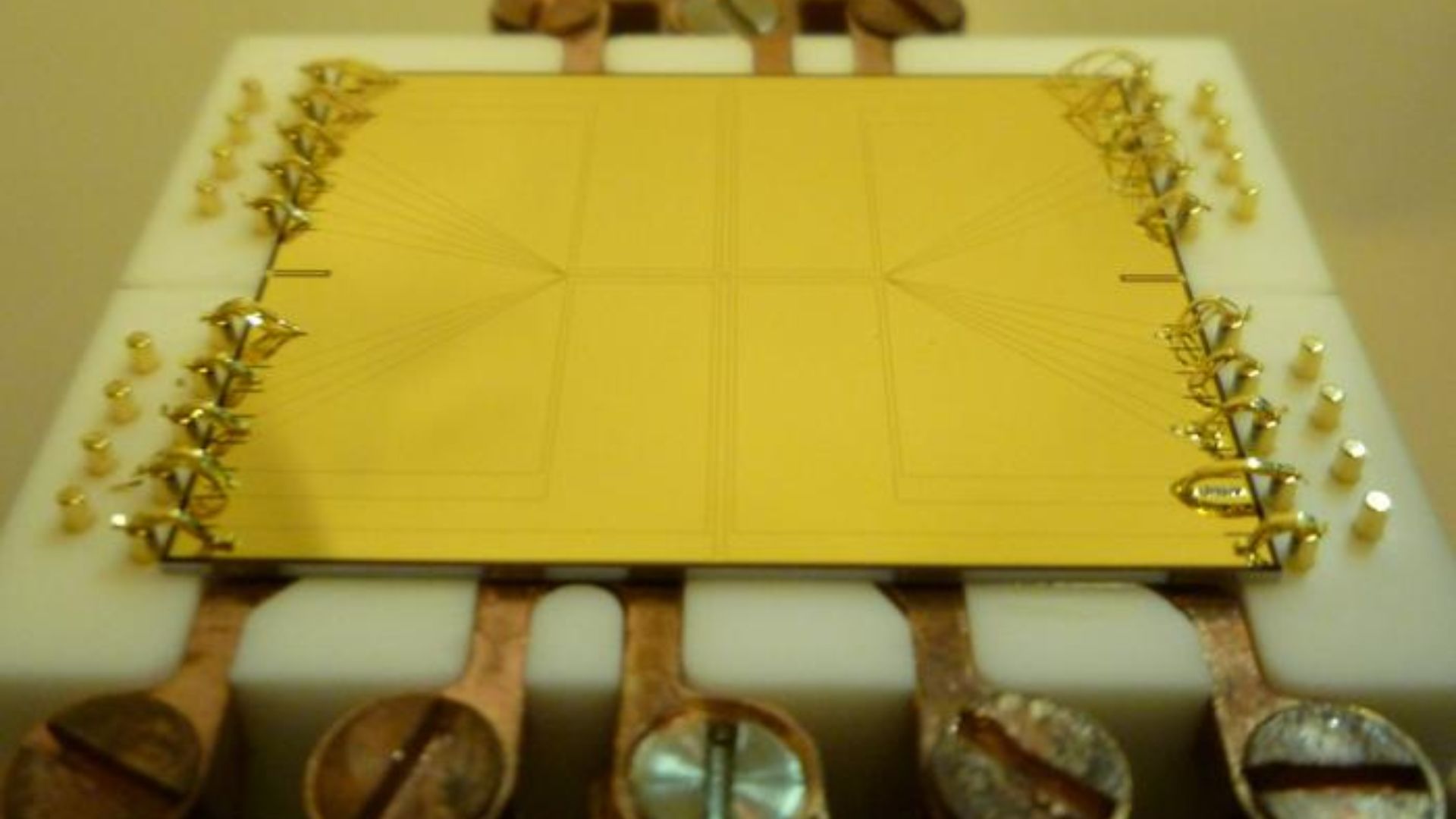
Scientists at the University of Ulm, the University of Oxford, and the Ben-Gurion University of the Negev collaborated to conduct experiments that for the first time showed that a falling quantum object also feels the effect of gravity, something that Albert Einstein had predicted long ago. The world of physics is quite divided. When it comes to macroscopic phenomena like how objects move or how heat is transferred, classical physics is used. However, when one gets to microscopic levels like how chemical bonds are formed or why atoms absorb or emit specific wavelengths, quantum physics comes to the rescue. While both approaches work for their respective purposes, science is always seeking a law that can explain everything. For such a law to explain something, the quantum and classical physics worlds must meet. The great physicist Albert Einstein had predicted in his theory of gravity an equivalence principle, which the scientists wondered, applied to quantum objects as well. A quantum test Einstein’s equivalence principle states that for an observer in free fall, gravity must disappear locally. This can be experienced if a lift or airplane falls freely and the occupants experience weightlessness. To test whether this applies to quantum objects too, the scientists needed to carry out the same experiment on a quantum object. Since these objects can behave like waves and travel on more than one path, the scientists used a special device called the Quantum Galileo Interferometer, which can split the quantum wave associated with an atom into two paths. The device does much more than just this. It can even hold one of the waves in free fall, while holding the other in place and later merging them to see if gravity had an effect on them. University of Oxford professor Sir Roger Penrose has earlier said that quantum mechanics could break down for massive objects held in quantum superpositions for very long times. Penrose was also involved in this work carried out at the Ben-Gurion University, where clouds of rubidium atoms on a specially designed atom chip were used to carry out the quantum test. How was the experiment done? In the experiment, the researchers first used microwave pulses to put ultracold rubidium atoms into quantum superposition, allowing them to travel along two different paths at once. Using tiny electrical wires on the chip, the researchers then created tiny magnetic fields, which created a tiny upward force that could counter the force of gravity. This allowed the researchers to hold the atomic wave stationary relative to the lab and the Earth. The other part was pushed upward using a magnetic pulse and then switched into a state with no magnetic field to simulate free fall under gravity. Using another magnetic pulse, the researchers were able to put the two wave parts together, where they interfered with one another. Using the interferometer, the researchers could measure the tiny difference in quantum phase between the two parts. This difference in phases was found to be the same as that Einstein had predicted. While similar experiments have used quantum objects to measure gravity, this is the first direct measurement of the predicted quantum phase of a freely falling object. The experiment does not unite quantum and classical physics; it only shows that Einstein’s equivalence principle holds even for quantum objects. “We have no consistent theory telling us why quantum physics should fail,” explained Vlatko Vedral, professor of physics at the University of Oxford, in a press release. “This experiment pushes quantum mechanics into one of its most intriguing frontiers, gravity, and shows that, once again, its predictions hold.” The experiment also does not show that Penrose’s argument for larger-sized objects is incorrect. Instead, it paves the way for future experiments for massive objects. The research findings were published in the journal Science Advances. Get the latest in engineering, tech, space & science - delivered daily to your inbox.Ameya is a science writer based in Hyderabad, India. A Molecular Biologist at heart, he traded the micropipette to write about science during the pandemic and does not want to go back. He likes to write about genetics, microbes, technology, and public policy.
Einstein was right: Quantum object falling does feel gravity, finds new research
Full Article
Original Source
Read the full article at Interestingengineering →KhanList aggregates and links to publicly available news content. We do not host full articles from third-party sources. Always verify important information with original sources.