
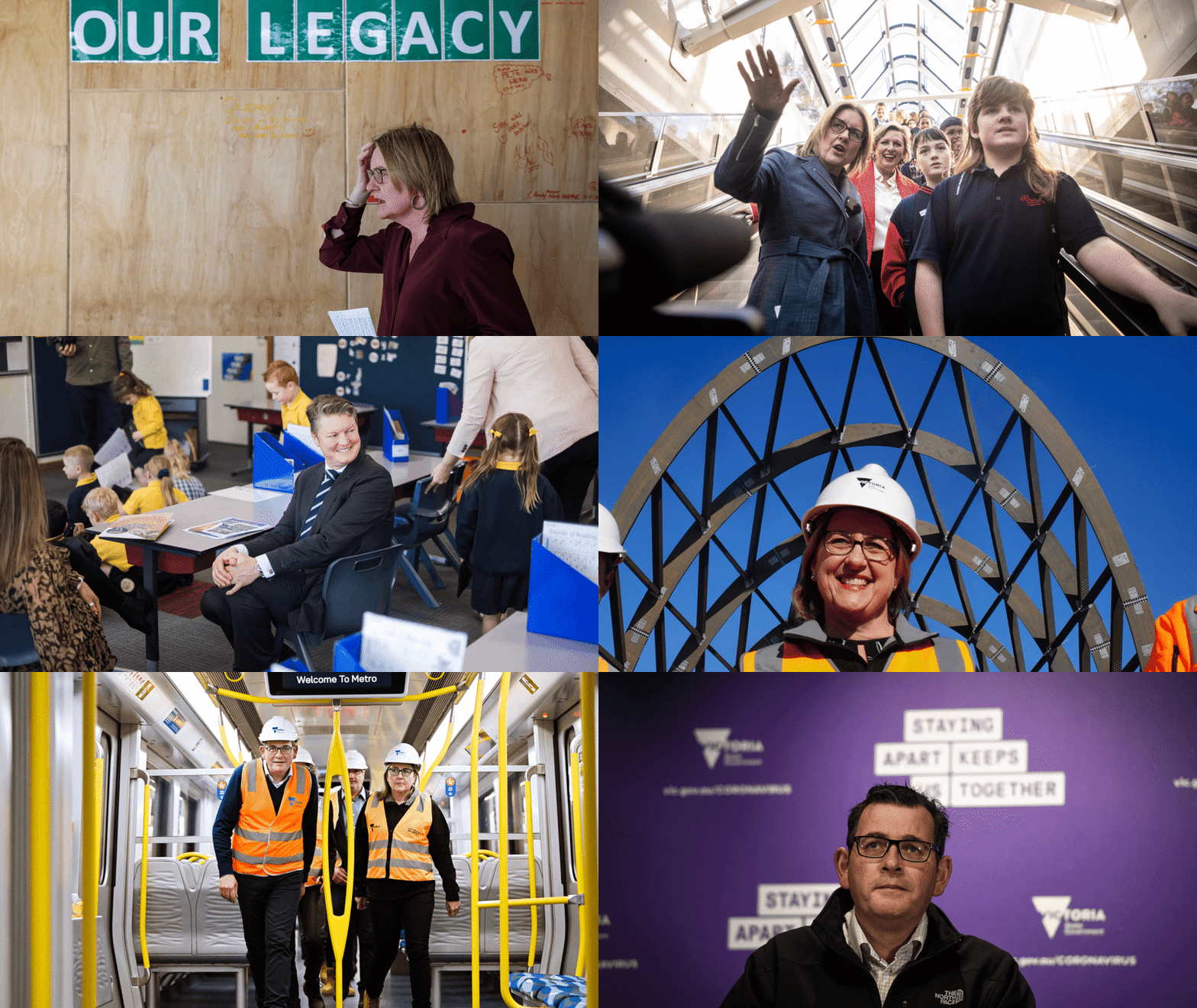
For 12 years, Victorians trusted Labor to teach their children, care for their sick, manage their money, keep the lights on and ensure their safety.Three times, voters gave Labor a mandate to make major changes to the state. On Saturday, if the polls are correct, those same voters will send a message to the state government that at some point things went awry.This is how Labor has changed Victoria – for better and for worse – under the leadership of Daniel Andrews, Jacinta Allan and Ben Carroll.EconomyWhen Labor came to power in 2014, Victoria’s net debt was $22.3 billion. The government’s latest financial update projects it will reach $172.5 billion by mid-2027, and $196 billion by the end of the decade. The debt-to-GSP ratio was 5.6 per cent when the Andrews government was elected – now, it’s 24 per cent.This rapid increase in borrowing has pushed Victoria’s interest bill this year to $8.85 billion, according to the May budget, equating to about $1 million an hour. This is more than what the state spends annually on police, public transport or ambulance services.Expenditure rocketed during COVID-19 to fund stimulus packages and welfare payments, but Labor has continued to spend intensely following the pandemic, especially on infrastructure.Economists have warned the government can only start to reduce debt when it delivers a net surplus, which there has not been in Victoria since 2008-9.Independent economist Saul Eslake said Victoria had grown too reliant on population growth to boost the economy.“And that in turn has meant that to a greater extent than in the rest of Australia, Victoria’s economy has come to depend on intrinsically low productivity industries, while intrinsically high productivity industries have declined by more as a share of Victoria’s economy than that of any other state,” Eslake said.CrimeDuring its 12 years in power, Labor has battled a roller-coaster crime rate, which hit a record high last year as the party’s primary vote began to evaporate.In June 2015, the rate of criminal incidents per 100,000 people was 5750. It plunged during the pandemic lockdowns, hit a peak of 6716 in 2025, and then fell to 6310 this year.The rise has been driven by retail and car theft, as well as increases in assault and aggravated burglaries. High-profile violent crimes, especially those carried out by young offenders, put Labor under pressure to change course multiple times on law and order, abandoning progressive reforms to the age of criminal responsibility and introducing its blunt “adult time for violent crime” laws.Labor came to power promising to address family violence, and immediately called a nation-leading royal commission. It made 227 recommendations and resulted in huge investments in the area. However, family violence assaults rose steadily after the inquiry and peaked in the pandemic, though police note these offences were previously underreported due to stigma.Family violence experts said that while the royal commission was momentous, domestic violence was getting worse in Victoria, underscored by falling investment and overwhelming demand for services.Polling shows crime and policing were among voters’ top concerns in the run-up to the election, and both parties have brandished their tough-on-crime credentials.HealthLabor invested billions in public health and built a dozen hospitals across the state. Throughout the campaign, Carroll leant heavily on Labor’s record on health, and attacked the Coalition on the issue, claiming Opposition Leader Jess Wilson would “Americanise” the system.But Labor has also struggled to address some major public health issues during its rule.Ambulances have not once hit their 15-minute response time benchmark under Labor, with standards falling since the pandemic. Waiting lists for elective surgery have climbed, and emergency departments have struggled under the weight of rising demand.Simon Judkins, Victorian president of the Australian Medical Association, said a major failure had been on mental healthcare.As part of Labor’s 2018 re-election campaign, Andrews promised a royal commission on Victoria’s mental health system, which made 74 recommendations, including establishing community mental health services.Early action was encouraging and reforming the system became a priority of the government, including creating a specialist tax designed to significantly boost mental health funding.But the promised funding hasn’t been delivered, progress has stalled, mental health patients are languishing in emergency departments due to a lack of specialist beds, and workers face high rates of abuse.Judkins said there was “significant lag time” acting on the recommendations from the royal commission, which made it challenging for mental healthcare workers and for staff in emergency departments. More funding was needed at a community level and also to staff more inpatient hospital beds, he said.“I think we’ve never had significant change there,” he said. “So I think that’s been ... for me, one of the standout things.”Former premier Daniel Andrews in his trademark North Face jacket.Paul JeffersAnd of course, Labor was in charge during the COVID-19 pandemic. Andrews initially won plaudits for his efforts to keep the virus at bay, only for the government’s lengthy lockdowns to become a source of controversy, along with the problem-plagued hotel quarantine system.TransportThe $100 billion Big Build will define much of Labor’s success – and its likely downfall. Andrews won elections promising major transport infrastructure works, and hard hats and high-vis became a natural look for the premier and his ministers.More than 130 projects have been completed, notably including the city-shaping Metro Tunnel and West Gate Tunnel, as well as 96 level crossing removals. The North East Link is due to open in 2028, while construction is under way on the controversial Suburban Rail Loop, although its future is under a cloud as the Coalition is promising to pause and review the project.The major projects and infrastructure boom has been marred by cost blowouts and corruption scandals.Revelations in this masthead of serious misconduct and the infiltration of criminals on the Big Build became a major political problem for Allan, and ultimately led to Carroll calling a royal commission. Its public hearings began in September, with explosive evidence already aired.Data from the Commonwealth Grants Commission also reveals Victoria’s infrastructure has come at a premium. The state has paid 10 per cent more than others in Australia to provide an average level of infrastructure.Economists have urged the next Victorian government to slash infrastructure spending to regain control of the budget.EnergyLabor supercharged the energy transition in Victoria, legislating ambitious renewable energy targets of 65 per cent of the state’s power generation by 2030, and 95 per cent by 2035. Labor set a target to reach net zero by 2045.The government has subsidised rooftop solar and banned gas connections in new home builds, and has negotiated the closure of all the state’s remaining coal-fired power stations by 2038.In 2021, Labor lifted a moratorium on onshore drilling for gas. It has approved significant offshore gas exploration to act as insurance against any future energy shortfalls.Analysis by Rystad Energy recently rated Victoria as having the cheapest wholesale power among economically developed countries.But the state’s offshore wind projects, a key plank in the government’s plan to offset the loss of coal-fired power, are behind schedule, and the auditor-general has warned of further delays.Community backlash over controversial transmission lines, in particular VNI West and the Western Renewables Link, has stalled progress on the energy transition. Gas reserves are declining rapidly in the Bass Strait and greater reliance on the fossil fuel would stretch supplies.Grattan Institute climate and energy program director Alison Reeve said Labor’s plan to transition from gas was nation-leading, but the government had failed to address emerging gaps in gas supply and continued demand for the fossil fuel from Victorians.Reeve said Labor had done well to get more renewables into the system but hadn’t thought through what “firming” – on-demand energy generation for when renewable output is low – was needed to supplement it.“It was not really that well co-ordinated with having to get more batteries, potentially more gas generators, and also ... how that was going to sequence with the closure of the coal-fired power stations,” Reeve said.“Because the two big problems that are sitting there for whoever gets in on Saturday are: how do you deal with the looming gas supply crunch? And how do you deal with Yallourn closing?”HousingUnder Labor, Victoria has consistently built more homes than any other state every year.It’s become a beacon of relative housing affordability: Melbourne’s median house price is cheaper than all other Australian capitals, bar Hobart and Darwin, and the city also has some of the nation’s cheapest rent.Labor introduced a townhouse and low-rise code which fast-tracked new housing in established suburbs by limiting the rights of neighbours to appeal against developments.It also instituted the controversial activity centres – 60 rezoned areas in metropolitan suburbs that allow for towers up to 20 storeys. This scheme has faced a backlash from local councils and some communities, who worry that high-rise developments will destroy neighbourhood character.EducationDuring the 2014 election campaign, Andrews said that new number plates would read “The Education State”. Labor’s first budget after its victory was spruiked as “the biggest education budget in history”.Throughout Labor’s 12-year rule, Victoria has consistently led other states in NAPLAN results.Labor introduced free kinder to the regions in 2020, and provided it statewide for three- and four-year-olds from 2023. In 2019, the government established Free TAFE, which has educated more than 230,000 students across 80 courses. Since 2017, the government has built 121 new schools.Last month, the state government signed an agreement with the Commonwealth to fully fund public schools by 2031 by meeting the minimum standard set by the Gonski review. But in 2025, Labor secretly delayed its promise to meet the standard, denying public schools $2.4 billion in funding.Social policyLong viewed as the nation’s most progressive state, Victoria has seen major social policy changes under Labor.In November 2017, the parliament passed assisted dying laws, becoming the first state to do so. And when it became clear, eight years later, that the laws were too narrow, amendments passed the upper house to allow more people access.Labor also introduced pill testing, allowing Victorians to test drugs to detect harm. In its first year, the program tested more than 5000 samples and detected an unexpected psychoactive substance in 12 per cent.After more than a decade of work, the government signed Australia’s first treaty with its First Peoples. It established Gellung Warl, a body to advise parliament and represent Indigenous Victorians, embed truth-telling bodies to monitor government, and set out formal engagement between First Peoples and state bodies.Wilson has pledged to scrap the treaty within 100 days, though that may prove practically fraught.The Coalition will also close Victoria’s only safe-injecting room, which was opened by Labor and has reduced overdose deaths. The room has faced a backlash from nearby residents and traders in North Richmond.Read more on the Victorian election:Exclusive poll: Nearly half a million voters abandon LaborQ&A: We asked Jess Wilson and Ben Carroll your questions‘Stuff that’: The question that One Nation refuses to answer‘$90m to build nothing’: Anger over Liberals’ last-minute cancellation
Eight ways Labor has changed the face of Victoria in 12 years
Full Article
Original Source
Read the full article at Smh →KhanList aggregates and links to publicly available news content. We do not host full articles from third-party sources. Always verify important information with original sources.