
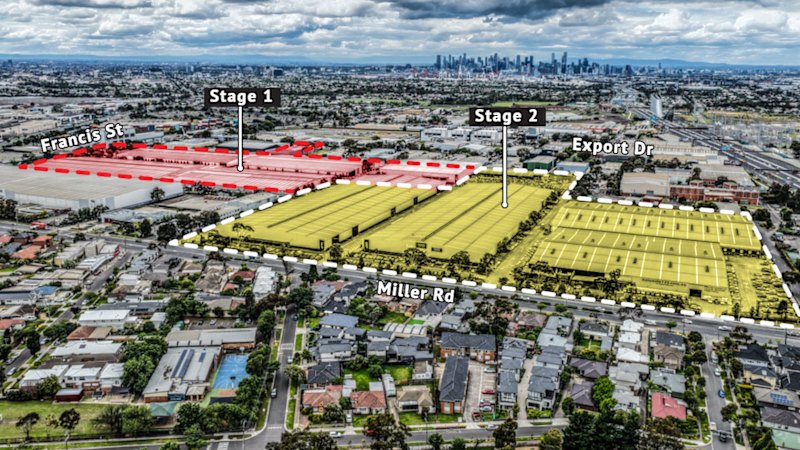
November 1, 2026 — 5:00amA sprawling data centre proposed for Melbourne’s west heads a queue of nine similar projects awaiting planning decisions as the clock ticks down to the state election.Planning Minister Sonya Kilkenny has until 6pm on Tuesday to make a call on more than $5 billion in data centre proposals before caretaker mode puts a freeze on government decision-making.Leading the queue is the Brooklyn proposal, where developer Stockland wants to spend almost $1 billion turning a thriving distribution centre it owns into an enormous data centre. Under the Stockland plan, the data centre would rise as high as an eight-storey building, with acoustic screens atop its data halls to stop scores of rooftop chiller units breaching night-time noise limits.Stockland had expected a state government decision last month on its proposal, to ultimately cover 22 hectares – the equivalent of 11 MCG playing surfaces – from Francis Street to the West Gate Freeway.An artist’s impression of Stockland’s proposed data centre.StocklandThe developer applied through the state government’s fast-track Development Facilitation Program in May; the ministerial pathway bypasses local councils and strips residents of appeal rights. Almost all of Melbourne’s proposed data centres are taking this approval route.Across Melbourne, the speed of data centre construction has outpaced traditional planning frameworks. Driven by the rapid adoption of artificial intelligence and cloud computing, tech companies have poured billions into Melbourne’s industrial west, making it the fastest-growing digital infrastructure market in Australia.“When I last searched for sites around my home, there were five hyperscale data centres within two-and-a-half kilometres of me,” said Carmen Largaiolli, a long-time Brooklyn resident who has campaigned for years to improve air quality and living standards in her suburb.An artist’s impression of part of stage one of Stockland’s $935 million data centre in Brooklyn.StocklandShe said the Stockland proposal was just the latest data centre to encroach on Brooklyn. An enormous CDC data centre campus to the immediate north of Brooklyn, facilitated by the state government, is still expanding, while down Francis Street sits a growing Microsoft data hub.Largaiolli said several data centre developers had employed a multi-stage strategy to get sprawling campuses approved. “This is what all the hyperscale data centres do: they get an approval for stage one, and then they’ve got all the subsequent stages yet to come,” she said. “As long as they get approval for stage one, all the remaining stages follow.”Brooklyn resident and environmental campaigner Carmen Largaiolli, on Millers Road, opposite where the second stage of Stockland’s plan would be built. She says her suburb will soon be surrounded by hyperscale data centres.Simon SchluterLargaiolli questioned Australia’s push to host vast server infrastructure for global firms, and called on state and federal leaders to halt suburban approvals. “I’m calling for a moratorium along with the growing voice of community groups from all over Melbourne. They are all concerned about the exact same thing.”On Friday, all 79 Victorian councils united to demand a moratorium on new data centre approvals. Municipal Association of Victoria president Jennifer Anderson said councils were not being given the time, information and resources to consider data centres’ cumulative impacts: “This is despite our sector being on the front line of managing community expectations, as well as the ongoing impacts and opportunities associated with the rapid expansion of data centres,” she said.The Australian Energy Market Operator projects data centre power use will rise from 2 per cent of national grid capacity to 6 per cent within a decade. The boom reflects a global phenomenon. In the United States, data centre clusters in states such as Virginia and Texas have driven up household energy bills and sparked street protests over transmission lines and continuous industrial hums. Across Europe, authorities in Ireland and the Netherlands have introduced outright bans on new grid connections to protect domestic power supplies.Australia is now running into the same sorts of community blockades, investor jitters and grid bottlenecks. Industry group Data Centres Australia counters that fears over energy drains are inflated by “phantom demand” – pointing to research showing only one in seven data centre electricity connection applications results in a finished building, as many developers lodge speculative bids.The Brooklyn plan remains on Kilkenny’s desk, alongside eight other mega-projects across outer Melbourne. Hobsons Bay City Council has objected to the Brooklyn plan, telling the state government that local community oversight had been reduced to a meaningless “procedural exercise”. If the planning minister does not make a decision by 6pm on Tuesday, the proposal will not be addressed until after the November 28 election – and likely not until well into next year.A Victorian government spokesman said every data centre proposal went through a rigorous assessment. Asked how many of the nine planning applications before the minister were likely to be decided by 6pm on Tuesday, the spokesman declined to answer.Technical assessments prepared by acoustic consultants for Stockland reveal the facility’s 96 rooftop chillers will require an 11-decibel noise reduction package just to meet state noise thresholds along busy Millers Road, where the nearest homes stand 170 metres away.Hobsons Bay planning officers criticised the project, stating it “ignores the fundamentals of planning in Victoria”. Mayor Diana Grima wrote to Kilkenny earlier this year, urging her to reject the application. She warned that placing a 24-hour data facility near homes – alongside 3.3 million litres of bulk diesel fuel and 112 emergency generators – poses severe cumulative noise, air quality, and visual risks for a suburb already burdened by heavy industrial pollution.The first stages of a CDC data centre campus at the corner of Geelong Road and McDonald Road in Brooklyn. It is 500 metres west of where Stockland wants to build another enormous data centre.Justin McManusLocal MP and Labor minister Melissa Horne backed calls for community feedback to be given weight. “I would like to see the same guardrails applied to this data centre that applies to any new planning determination,” she said.The Liberal candidate for Williamstown, Paul Lindemann, declined to comment on Stockland’s proposal when contacted about the plan. “It’s Liberal Party policy at this stage that we don’t speak to any mastheads about our policies,” Lindemann said, before adding: “No comment.”Opposition planning spokesman David Southwick did not respond to multiple attempts to contact him about data centre approvals.Former Hobsons Bay mayor Tony Briffa, also running for the state seat of Williamstown, said while she appreciated data centres could be useful, “applications must be put on hold while Victoria does not have adequate planning rules to address serious issues about them”.Briffa said the Stockland data centre’s first stage was less than 200 metres from homes. “And stage two is about 40 metres from homes and about 100 metres from Annunciation Primary School.” (Annunciation Primary School was contacted for comment for this story but did not respond.)Briffa said adequate buffer distances needed to be established around data centres. “And these should be significantly more than the 150 metres announced by the premier last month.”The proposed Brooklyn complex will draw an ultimate grid capacity of around 225 megawatts, the equivalent of 250,000 average Victorian homes. And despite its $935 million first-stage cost, the automated facility will employ just 50 full-time staff during the day and as few as 13 workers on night shifts.A visit on Wednesday to Stockland’s existing Brooklyn Distribution Centre found a bustling light-industrial complex housing 10 commercial tenants across 130,000 square metres of warehouse space. Demolition for stage one of the data centre will clear 67,200 square metres of active industrial warehouses.A Stockland spokesman said the Brooklyn data centre was subject to a rigorous planning assessment process and would only proceed if it met all applicable requirements.“These matters will be considered by the relevant authorities as part of their assessment,” the spokesman said. “The Brooklyn site is within an established industrial precinct with the appropriate zoning and access to the infrastructure and network capacity required to support this type of development.”From our partners
Eight-storey hub equivalent to 11 MCGs heads up $5 billion data centre queue
Full Article
Original Source
Read the full article at Smh →KhanList aggregates and links to publicly available news content. We do not host full articles from third-party sources. Always verify important information with original sources.