
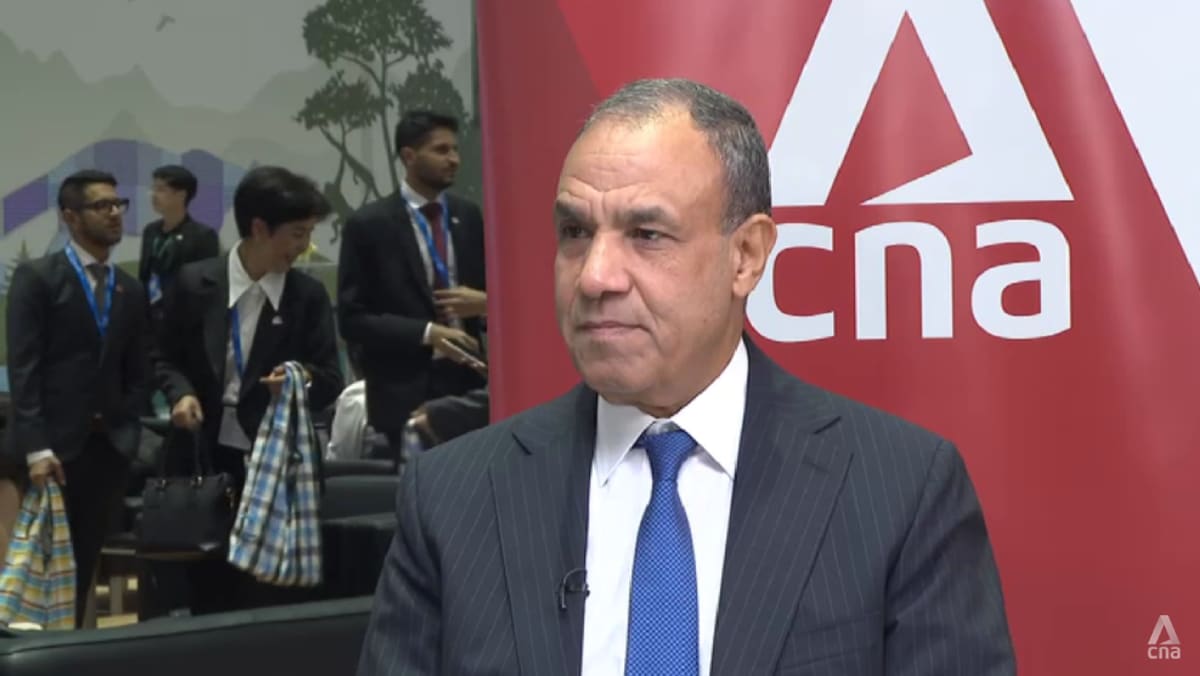
There is “no military solution” to the conflict in the Middle East, Egyptian Foreign Minister Badr Abdelatty said on Tuesday (Oct 13), warning that further fighting would only deepen human suffering and instability in the region. Speaking to CNA on the sidelines of the International Monetary Fund (IMF) and World Bank Annual Meetings in Bangkok, Abdelatty said Egypt is putting in “maximum efforts” to de-escalate tensions and promote a diplomatic solution. “Our region is in turmoil. Military solution will just add to the suffering of the people, creating more chaos, more challenges,” he said. “This is what we convey to all our regional and international partners: There is no military solution.” He added that the situation in the region remains tense despite diplomatic efforts to end the hostilities, warning that further violence “could erupt any time”. Egypt has been involved in mediation efforts alongside Pakistan, Qatar and Turkiye to bring the United States and Iran back to the negotiating table. Abdelatty pointed to the Islamabad Memorandum of Understanding, signed in June between the US and Iran, as an important framework for negotiations, saying its 14 points could help guide a future settlement. Iran recently put forward a seven-point proposal, to which the US had responded with a counterproposal. Egypt was encouraging Iran to respond and move the process forward, Abdelatty added. “We must push for a final settlement which includes all elements, including sanctions, freedom of navigation, the nuclear file,” he said. Those issues, he added, would be important pillars of any permanent political agreement between Washington and Tehran. ECONOMIC COST OF REGIONAL INSTABILITY The Iran conflict and wider instability in the Middle East over the years have also taken a heavy economic toll on Egypt, Abdelatty said. The country had lost US$20 billion in Suez Canal revenue due to a decline in traffic through the crucial waterway in recent years, he said. Higher energy prices since the Iran war started on Feb 28 have also placed additional pressure on Egypt’s finances. “Our current budget was based on projection that the price of barrel will be around US$65. Now it's US$105 or more, so that's adding more pressure on our budget and on inflation, and people are suffering,” Abdelatty said. He also pointed to disruptions to supply chains and the flow of fertilisers as a threat to food security, creating challenges over both the availability and affordability of essential goods. Before the outset of the war on Iran, the Strait of Hormuz carried about a fifth of global oil supply and around a third of seaborne fertiliser trade. Despite those pressures, Abdelatty said Egypt’s economy had remained resilient, which he attributed to its diversification. Real GDP growth reached 5.2 per cent in the first nine months of fiscal year 2025/2026, while core inflation eased to 14.1 per cent in September. EGYPT LOOKS TO ASIA During the wide-ranging interview, Abdelatty also outlined Egypt’s push to strengthen its economic ties with Asia-Pacific, including Southeast Asia. He said Cairo wants to attract more Asian investment, expand trade and tourism, and position Egypt as a logistics hub linking Asia with Africa and the Middle East. “We consider ourselves as a gateway to Africa and to the Middle East,” he said, adding Egypt has invested US$600 billion in infrastructure over the past decade, including ports, airports, roads, power stations and railways. He said the country could provide storage and distribution facilities for commodities such as palm oil, grains and petrochemicals, particularly as disruptions in the Strait of Hormuz and the Red Sea continue to affect global supply chains. “In light of the challenges, the interruptions of the supply chains … we can be a strategic and logistical hub for Asian countries, and then for distribution to Africa, to Arab countries, and the Middle East,” he said. Abdelatty also pointed to the Suez Canal Economic Zone as a potential manufacturing base for Asian companies seeking access to African markets. He also advocated closer ties among developing economies, particularly between Asia and Africa. “We must have more focus on South-South cooperation. Forging partnerships between Asia and Africa … is a must because it's a win-win situation, and a testament of the Global South solidarity,” he said. CALL TO REFORM FINANCIAL INSTITUTIONS Abdelatty, who also serves as Egypt’s governor to the World Bank, has called for reforms to the global financial system to ease the debt burden on developing and middle-income countries. The issue has also been in focus at the IMF-World Bank Annual Meetings. Taiwo Oyedele, chair of the Group of 24 (G24) nations, said estimates showed developing countries were paying some US$500 billion more for their debt than developed economies.The G24, which includes Egypt and represents emerging and developing economies, has urged the IMF and World Bank to provide more accessible and affordable concessional financing to vulnerable countries.Abdelatty said current efforts were insufficient, particularly for middle-income countries.“There is no single regional or global mechanism dealing with the issue of debts of the middle-income countries,” he said.“We have to do more. We have to be more serious and we have to alleviate the burden from the developing countries, because this is the main impediment now.”He called for greater political will to reform the global financial system and urged the IMF, World Bank and other financial institutions to step up efforts to address the debt burden.
Egyptian foreign minister urges diplomacy, says ‘no military solution’ to Middle East conflict
Full Article
Original Source
Read the full article at Channelnewsasia →KhanList aggregates and links to publicly available news content. We do not host full articles from third-party sources. Always verify important information with original sources.