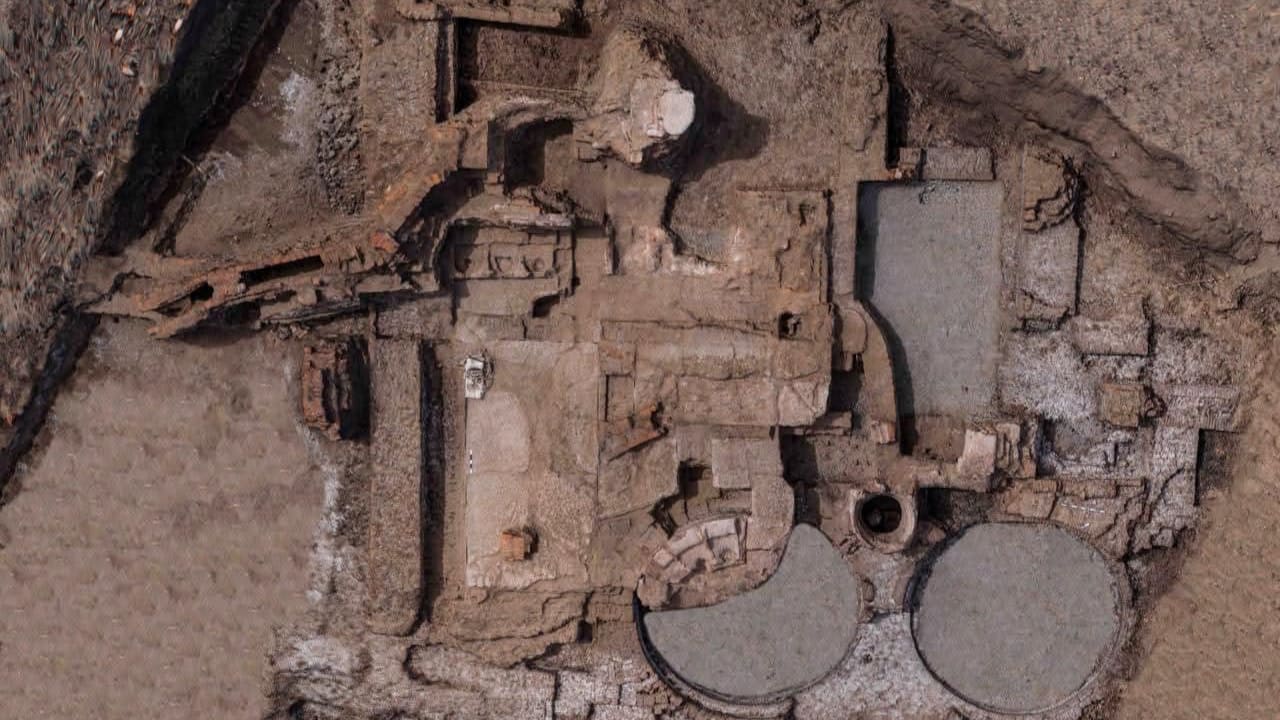
ByMIRIAM SELA-EITAMAUGUST 8, 2026 04:37Archaeologists unearthed the first complete bathing facilities to be found at the Tell Nasser archaeological site in Port Said, Egypt’s Tourism and Antiquities announced in a statement late last week.The complex was found during the first excavation season in the area, which sits roughly 40 km south of Port Said and 1.5 km north of the Suez Canal.Preliminary study of the site's archaeological layers revealed a clear succession of settlement, beginning in the late fourth and early third centuries BCE, said Secretary-General of the Supreme Council of Antiquities Dr. Hisham El-Leithy.Leithy added that the layer is marked by remnants of ancient Cypriot pottery and Greek amphorae, confirming that settlement of the site began before the construction of the bathing complex.The layers above it, he explained, point to a Ptolemaic settlement phase during the second and first centuries BCE, represented by a collection of Rhodian amphora stamps found alongside other local and imported pottery.Pottery fragments found at Tell Nasser archaeological site in Egypt, August 7, 2026. (credit: EGYPTIAN TOURISM AND ANTIQUITIES MINISTRY)Ancient hydraulic system unearthed at siteFurther, he said that the discovery is significant for two reasons: the first being the documentation of the first complete bathing complex to be unearthed at Tell Nasser, and the second being confirming that the site was settled prior to Ptolemaic period while showing that it was in use throughout the Roman period as well.Beyond that, Leithy said that the discovery offers a full picture of ancient hydraulic engineering in the eastern Delta region and bears similarities to known Hellenistic baths found elsewhere in Egypt, including the recently discovered bath at Tell el-Herr in northern Sinai.What sets the Tell Nasser complex apart from other bathing complexes found in Egypt, Leithy explained, is that it combines a private bathing unit with the public bath, together with a complete water supply and drainage system.The private bathing unit is centered on a circular basin that measures at around 2.5 meters across, made of red brick and lined with moisture-resistant pink mortar.Nearby is a low structure believed to have been used for heating water, according to Head of the Egyptian Antiquities Sector at the Supreme Council of Antiquities Mohamed Abdel Badi.Evidence of continued use of complex through Roman periodBadi added that the complex was likely built in the late first century BCE and remained in use through the Roman period, with architectural evidence pointing to a series of modifications over time.Later though, during the late Roman period, parts of the complex appear to have been repurposed for storage, as suggested by Gaza amphorae recovered from the site.He also described the public baths as consisting of two circular rooms, or tholoi, each measuring about five meters in diameter.The first room held five footbaths, three of which have survived in good condition, explained Badi.Each of the five features a backrest, side armrests, and a rounded recess for the feet, along with three rectangular basins and a quarter-circular basin used to collect and distribute water.The floor was finished in slip-resistant hydraulic mortar, with a drainage opening linked to the site's internal drainage network.Khaled Farid, director of the Port Said Antiquities Zone and head of the archaeological mission, said the a complete hydraulic system had been uncovered during excavations.Farid noted that the find included a six-meter-long water supply channel made of red brick, with part of the channel covered by a vaulted red-brick roof, and a complete drainage network.An older channel was found beneath it, and remnants of residential walls were unearthed during excavations of the area, giving archaeologists evidence that the site went through even earlier phases of construction.Tourism and Antiquities Minister Sherif Fathy praised the archaeological and scientific results the mission has produced, noting that the discovery adds “new insight into the history of settlement and the development of architecture and public services in the eastern Delta during the Ptolemaic and Roman periods.”Follow us on Google
Egypt uncovers first complete bath complex, ancient hydraulic system north of Suez Canal
Full Article
Original Source
Read the full article at Jpost →KhanList aggregates and links to publicly available news content. We do not host full articles from third-party sources. Always verify important information with original sources.