
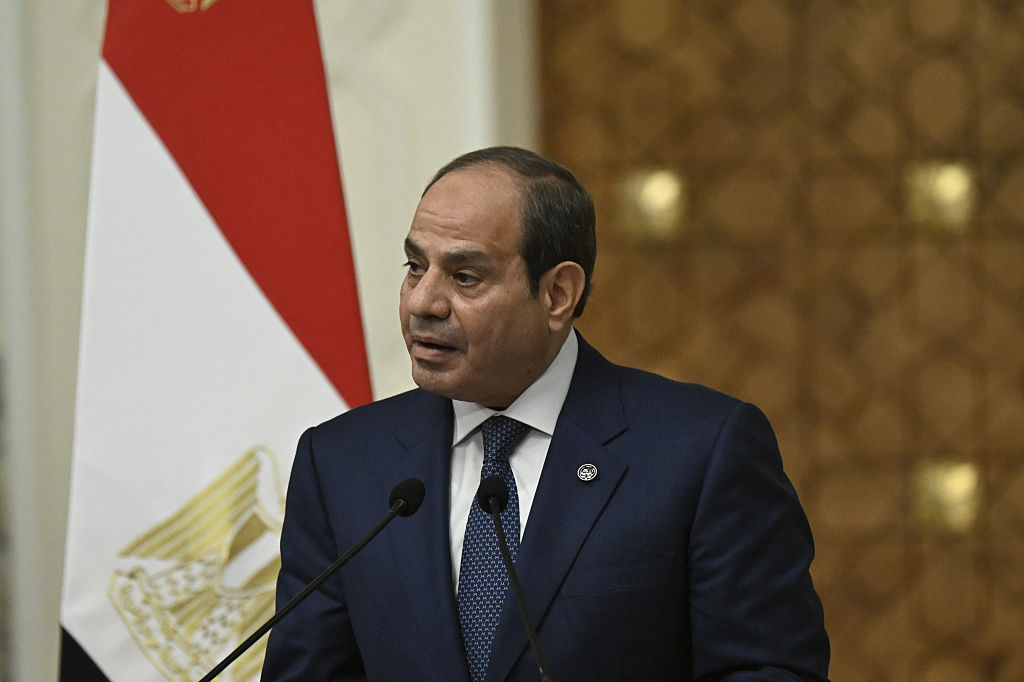
After nearly three years of staying out of the wars in the Middle East, Egypt may finally be ready to engage. On October 18, Egyptian President Abdel Fattah al-Sisi pledged to provide Saudi Arabia with “all necessary and possible” support to defend itself against Houthi attacks. A day prior, Sisi had requested parliamentary authorization to deploy Egyptian forces if Riyadh asks for such assistance. While the Egyptian parliament delayed the vote until October 26, officials have specified that any support would be exclusively defensive. This change comes on the heels of sustained efforts by Riyadh to garner regional support as it faces deadly attacks from the Houthis. On September 15, Saudi Crown Prince Mohammed bin Salman (MBS) visited Cairo to seek Egyptian assistance. Yet a commitment to defensive support falls short of the more consequential contribution needed to help Saudi Arabia and Yemen’s internationally recognized government decisively address the Houthi threat. Despite Economic Strain, Egypt Has Failed To Respond to Houthi Attacks Since the Houthi’s began attacking commercial shipping in the Red Sea in the aftermath of the October 7, 2023, Hamas attack that plunged the region into war, merchant ships have avoided the Suez Canal, costing Egypt billions of dollars in tolls and spurring a prolonged economic crisis. Despite these direct costs, Cairo had refused to engage the Houthis. It has opted instead for statements urging deescalation. Before the attacks began, the Suez Canal generated a record $10.25 billion in revenue in 2023. That figure plummeted 61 percent to $3.99 billion in 2024, before recovering only slightly to $4.2 billion in 2025. The disruption has deprived Cairo of a critical source of foreign currency while its economy remains under strain. Cairo Isn’t Alone in Limiting Its Support for Riyadh to Defense Saudi Arabia’s Mecca Pact partners, Pakistan and Turkey, activated the agreement on October 5 and announced the “rapid deployment” of forces to the Kingdom. Pakistan Army spokesman Lt. Gen. Ahmed Sharif Chaudhry said that the country is giving Riyadh “whatever support is needed.” However, he added, the alliance “is purely defensive.” Turkey is also providing defensive and technical assistance only. Egypt Has a Role To Play, but Washington Can Do More Restricting assistance to defensive measures helps treat the symptom, not the cause. Washington should work with Riyadh to translate its regional and global support into a coordinated strategy that combines maritime security, air and missile defense, and support for Yemeni government forces in their counteroffensive against the Houthis. Cairo can contribute to maritime efforts to isolate the Houthis with naval and intelligence assets. There are multiple regional and international maritime missions tasked with defending shipping in the Red Sea — both Riyadh and Cairo are members of at least two. Instead of operating parallel maritime efforts, Washington should work to harmonize and potentially consolidate anti-Houthi maritime missions. The missions should focus not only on defending shipping in the Red Sea, but also interdicting Houthi maritime smuggling routes which are essential to the group’s weapons supply. Additionally, Cairo and other regional partners can support Saudi efforts to fund and supply Yemeni armed forces which are leading the fight against the Houthis on the ground. Without isolating the Houthis from weapons resupply and challenging their control in northern Yemen, their capacity to threaten not just Saudi Arabia, but the region, will persist. Bridget Toomey is a research analyst at the Foundation for Defense of Democracies (FDD). Mariam Wahba is a research analyst at FDD. For more analysis from Bridget, Mariam, and FDD, please subscribe HERE. Follow Bridget on X @BridgetKToomey and Mariam on X @themariamwahba. Follow FDD on X @FDD. FDD is a Washington, DC-based, nonpartisan research institute focusing on national security and foreign policy.
Egypt May Finally Step Up Against the Houthis
Full Article
Original Source
Read the full article at Fdd →KhanList aggregates and links to publicly available news content. We do not host full articles from third-party sources. Always verify important information with original sources.