
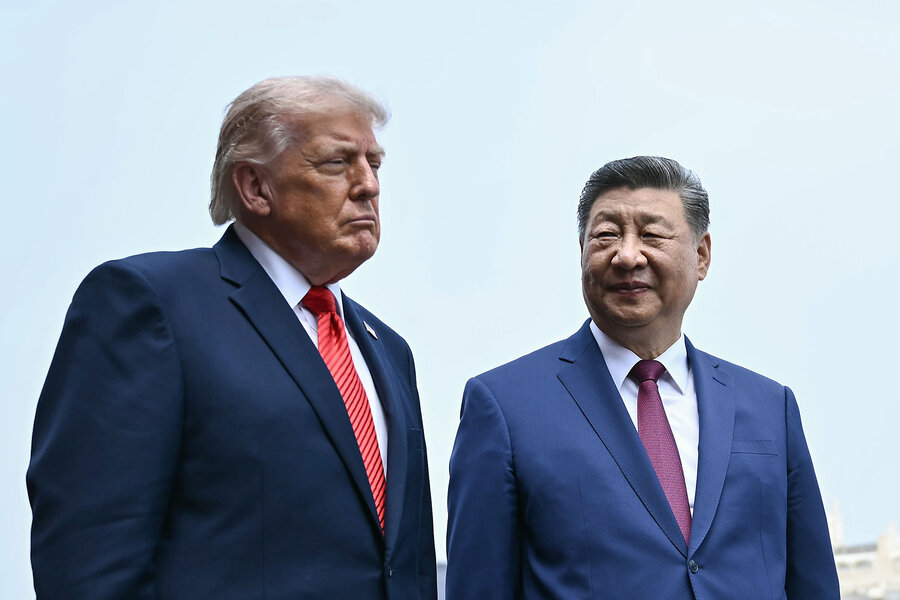
In a telling gesture, U.S. President Donald Trump plans to personally greet Xi Jinping when the Chinese leader alights his plane at Joint Base Andrews for this week’s state visit.The rare honor is sure to please Beijing and will be seen as yet another public display of deference from Mr. Trump – the first president to speak of China as a U.S. peer.China’s Foreign Minister Wang Yi stressed as much. The U.S. and China should advance “in a spirit of equality,” he told Secretary of State Marco Rubio in a preparatory phone call, according to the state-run Xinhua News Agency. In reality, the Trump-Xi summit – the second of four likely face-to-face meetings this year – marks an effort by both leaders to steady ties and buy time as their nations compete fiercely to gain the upper hand, experts say. At their May summit in Beijing, the two men agreed to call this “constructive strategic stability.”“The assumption in Beijing ... is that China and the U.S. will hold each other in check for the foreseeable future,” says Mikko Huotari, executive director of the Mercator Institute for China Studies, a nonprofit German think tank. “Xi really doesn’t need a breakthrough in Washington. He needs more time [to address vulnerabilities], and the same is true for Washington. So we have this strategic stalemate.” Yuki Iwamura/AP/FileA box of produce is filled with fresh ginger at a market in New York, Feb. 10, 2025. That’s not to say that Messrs. Xi and Trump don’t have room for cooperation – particularly on the trade front – or big issues to discuss, such as the risks of artificial general intelligence (AGI), an AI system with human-level ability to reason and act.Other topics sure to be on the agenda include Taiwan, and China’s support for Iran. On trade, the two leaders may agree to extend the one-year trade truce struck at their meeting in Busan, South Korea, last October. Under that deal, China agreed to a one-year pause on some of its rare earth export controls and to purchase U.S. soybeans, while the United States lowered some tariffs on Chinese goods, among other measures. The truce cooled down the intense trade war that began in April 2025.Both sides remain concerned about securing key exports – a topic likely to be raised at the upcoming summit, experts say. The U.S. depends heavily on China for rare earths to make smartphones, cars, wind turbines, aircraft engines, and many other goods, and China needs U.S. semiconductors to power its AI development.Meanwhile, they are working to become less dependent on each other.“The United States is trying to ... find alternative sources of supply outside of China for rare earths and permanent magnets,” says Chad Brown, a senior fellow at the Peterson Institute for International Economics, and a former economist for the Biden and Obama administrations, while “China’s trying to ... break its dependence on the West” by creating its own local AI systems.Under a new U.S.-China Board of Trade that began operating over the weekend to manage nonsensitive goods, each country is also working on finalizing a list of up to $30 billion worth of products that will be traded at reduced tariff levels. While less progress has been made on the investment front, Mr. Xi is reportedly including in his delegation to Washington a number of leading Chinese business executives, much as Mr. Trump flew to Beijing with scores of American CEOs in tow. Ng Han Guan/APVisitors walk past a display depicting artificial intelligence and a human hand at the China International Supply Chain Expo in Beijing, June 22, 2026. The United States and China have “crucial shared economic interests in trade and investment going both ways, and that has the potential to help stabilize the relationship,” says Jake Werner, East Asia director of the Quincy Institute for Responsible Statecraft in Washington.Artificial intelligence governance will also be a prominent topic on the leaders’ agenda, experts say. The U.S. and China are unlikely, though, to agree to slow the development of AI models, despite a crescendo of warnings from United States AI company executives.President Trump has rejected the concerns as “a hoax” and warned that a slowdown could let China win the AI race. Beijing has criticized the American calls to pace AI as a ploy to lock in the U.S. lead and blunt China’s progress.However, China is interested in discussing AI global governance and establishing safety rules, experts say. Broadly speaking, Beijing’s goal is to “keep humans in the loop,” says Yun Sun, director of the China Program at the Stimson Center in Washington. Deepen your worldviewwith Monitor Highlights.Politics with respectGet political stories with respectful analysis.There‘s a world of new ideas in everyBooks newsletter.There‘s more to life, enrich yours withCulture & Learning weekly.Follow humanity‘s discoveries withScience & Nature stories in your inbox.Gain a spiritual perspectivefrom the stories in your inbox.Want to understand the deeper impact of critical events? Learn the Monitor‘s insight.Already a subscriber? Log in to hide ads. In 2024, Mr. Xi and then-U.S. President Joe Biden agreed that humans, not AI, should control the decision to use nuclear weapons. Similar agreements could address the need to prevent AI from enabling rogue actors to obtain biological or chemical weapons, they say.“There is definitely a willingness and interest on the Chinese side of talking to the U.S. about safety,” says Alvin Wang Graylin, a senior fellow at the Asia Society Policy Institute’s Center for China Analysis. “We cannot compete our way out of the danger that can come from third-party, nonstate, bad actors,” he adds. ALREADY A SUBSCRIBER? LoginReal news can be honest, hopeful, credible, constructive.The Christian Science Monitor was founded in 1908 to lift the standard of journalism and uplift humanity. We aim to “speak the truth in love.” Our goal is not to tell you what to think, but to give you the essential knowledge and understanding to come to your own intelligent conclusions. Join us in this mission by subscribing.
Effort to steady ties as Xi and Trump prepare to meet in Washington
Full Article
Original Source
Read the full article at Csmonitor →KhanList aggregates and links to publicly available news content. We do not host full articles from third-party sources. Always verify important information with original sources.