
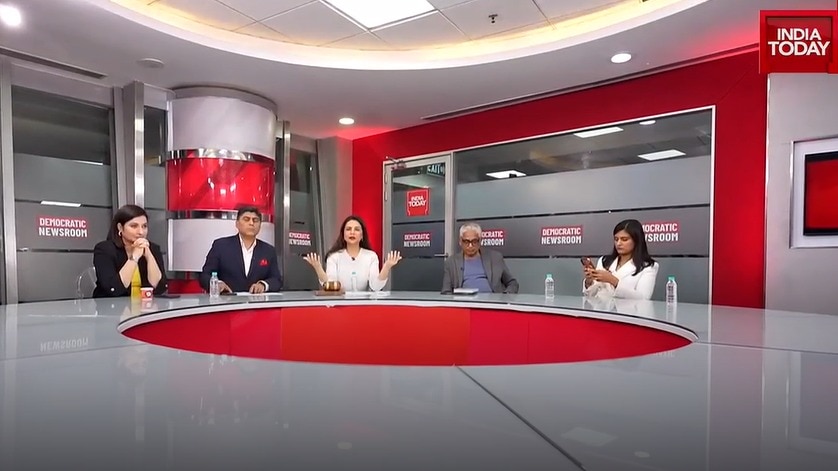
The discussion explored whether political alliances are driven by shared ideology or electoral convenience before turning to the proposed special Parliament session, the government's numbers, delimitation and the implementation of women's reservation.Democratic Newsroom: Political alliances and Parliament arithmeticNov 26, 2026 21:46 ISTLast UpdatedNov 26, 2026 21:46 IST Published byIndia Today Web Desk Nov 26, 2026 21:46 ISTThe debate began with a question at the heart of the latest round of political realignments: are parties joining hands because they share a common ideology, or are their alliances driven primarily by electoral convenience? The discussion initially centred on alliances involving the BJP, Congress and regional parties, with particular attention to political developments in Punjab and Uttar Pradesh. The focus shifted following news of a special Parliament session, bringing the government's numbers and its ability to secure support for legislation linked to delimitation and women's reservation under scrutiny.The roundtable featured Rajdeep Sardesai, Senior Journalist and Consulting Editor; Gaurav C Sawant, Managing Editor, India Today TV; Preeti Choudhry, Managing Editor, India Today TV; Akshita Nandagopal, Senior Editor, India Today TV; and Pooja Shali, Editor, India Today TV. The discussion also drew on live reporting and updates from colleagues tracking Parliament, the government and regional political parties as details of the proposed special sitting emerged.The participants broadly agreed that electoral calculations often take precedence over ideological differences when parties forge alliances. However, they differed in their assessment of how the BJP and Congress manage their regional partners. The discussion examined the BJP's organisational clarity, the Congress's diminishing leverage and contradictions within opposition alliances, alongside seat-sharing calculations in Punjab and Uttar Pradesh.The parliamentary development brought a fresh dimension to the debate. Attention turned to the possible link between delimitation and the implementation of women's reservation, the positions of parties such as the DMK and the NCP, and whether the government could muster the numbers needed to pass a constitutional amendment.Rajdeep Sardesai Senior Journalist & Consulting EditorAlliances are generally exercises in political convenience rather than coalition dharma. The BJP has displayed greater flexibility and strategic skill, using alliances and political power to expand its influence while its regional partners grow weaker. The Congress, by contrast, continues to behave like a once-dominant party despite losing ground and political leverage. It must accept greater give-and-take with its allies. As for the special session, the government is unlikely to proceed without being confident of having the numbers, though the fine print of the proposed legislation remains decisive.Gaurav C Sawant Managing Editor, India Today TVPolitical convenience in coalitions is not a post-2014 phenomenon and cannot be attributed selectively to one party. Indian politics has repeatedly brought ideologically diverse parties together, whether to oppose the Congress, keep the BJP out or secure power. The Congress has steadily ceded ground to regional parties under the banner of secularism without rebuilding its organisation. A strategy focused primarily on excluding the BJP, rather than growing independently and winning on the ground, has left the party diminished across several states.Preeti Choudhry Managing Editor, India Today TVPolitical opportunism cuts across party lines, but alliance negotiations also reflect electoral strength and recent voting patterns. The balance within the BJP-Akali arrangement has shifted, while the Congress can reasonably resist an inadequate offer in Uttar Pradesh. The special Parliament session raises the immediate question of whether the government has secured the required numbers for delimitation and women’s reservation. The draft’s details, possible abstentions and assurances from parties such as the DMK and NCP will determine how the legislation proceeds.Akshita Nandagopal Senior Editor, India Today TVPolitical opportunism is practised by every party, but glaring contradictions make some alliances difficult for voters to understand. Parties cannot credibly operate together at the national level while presenting themselves as opponents in individual states without a coherent common programme. If alliances are formed for electoral advantage, they must at least be strategically consistent and workable. On delimitation, the DMK is not opposed in principle but has concerns about implementation, leaving room for negotiations and a possible agreement through sustained communication with the government.Pooja Shali Editor, India Today TVNo single party should be isolated for alliance opportunism when power encourages flexibility across the political spectrum. The opposition’s larger problem is the absence of a clear and consistent vision for voters. Shifting equations involving the Congress, Samajwadi Party, BSP, DMK and other parties create uncertainty about what an INDIA bloc vote represents. The BJP-led alliance, by contrast, communicates its priorities more clearly. Opposition parties need a defined programme and stable electoral message rather than changing arrangements from one election to another.- Ends
Editors examine alliance arithmetic as special Parliament session shifts the debate
Full Article
Original Source
Read the full article at Indiatoday →KhanList aggregates and links to publicly available news content. We do not host full articles from third-party sources. Always verify important information with original sources.