
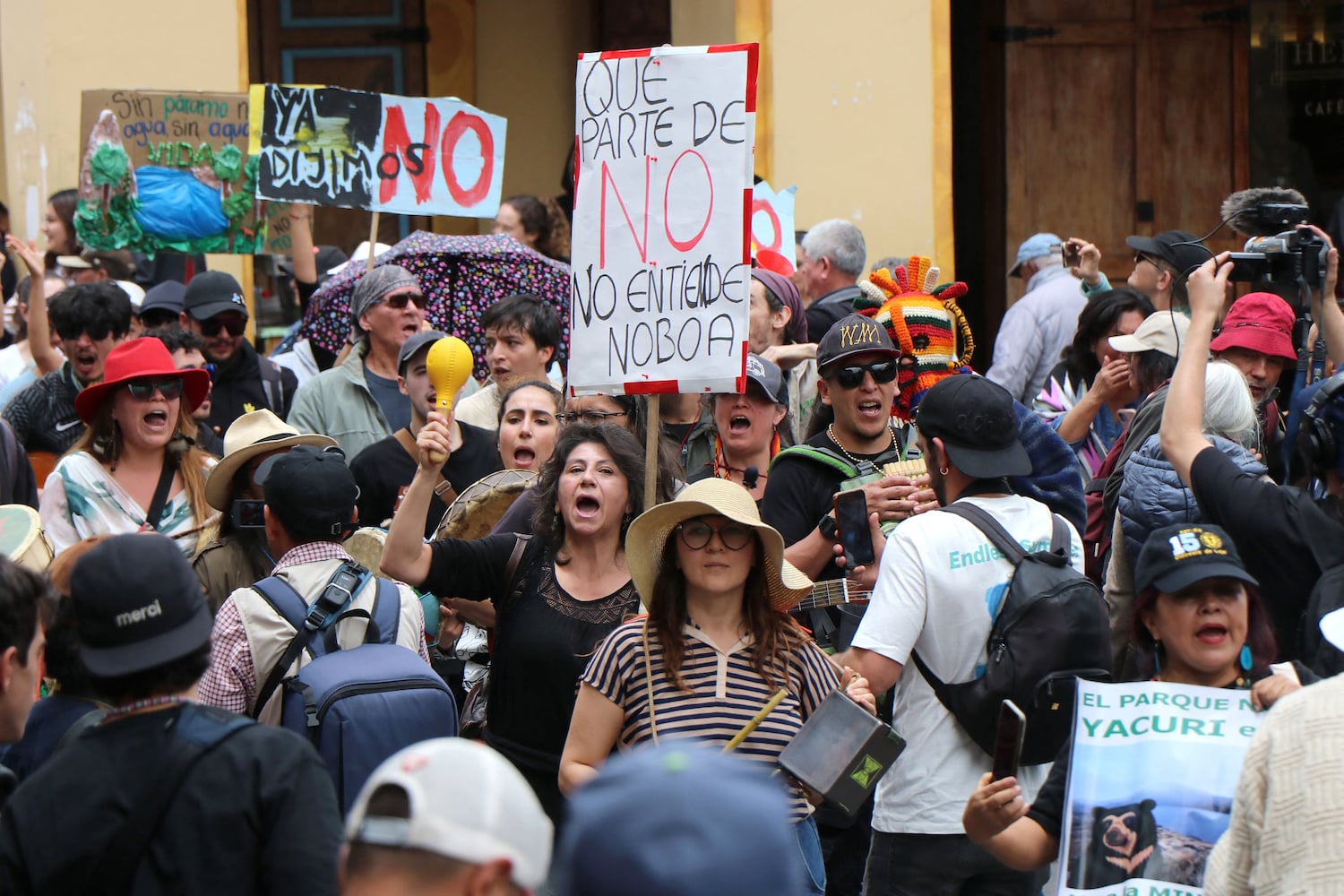
In February, Ecuadorian President Daniel Noboa’s right-wing coalition ushered in the most sweeping reform to the country’s mining rules in nearly two decades. The government tapped the military to protect strategic mining areas, extended mining contracts from 25 years to as long as 40 years, and replaced its rigorous environmental licensing system with an authorization process that allows projects deemed low impact to skip environmental review and citizen consultation. Noboa argued that mining is Ecuador’s ticket out of poverty. The country is home to an estimated $220 billion of untapped mineral wealth—mostly gold, copper, and silver, according to the World Bank. But Ecuador has geochemically mapped just 30 percent of its territory, compared to 77 and 85 percent in neighboring Peru and Colombia, respectively. Ecuador’s two existing industrial mines didn’t begin large-scale extraction until 2019. That is partly due to legal protections: Ecuador enshrined the rights of nature in its 2008 constitution, which requires environmental consultations and consent from affected Indigenous groups before major mining projects can begin. The constitution also allows communities to force referendums that can halt extractive projects. Noboa wants to change that. His government has framed rolling back regulations and militarizing the sector as the path to dismantling illegal mining and bringing sustainable investment to Ecuador. Economists and security experts doubt that his policies can deliver on either front. “There are potentially massive benefits to [mining]. But there are massive costs, too,” said Monica DeBolle, a senior fellow at the Peterson Institute for International Economics. If your objective is to have the benefits outweigh the costs, she said, “it all boils down to governance.” That has been a major issue for Noboa, who observers have accused of executive overreach. Noboa was elected president in 2023. He kicked off his pro-mining agenda the next year, attending the world’s largest mining convention in Canada and leading a delegation that secured investment commitments in Ecuador worth nearly $5 billion from companies in Australia, Canada, and the United Kingdom. After the visit, Noboa used an executive decree to concentrate mining, environmental, security, and financial powers into a single presidential committee. He followed up in 2025 by reopening Ecuador’s mining registry for the first time in seven years and absorbing the Environment Ministry into the Energy and Mining Ministry. That October, Noboa signed another presidential decree, this time barring nonprofits from “obstruction or interfering” with legally authorized mining projects and requiring them to seek ministry approval for any social programs. He ended the year with yet another decree, handing Ecuador’s mining regulator broad control over concessions and royalties, making it easier for mining companies to move into new areas. The last decree laid the groundwork for the February overhaul: a sweeping mining reform that loosened environmental licensing, authorized military control of private concessions, and set the stage for a U.S.-backed crackdown on illegal mining. Throughout his time in office, Noboa has also invoked his fight against organized crime to declare states of emergency that curb civil liberties and expand military control over mining provinces. “No other government—including my own—has ever pushed mining so aggressively,” said Fernando Benalcázar, Ecuador’s former vice minister of mines, who was in office when Ecuador’s two existing large-scale mines—Fruta del Norte and Mirador—came online. Both are in the Amazon rainforest, near the border with Peru. Under Noboa, another six major projects are in various stages of development. Ecuador’s mining sector generated a total of nearly 12,000 direct jobs through the fourth quarter of 2025, and some estimates project that the industry may create another 460,000 direct and indirect positions by 2030. Minerals, which produced a record $4.16 billion in export revenues in 2025, now fall just behind Ecuador’s other top non-oil exports: cacao, bananas, and shrimp. But Noboa’s determination to rewrite Ecuador’s mining landscape has put him on a collision course with the constitutional order. The political opposition has argued that Noboa’s policies have relied on sidelining regulatory institutions and local communities. In the words of legislator Verónica Iñiguez, the president’s agenda “put the rat in charge of guarding the cheese.” Noboa’s mining decrees have not yet faced direct judicial challenges, but Ecuador’s top court has curbed many of his emergency declarations. It has also agreed to hear a challenge to the February mining law brought by Indigenous and community organizations. The plaintiffs argue that the government violated the constitution by failing to consult Indigenous communities, authorizing military activity in ancestral territories, and weakening environmental safeguards. Although they might promote investment in the short term, aggressive tactics like Noboa’s can backfire in the long term, according to analysts. When top-down mining policy meets resistance in the form of legal setbacks and popular opposition, it creates uncertainty that spooks investors. “If there’s one thing that investors hate, that one thing is uncertainty,” DeBolle said. “[Policies] at loggerheads with the country’s constitution—that’s a recipe for uncertainty.” The World Bank likewise emphasizes that strong, transparent, and independent government institutions are critical for resource-rich countries to capture and sustain the benefits of mining. Mounting opposition has already forced Noboa’s government to backtrack on projects that it rushed through. In 2025, the government issued a license for Dundee Precious Metals’ Loma Larga gold-silver-copper mine, despite local resistance and environmental concerns. The site rests atop a fragile ecosystem and a crucial water source, and communities repeatedly voted against mining there. After the rushed approval, local authorities and residents mobilized—filing lawsuits, launching media campaigns, and organizing a “March for Water” with more than 100,000 participants. Noboa’s office announced in late September that it would revoke the mine’s license. The environmental ministry did so a week later. Noboa’s push to fast-track mining permissions isn’t just a bid for investment. Paired with military operations against illegal mines, the government also casts approved mining projects as a security tool to weaken organized crime groups, which have pushed into the illegal mining sector over the past decade. By 2024, illegal mining was estimated to generate up to $1 billion a year for criminal groups in Ecuador. In March, Noboa announced that Ecuador and the United States would increase their cooperation to fight illegal mining and drug trafficking. By October, Ecuador’s military said that it had destroyed more than 1,000 illegal mining camps so far this year. Authorities have not released official casualty figures, but according to local reporting, there have been at least three deaths and many more injuries in these operations. Luis Córdova Alarcón, who heads a program on conflict and violence at the Central University of Ecuador, said that the logic at the heart of Noboa’s policy is backward. “Legal mining isn’t the opposite of illegal mining. It is its partner in crime,” he said. Córdova, who described the militarized approach as a “smokescreen,” pointed to illegal extraction within legally granted mining concessions, including arrangements in which concession holders rent access to illegal miners. He also highlighted the formal sector’s role in laundering illegal gold and the direct involvement of corrupt figures in the criminal economy. His conclusions are backed by the United Nations Office of Drugs and Crime (UNODC), which recently published a report concluding that legally registered corporations can “become involved in illegal mining in different ways,” including infiltration by organized crime groups. Multinational companies bring their own risks, including corruption, tax evasion, weak ownership transparency, and community conflict, said Julia Yansura, the program director for environmental crime and illicit finance at the FACT Coalition, a Washington-based financial-transparency advocacy group. “I think some governments can’t accept or don’t see risk with these big mining companies. It’s like they’re totally blind to it,” she said. Easing regulation may open the door to more opaque foreign companies and weaker safeguards, according to Yansura. Militarized crackdowns ignore this sort of illegal mining, targeting small-scale and informal operations tied to organized crime. Yet even when it comes to informal small-scale mining, research has shown militarized approaches to be ineffective in the long run. Authorities “blow up machinery, harass local people, and then leave,” Yansura said. “That doesn’t actually solve the problem.” In fact, such operations can push miners deeper into illegality, undermine trust in public authorities, and fuel conflict and corruption. For governments to curb illegal mining and undermine organized crime, UNODC recommends increasing regulation rather than relaxing it, holding big corporations criminally responsible for participating in or facilitating illegal mining activity, and empowering affected communities through democratic engagement. Noboa is failing on that last front. His mining policies are part of a broader centralization of power that has weakened Ecuador’s democracy. Under the guise of combating illegal mining, Noboa’s administration has pushed through legislation that expands his emergency powers, reduces restrictions on using lethal force against civilians, increases state surveillance, centralizes executive control over protected areas, and targets financing for environmental nongovernmental organization. Indigenous groups, human rights advocates, and environmental defenders say that Noboa’s administration has used these laws to go after individuals who oppose his mining policies. They point to recent criminal charges against water defenders, the violent police dispersal of anti-mining protests in the capital of Quito in February, and the conviction of at least 15 anti-mining protesters on criminal charges throughout the course of this year. “Quite simply, what the Ecuadorian government is doing is rolling back rights and eroding the institutions meant to protect them,” Iñiguez said. In August 2025, when Ecuador’s highest court challenged the constitutionality of some of the new laws, Noboa led a march on the court, and senior members of his administration called judges “enemies of the citizenry,” alarming observers. He defended the suspended security measures and his efforts to pressure Ecuadorian institutions as necessary to combat criminal gangs, telling a crowd at the march that “[w]e are here to pursue justice and peace.” A month later, when Ecuador’s powerful Indigenous movement CONAIE declared a nationwide strike triggered by the end of fuel subsidies, Noboa deployed the military to break up roadblocks, resulting in at least three civilian deaths, and vowed to prosecute protest leaders for terrorism under a new statute. In October 2025, CONAIE called off the strike, citing fear of government violence. Noboa’s aggressive approach initially appeared popular with a public preoccupied with crime. But that changed on Nov. 16, 2025, when Ecuadorians went to the polls to vote in a national referendum. In a surprise upset, Noboa lost all four questions that would have further concentrated power in the executive. The biggest rebuke was to his proposal to convene a constituent assembly: Voters rejected rewriting Ecuador’s environmentally protective constitution. Continuing to push through mining policy at odds with Ecuador’s constitution may turn out to be Noboa’s Achilles heel. Polling showed a sharp decline in the president’s approval ratings in the first half of this year compared to 2025. “The decline stems directly from his failure to respect the mandate of the ballot box,” Iñiguez said.
Ecuador’s Fraught Mining Boom
Full Article
Original Source
Read the full article at Foreignpolicy →KhanList aggregates and links to publicly available news content. We do not host full articles from third-party sources. Always verify important information with original sources.