
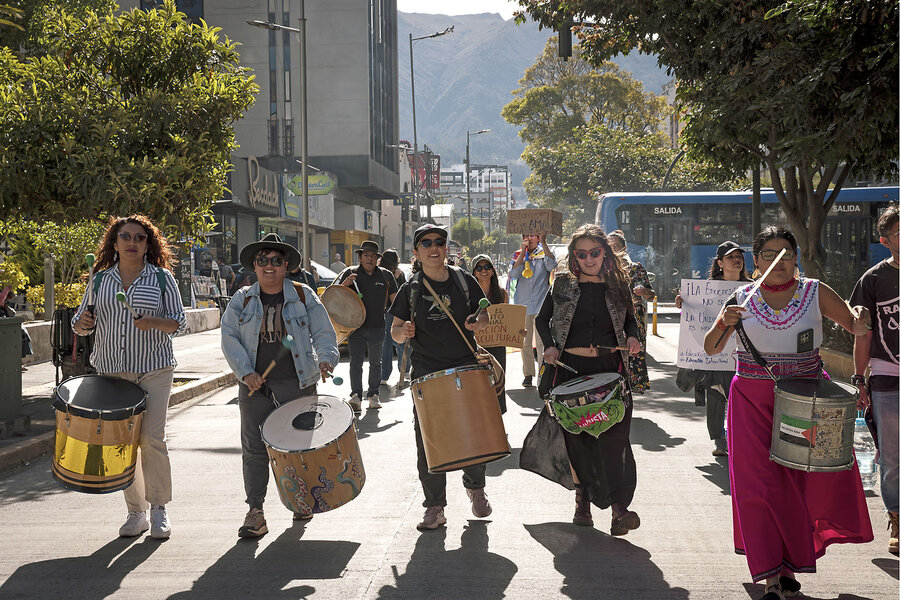
On a sunny afternoon in Ecuador’s capital, just weeks before the new school year is set to begin, a group of mostly first-generation university students is on the streets banging drums, waving hand-painted signs, and calling for government action.They’re worried they won’t have a school to return to when classes start Oct. 12.In the early 2000s, Ecuador opened its first public intercultural university, created after decades of demands from Indigenous groups who felt their history, language, and traditions were missing from the education system here. The school offers classroom and hands-on field courses steeped in Indigenous, Afro-Ecuadorian, and minority history and culture. It launched at a moment when leadership across Latin America was swinging to the political left, putting an emphasis on pluralism and Indigenous rights. But today, the Universidad Intercultural de la Nacionalidades y Pueblos Indigenas, known as Amawtay Wasi, is under threat. The school of about 2,200 students – most of them low-income, female, and Indigenous – has had its budget slashed by nearly 70% this year. Its funding dropped from $12.2 million to $3.79 million, making it Ecuador’s public university with the fewest resources.The move, which also included staff terminations, underscores a broader shift in Ecuadorian society, at a time when many governments in the region are moving to the political right, away from heralding social inclusion. In Ecuador, right-wing President Daniel Noboa has had increasingly tense relations with Indigenous organizations. That includes friction over economic policy and the extraction of oil in protected natural areas that are home to several Indigenous groups. Karen Toro/Special to The Christian Science MonitorThe facade of Amawtay Wasi is pictured during a protest against state budget cuts, in Quito, Ecuador, Aug. 12, 2026. The school’s precarious status highlights how fleeting social gains can be, and how easily they can be rolled back. Ecuador has a constitution that defines it as a plurinational, intercultural state, and yet the crisis at Amawtay Wasi suggests the nation is still reluctant to recognize Indigenous peoples’ authority to shape their own model of higher education, experts say.“It is a matter of social justice,” says Luis Andrés Padilla Suárez, a former researcher at the university’s Center for African and Afro-American Studies.“The power of knowledge”Ecuador’s intercultural education movement can be traced to Kichwa leader Dolores Cacuango. In the 1940s, she launched schools where children were taught primarily in Kichwa – and which operated in secret for more than two decades. At a time when Indigenous people were pushed to the edges of society, she saw education in one’s own language as a tool for emancipation. “Mama Dolores Cacuango ... understood the power of knowledge,” says Ercilia Castañeda, a Kichwa Otavalo leader and vice president of the Confederation of Indigenous Nationalities of Ecuador (CONAIE).Cacuango’s work inspired other initiatives, and her legacy became part of the broader push for Indigenous educational autonomy. In the late 1980s, CONAIE, through an agreement with Ecuador’s Education Ministry, helped create the National Directorate of Intercultural Bilingual Education. The group spent years negotiating with successive governments before Amawtay Wasi was founded in 2004. Karen Toro/Special to The Christian Science MonitorErcilia Castañeda, vice president of the Confederation of Indigenous Nationalities of Ecuador, in Quito, Ecuador, Aug. 13, 2026. Indigenous rights were enshrined in Ecuador’s 2008 constitution. Today, Spanish, Kichwa, and Shuar are all recognized as official Ecuadorian languages. Some 14 Indigenous nationalities are recognized by the state.A university built from the perspective of Indigenous people has meant access to “a space for critical thinking, where knowledge can be recovered and strengthened,” says Ms. Castañeda, who also studies law. The school stands out for its unusual academic offerings like “ancestral knowledge in intercultural and community foodways” and “community water management.”That struggle for inclusion, recognition of past wrongs, and the value of Indigenous practices extends around the globe, from Canada to New Zealand to Sweden. The 2015 final report of a Canadian Truth and Reconciliation Commission on residential-school abuses called for a greater integration of Indigenous knowledge into postsecondary institutions there, similar to what Amawtay Wasi has tried to accomplish over the past two decades.But inclusion must go beyond classroom content, says Kahente Horn-Miller, a Kanien:keha’ka (Mohawk) member of the Bear Clan and a professor of Indigenous Studies at Carleton University in Ottawa, Ontario. “It’s about helping people to understand who we are, where we come from, what our knowledge is, and how we can share that and work with us, alongside us as allies,” she says. The budget cuts at Amawtay Wasi forced the school to lay off dozens of teaching and administrative staff members last spring. Then, in July, Ecuador’s higher education authority, the Consejo de Educación Superior, moved to replace top university officials, appointing a special commission to oversee the school for a 90-day intervention. The CES cited a failure to comply with legal and institutional regulations, alongside academic and financial irregularities. Its investigation also said it found an atmosphere of “growing conflict” within the school.The intervention has drawn criticism from civil society and human rights organizations, which say the collective rights of Indigenous people and their constitutionally protected right to their own forms of education are at threat. Once the CES was in control, another $2 million in funding was granted to the school, underscoring for critics the idea that pushing out staff from Indigenous and minority backgrounds was the government’s end goal. Karen Toro/Special to The Christian Science MonitorJohn Tipantuña, a graduate of the language and culture program at Amawtay Wasi, is pictured during a protest in Quito, Ecuador, Aug. 12, 2026. Teaching othersSheltering from the blazing sun at Quito’s Casa de la Cultura Ecuatoriana, John Tipantuña, a Kichwa Panzaleo Indigenous student, says Amawtay Wasi has uniquely prepared him for his career. He mastered the Kichwa language, studied community development, and took courses like “community challenges,” which sends students out of the classroom to work directly with Indigenous communities.Ms. Castañeda, the CONAIE vice president, fears that Amawtay Wasi’s current crisis could jeopardize learning experiences like these, which teach students to understand and value other ways of solving problems, relating to nature, and administering justice, she says. “We are returning to a homogenized culture, where this diversity of knowledge is not recognized,” she warns.By early September, the state’s temporary commission informed students that Amawtay Wasi could continue operating this semester. Though there is a sense of relief, students say they fear the school under new leadership is no longer the institution they enrolled in.Student groups are petitioning the CES to maintain the school’s traditional hiring practices, where the teaching staff isn’t chosen based only on academic credentials, but also on lived experience. Deepen your worldviewwith Monitor Highlights.Politics with respectGet political stories with respectful analysis.There‘s a world of new ideas in everyBooks newsletter.There‘s more to life, enrich yours withCulture & Learning weekly.Follow humanity‘s discoveries withScience & Nature stories in your inbox.Gain a spiritual perspectivefrom the stories in your inbox.Want to understand the deeper impact of critical events? Learn the Monitor‘s insight.Already a subscriber? Log in to hide ads. Mr. Tipantuña worries about the future of the Kapak Ñan Collective, a project he founded with fellow students in his “community challenges” course. For the past five years, it has worked to preserve an ancient Andean network of roads, bridges, and trails that are still used by local communities.“Without this university, we would stop going to the communities,” Mr. Tipantuña says. But, it’s there, in the field, “where we nourish ourselves so that we can also teach others what we have learned.” ALREADY A SUBSCRIBER? LoginReal news can be honest, hopeful, credible, constructive.The Christian Science Monitor was founded in 1908 to lift the standard of journalism and uplift humanity. We aim to “speak the truth in love.” Our goal is not to tell you what to think, but to give you the essential knowledge and understanding to come to your own intelligent conclusions. Join us in this mission by subscribing.
Ecuador created a landmark university focused on Indigenous culture. Why is it now at risk?
Full Article
Original Source
Read the full article at Csmonitor →KhanList aggregates and links to publicly available news content. We do not host full articles from third-party sources. Always verify important information with original sources.