
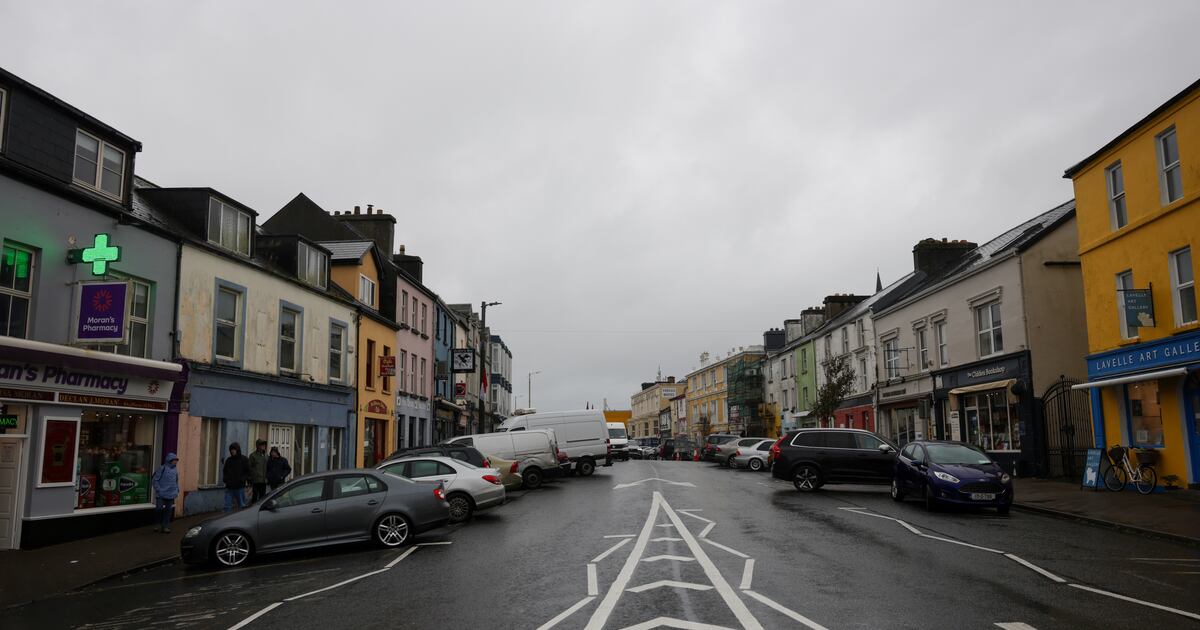
It’s mid-afternoon, midweek, mid-October and Clifden, Co Galway, is quiet. A temporary mural, titled Welcome, by award-winning artist James Kirwan, commissioned for Clifden Arts Festival, is still visible on the Town Hall on Sky Road. That wall painting, and colourful bunting that flaps in the autumn wind blowing through Market Square, are the only visual reminders of the festival that attracted thousands of tourists to the town over 10 days taking in the two final weekends of September. Since then, the capital of Connemara, like seasonal tourist towns right across Ireland, has been hurtling towards hibernation. READ MOREA large “Dúnta/Closed” sign hangs in the window of the Clifden Tourist Information Centre on Galway Road. It won’t reopen until June 2027. A number of seafood restaurants have shut for the season, too. “Once arts week ends in Clifden it gets very quiet, very fast. There’s a big bang on the Saturday night of arts week and then by Monday the town is just dead,” says Lisa King, manager of King’s Paper and Gift Shop. Almost proving her wrong, a family of six French speakers searching for sweets, squeeze into the shop owned by her mother, Joan. “Surprising,” says King, adding there are “a few [tourists] around today” but “yesterday was dead. It was painful.” Mother and daughter Joan and Lisa King run King's Paper and Gift Shop on the Main Street. Photograph: Enda O'Dowd Outside on Main Street, the visitors – or “strangers”, as Clifden locals affectionately call them – that throng the streets in summer are outnumbered by residents going about their business. On Bridge Street, an elderly German-speaking couple have no problem finding parking for their electric hire car. They look on curiously at two burly, bearded Connemara men across the road erecting a red-and-white flag on an electricity pole ahead of the local GAA club’s appearance in a county minor final – a healthy sign there are enough youngsters around to sustain a Gaelic football team at a high level. Farther along, on Market Street, an American, or possibly Canadian, customer’s voice can be heard chatting inside Love Vintage, a quirky clothes store run by mother-and-daughter duo, owner Carol Anne Joyce and manager Emma O’Sullivan. “We are all absolutely exhausted after the summer. There are about six weeks when it’s mad in July and August,” says Joyce, who exudes positive energy. O’Sullivan agrees with King’s analysis that the arts festival marks the “last hurrah” for many Clifden businesses until December, but her mother says she’s “not sure the season ends any more”. Carol Anne Joyce and her daughter, Emma O'Sullivan, at Love Vintage on Market Street. Photograph: Enda O'Dowd They close their clothing and jewellery shop when schools return early in the new year, but according to Joyce, “even in January, you could open, particularly at weekends”. They used to shut for at least six weeks until St Valentine’s Day but a new bank holiday in early February to celebrate St Brigid means their off-season is truncated. “Bloody Bridget! I mean I love Bridget, but feck her, she’s put the kibosh on the holiday,” says King, laughing. King is a Clifden native. Her mother was from Inishbofin; her father, from Clifden, ran a local grocer’s and supermarket. [ ‘It is so important to support smaller shops’: west coast villages count on loyal locals at ChristmasOpens in new window ]She opened Love Vintage 17 years ago after becoming “fed up” of the drudgery of working in “high fashion, forward ordering” in France and Copenhagen.Clifden sees a dramatic fall in visitors from summer to winter. Photograph: Enda O'Dowd It’s her 13th shop and it has its origins in good luck. “I won €35,000 on Spin the Wheel,” she says, referring to an appearance on the National Lottery’s former TV gameshow Winning Streak thanks to a scratch card. She invested the winnings into Love Vintage, which started as a pop-up during Connemara Pony Show in August 2009. O’Sullivan says Americans are big spenders. Joyce says Irish visitors give repeat business. She senses visitors to west Connemara have an “appreciation of wildlife, a quieter and more authentic way”. This, she says, attracted well-known people such as actor Peter O’Toole, Sting, U2 and Bill Whelan of Riverdance to the area. “There are very unusual shops in Clifden, like my own, that buy out of the ordinary and don’t present the same as the cities or mass produced. “We’ve always been a bit mad in Clifden,” she adds. “It’s a funky town; a lot of that is because we are so far out. The thing about a small town like this is you don’t pass through it. We are the end. The sea is next. New York is over there.” Clifden is a coastal market town about 80km west of Galway city. Founded more than 200 years ago by John D’Arcy – of one of the famous merchant families or 14 tribes of Galway – it has a rich history that attracts cultural visitors. Clifden “townie” Eileen Mannion, a county councillor, describes her hometown as “vibrant, resilient and welcoming”. She says the town has upped its game in trying to attract tourists in off-season. Christmas in Clifden, launched one year by Ryan Tubridy – who has a soft spot for and familial connection to the town – provides a boost over three winter weekends. The county council’s planned public realm enhancement project is also geared towards improving amenities that can be enjoyed year-round. A planned redesign of the town centre and Market Square, which proved controversial due to a planned reduction in parking spaces, has been put off in favour of focusing on securing national funding for improvements at Beach Road Quay and Harbour Park. The Fine Gael councillor hopes work can start in 2028 to deliver an amphitheatre performance space, climbing wall, picnic area and other sports facilities. “It will enhance the area for locals and tourists and provide an amenity park, which we don’t have at present,” she says. Clifden is well known for the Connemara pony; Alcock and Brown, pilots who made the first nonstop transatlantic flight, from North America to Europe, in 1919; the Marconi radio transmission site that sent the first transatlantic wireless message 12 years earlier; and Richard Martin or “Humanity Dick”, a 19th-century MP and animal rights activist. “Clifden has a great story to tell, and every night before dinner, we tell that story with pride, vim and vigour,” says Brian Hughes, manager of the family-run Abbeyglen Castle Hotel. Froda the parrot keeps a watchful eye over guests in the lobby of Abbeyglen Castle Hotel. Photograph: Enda O'Dowd The genial, piano-playing host recites Clifden’s story in his hotel bar, where he vies for customers’ attention with Froda, a resident parrot, who lives in a cage in the lobby next to an open turf fire. The seven-year-old bird, who speaks intermittently – “see you later”, “goodbye” – recently started imitating meowing cats to bemused guests in the foyer. “It’s about character, atmosphere and charm – and the application of common sense,” says Hughes as he explains the attraction of the hotel. Renowned for its warm hospitality and entertainment, it’s not unusual for the likes of Irish singer Eleanor Shanley to give impromptu renditions of Hard Times or Maggie before or after dinner. [ Family shops in Mayo on their challenges: ‘At one point council rates were almost €20,000 a year’Opens in new window ]“Our leisure centre is the piano in the bar, and the atmosphere in the diningroom. We create an atmosphere and product you won’t find anywhere else in Ireland or the world – it is unique,” says Hughes. Fáilte Ireland, the national tourism agency, published a Business of Tourism Report in July, which highlighted that overseas tourists spent €5.7 billion in Ireland in 2025. It showed that overseas tourism was seasonal, with more than two-fifths of visitors arriving between June and September. Domestic demand – worth €3.6 billion – “was more evenly spread”, with 69 per cent of short trips taking place outside the summer peak. A tourist at Clifden Castle. Photograph: Enda O'Dowd Those figures are broadly reflected in the bottom line of hotels such as Abbeyglen. In peak season, “we make our living by selling beds primarily to Americans who stay one night, and one night only, and they never come back again”, says Hughes. Off peak they focus on the home market, luring customers mostly from Galway city and Dublin with special offers, including dinner, B&B and golf at Connemara Golf Club. They don’t make profit from off-season visitors, but it means they can remain open for most of the year and employ about 75 staff. “A good hotel is always about a culture. To maintain that culture, you have to keep the team with you the whole year,” he says. “You can’t expect people to come in, work very hard for nine weeks in July and August, and then let them go. We keep people here all the time and we look after them.” This theme is touched on by another Clifden businessman, Declan Mannion, who closes in January allowing international staff to return home. Opening the doors of Mannion’s Seafood Bar and Restaurant on Market Street on rainy Monday nights in November “erodes the bottom line” but “you have to be loyal to the staff”, he says. “Economically, it probably would make sense to close. But staff are loyal to you in the busy times, and you have to be loyal to them in the quiet times,” says Mannion. The Abbeyglen closes for a period in January, too. When their regular staff take leave, an army of about 40 tradespeople replace them and focus on renovations. “We plan that work and book our tradesmen in September,” says Hughes. Americans travelled later than usual this year, he says, but they were replaced in summer by so-called “coolcation” European visitors. “In July and August, we had a lot of very well-heeled Europeans who left France, Germany, Holland and Italy to avoid very hot weather on mainland Europe.”Declan Mannion of Mannion's Seafood Bar and Restaurant on Market Street. Photograph: Enda O'Dowd Mannion’s restaurant is a family business, which opened in 1930. Like many old-school Irish retailers, it was previously a butcher’s and grocer’s that happened to have a bar. Nowadays it makes its money from selling quality meats and fish, such as lamb cutlets, T-bone steaks and scallops, to hungry – but not necessarily thirsty – tourists. “Turnover is 80 per cent food. Drink sales are decreasing as a percentage of overall turnover every year,” says Mannion. “Turnover is going up but the drink element of turnover is going down.” It is popular with Irish visitors but he says they would “be goosed” without North Americans, who account for about 25 per cent of custom. “[Americans’] pain threshold is higher,” he says. “Continental Europeans don’t think we are good value. They don’t think we are bad value, but they wouldn’t classify us as cheap. The Americans think we are still good value.” [ ‘We can’t afford to live here’: Westport housing crisis leaves no room for locals as homeowners turn to AirbnbOpens in new window ]Small retailers such as King’s Paper and Gift Shop rely on locals, although “tourists do help, and having a few busy months in summer helps us get through the winter”, says Lisa King, who first started working in the shop 26 years ago, aged 14. She appreciates the locals who sustain the family business she operates with her mother, and brother Declan, during lean winter months. To entice them into their treasure trove of toys, gifts, stationery and sweets, during off-peak days in October, they’ve already opened a “Christmas shop” to the rear of the building. It’s subtle, for now. But once Halloween is over, “the Christmas shop explodes into the rest of the shop, and it will be everywhere”, she says. “We’ve been so busy in there,” she adds. “We have great bargains. Some local people are very big into Christmas and the bargains in there are helping during this quiet month to get money in for new stock. “Our suppliers tell us that our type of small family-run shop is a dying breed in towns around the country. So, our locals are the only reason we are still here.” Clifden is not a backpack or stag-party destination, and its visitors are “more well-heeled, more discerning”, due to the presence of unique, quality hotels in Connemara such as Ashford Castle and Ballynahinch Caste, Mannion says. As well as rising business costs, he fears succession is threatening seasonal tourist towns such as Clifden, where many businesses are family owned and independent. “That’s coming under pressure because we are all around the same age, and there’s going to be a challenge as to whether the next generation are willing to do this,” he says. “I’m not sure they will. It’s a lot easier to make money sitting at a desk than it is in hospitality.” After the Sun, a series about how tourist places cope when the holiday season ends, continues next week with Andrew Hamilton in Inis Mór; Sorcha Crowley in Bundoran, Co Donegal; and Noel Baker in Glengarriff, west Cork
‘Economically it probably would make sense to close’: Clifden businesses prepare for barren winter
Full Article
Original Source
Read the full article at Irishtimes →KhanList aggregates and links to publicly available news content. We do not host full articles from third-party sources. Always verify important information with original sources.