
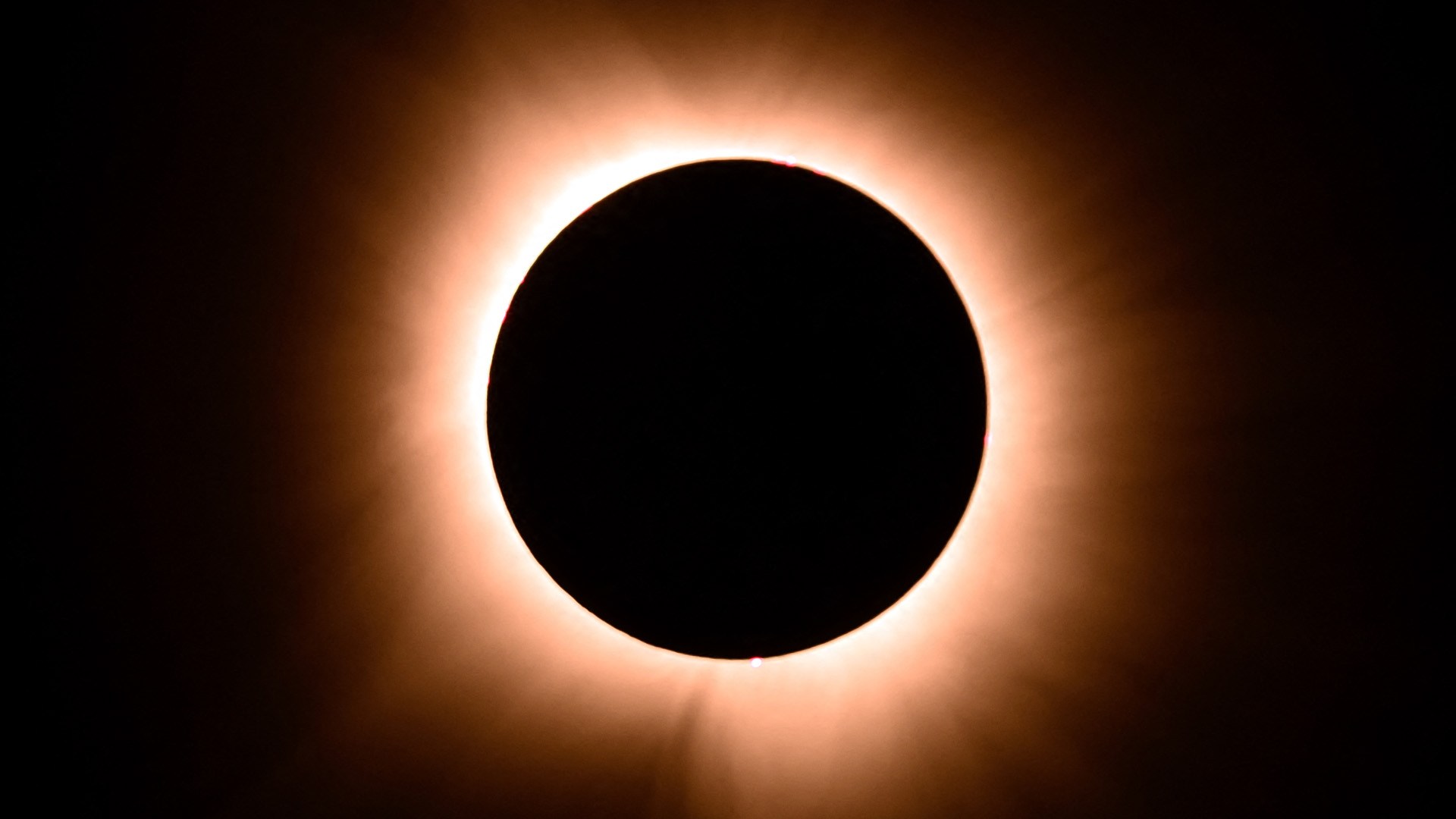
EYES to the skies, stargazers! There are three total solar eclipses coming up in as many years – including one in August 2026 and a truly spectacular event in 2027. We’re not far from what some call the “eclipse of the century”, and millions of people around the world will get a chance to see it. This is the 2024 total solar eclipse as seen from Arlington, Texas in the USA Credit: AP This 2024 total solar eclipse image was snapped on April 8 in Bloomington, Indiana Credit: AFP The latest total solar eclipse to grace Earth‘s skies was back in April 2024, and the next is due on August 12, 2026. Skywatchers in the USA, Canada, and Mexico were able to see the stunning space spectacle – although Brits haven’t caught one since August 1999. Sign up for the Tech newsletter Thank you! So if you want another chance to see one soon, we’ll reveal exactly where you need to be. WHAT IS A TOTAL SOLAR ECLIPSE? Solar eclipses happen when the Moon moves between the Sun and Earth. It puts the Earth in the Moon’s shadow – but because the Moon is quite small, the shadow only affects specific regions of our planet at any one time. The best type of eclipse is a total solar eclipse. That’s when the Moon completely covers the Sun for observers who are watching from the umbra – the darkest part of the shadow. Sometimes, the Moon, Sun, and Earth don’t line up perfectly, so only part of our star is covered. Most read in Tech That’s called a partial solar eclipse, because only a section of the Sun is blocked by the Moon. They’re a stunning sight, but pose serious danger: you must never look at a partial solar eclipse with the naked eye. And during a total solar eclipse, the only period where it can be safe to view the event without protective glasses is during the totality (when the Sun is totally covered) which only lasts for a few minutes. Using regular sunglasses isn’t safe for viewing: you need approved solar glasses that give your eyes enough protection. If you stare at the Sun, even during a significant partial eclipse or outside of the totality in a total eclipse, you risk permanent eye damage. WHEN ARE THE NEXT TOTAL SOLAR ECLIPSES? There are several eclipses coming up to look out for. The next total solar eclipse is on August 12, 2026. To see that one properly, you’ll need to be on the Balearic Islands or in the middle of Spain, or along a curved arc that then runs over the Atlantic Ocean up the west of Iceland, and then the east of Greenland The 2026 eclipse will sweep to the left of the UK Credit: US National Science Foundation National Solar Observatory / OpenStreetMap / The Sun Your best bet for a full view is to head to Spain In the UK, you’ll still get a show, but sadly it won’t be a total eclipse. Instead it should be a major partial eclipse, covering about 90% (and even 96% in the southwest of England) of the Sun, giving it a wondrous ultra-thin crescent appearance. ECLIPSE TIMINGS – WHEN AND WHERE TO SEE IT The BBC‘s Sky at Night Magazine made a handy chart for the August 2026 eclipse, complete with locations, timings and coverage: Valencia, Spain – total eclipse – 8.33pm CEST – 100% coverage Bilbao, Spain – total eclipse – 8.27pm CEST – 100% coverage Zaragoza, Spain – total eclipse – 8.29pm CEST – 100% coverage Valladolid, Spain – total eclipse – 8.30pm CEST – 100% coverage Madrid, Spain – partial eclipse – 8.31pm CEST – 99.97% coverage Barcelona, Spain – partial eclipse – 8.29pm CEST – 99.8% coverage Bragança, Portugal – partial eclipse – 7.30pm WEST – 99.9% coverage Lisbon, Portugal – partial eclipse – 7.36pm WEST – 94.5% coverage Porto, Portugal – partial eclipse – 7.32pm WEST – 98.2% coverage London, UK – partial eclipse – 7.13pm BST – 91.3% coverage Cardiff, UK – partial eclipse – 7.13pm BST – 93% coverage Edinburgh, UK – partial eclipse – 7.05pm BST – 91% coverage Belfast, UK – partial eclipse – 7.08pm BST – 93% coverage Dublin, Ireland – partial eclipse – 7.10pm IST – 94% coverage New York, NY, USA – partial eclipse – 1.54pm EDT – 9.5% coverage Boston, MA, USA – partial eclipse – 1.55pm EDT – 16% coverage Chicago, IL, USA – partial eclipse – 12.28pm CDT – 0.1% coverage Anchorage, AK, USA – partial eclipse – 8.21am AKDT – 27.9% coverage St John’s, NL, Canada – partial eclipse – 3.35pm NDT – 53.2% coverage Montreal, QC, Canada – partial eclipse – 1.45pm EDT – 18% coverage Winnipeg, MB, Canada – partial eclipse – 12.02pm CDT – 5.4% coverage Source: Sky At Night Top 9 UK locations to view solar eclipse Try to make it to one of these scenic viewing spots... Hugh Town Land’s End Galloway Forest Dark Sky Park Giant’s Causeway Llŷn Peninsula Strumble Head – pictured above Rhossili Bay Exmoor Dark Sky Reserve Boscastle Next up is the August 2, 2027 eclipse, which follows a very different route. For this one, you’ll want to be in North Africa (think Egypt, Morocco, Tunisia), or the very south of Spain. It’ll also be visible in Saudi Arabia, if you happen to be in the area. The 2027 eclipse crosses a huge swath of North Africa Credit: US National Science Foundation National Solar Observatory / OpenStreetMap / The Sun This eclipse will also be visible from the UK, but only partially. “The partial eclipse will begin around 9am BST in London,” said the Royal Observatory Greenwich. “It will reach maximum at 10am and end around 11am. “At maximum roughly 45% of the Sun will be in shadow.” The third eclipse is expected to take place on July 22, 2028. To get this one as a total eclipse, you’ll need to be down in Australia or New Zealand – and the surrounding islands. The 2028 eclipse runs right across Australia, bringing the spectacle back to Sydney for the first time in over 170 years But lots of areas will see a partial solar eclipse, including much of south, southeast and east Asia. It’s a big deal, as Sydney hasn’t had a total solar eclipse since March 26, 1857. Sadly, the next total solar eclipse due over the UK isn’t due until September 23, 2090. WHAT IS THE ‘ECLIPSE OF THE CENTURY’? The “eclipse of the century” is the one taking place on August 2, 2027. That’s because the Moon is close to its nearest point to Earth for this eclipse. What’s special is that it’ll have the longest totality over land for the 21st century. The best spot will be about 37 miles southeast of Luxor in Egypt. If you’re there, you should see a totality lasting for six minutes and 22 seconds. Sign up for The Sun Tech newsletter for gadgets, games & more Hello! I'm Sean Keach, The Sun's Head of Technology and Science I’ve been writing about gadgets, games and the future of technology for more than a decade. During that time I’ve penned thousands of articles, filmed hundreds of videos, talked tech on TV and radio, and travelled around the world to bring you the latest on Apple, Meta, Google, Amazon, Netflix and more. And I’ve got a weekly newsletter called The Sun Tech that you can read for free every Thursday. Sign up here I bring you the latest from the world of tech, including behind-the-scenes action, exclusive content, expert analysis, and plenty of help advice – so please follow along! It was technically beaten in 2009 by an eclipse totality that lasts for six minutes and 39.5 seconds, but that was over the Pacific Ocean. And during the same eclipse, the longest point on land was over North Iwo Jima, which is uninhabited. We won’t see a longer totality for a solar eclipse over easily accessible land until June 3, 2114.
‘Eclipse of the CENTURY’ on its way as astronomers reveal when & where to see next three total solar eclipses
Full Article
Original Source
Read the full article at Thesun →KhanList aggregates and links to publicly available news content. We do not host full articles from third-party sources. Always verify important information with original sources.