
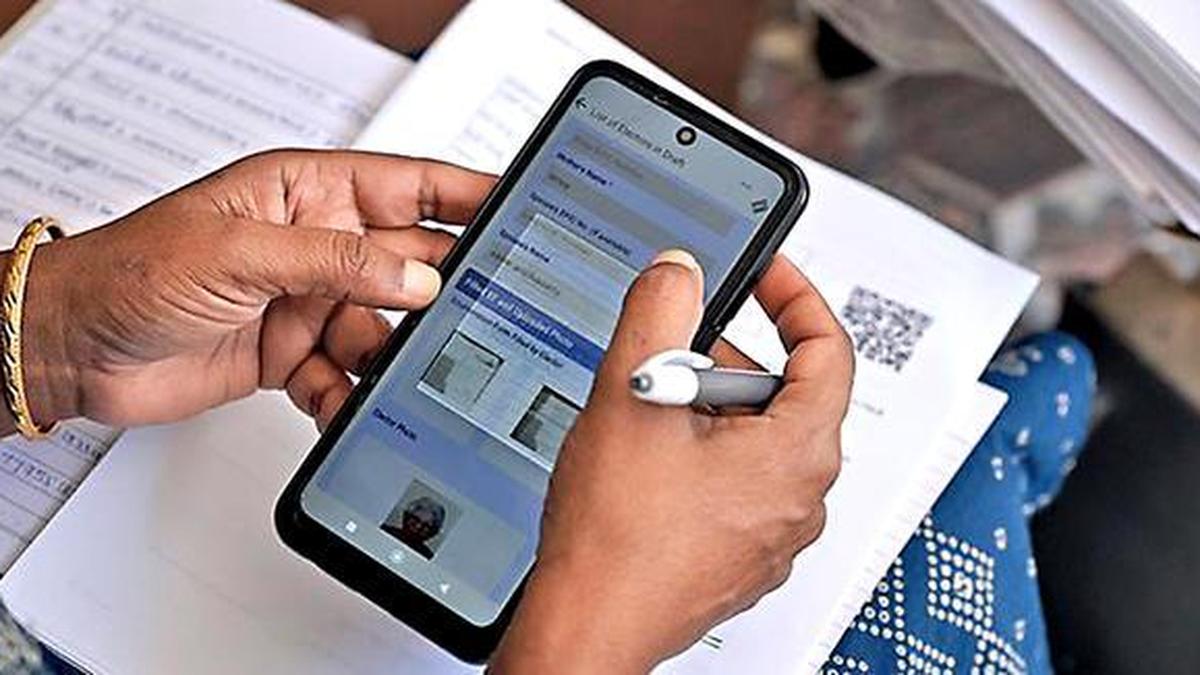
The ECI has directed Electoral Registration Officers to make special efforts to identify eligible people who have not enrolled. | Photo Credit: File Photo The Election Commission of India (ECI) has ordered a Special Summary Revision (SSR) of electoral rolls in Karnataka and Meghalaya, with January 1, 2027, as the qualifying date, to facilitate the enrolment of “left out”, young and first-time voters.According to the schedule issued by the ECI on Monday, the integrated draft electoral rolls will be published on December 1, and people can file claims and objections until December 31. The final electoral rolls will be published on January 20, 2027.The SSR will allow advance applications from those who will turn 18 on April 1, July 1 and October 1, 2027. Applications from people eligible to vote by January 1, 2027, will be processed during the current revision. Those applying in advance on the basis of the three subsequent qualifying dates will have their applications processed in the respective quarters in 2027, and the names will be part of respective supplementary list.The SSR was skipped in 2026 as the ECI undertook the Special Intensive Revision (SIR). The SIR resulted in the deletion of more than 99 lakh names from Karnataka’s final electoral rolls.The commission has directed Electoral Registration Officers (EROs) to make special efforts to identify eligible people who have not enrolled.SafeguardsThe commission has laid down specific safeguards for deleting names from electoral rolls. Where deletions exceed 2% of the total electors in a polling station, or where the same person has filed objections in more than five cases, the ERO must personally cross-check the cases.In cases involving multiple or duplicate entries reported by citizens, Booth Level Agents (BLAs) or residents’ welfare associations, the Booth Level Officer (BLO) must conduct field verification in every instance. Confirmed cases of duplicate entries, permanent shifting and death can be removed only after a Form 7 application is received from the elector or, in the case of a deceased person, a near relative or family member.For deletion of the name of a deceased person, Form 7 from any elector in the Assembly constituency is sufficient. In its absence, the ERO can proceed on the basis of a written field report from the BLO. The commission has also directed district election officers to regularly obtain information on deaths from local bodies and the Registrar of Births and Deaths. The ERO must pass a reasoned order in every deletion case, give the affected person an opportunity to be heard and upload the order on the ECINET platform, the commission said.The commission has also reiterated that an Aadhaar number is voluntary while applying for inclusion or correction of electoral roll entries. No application for inclusion can be rejected, and no existing entry deleted, because an individual is unable to furnish an Aadhaar number.Focus on gaps in enrolment The ECI has directed EROs, District Election Officers (DEOs) and CEO to analyse electoral roll data to identify gaps in enrolment. The analysis must examine the ratio of electors to the population, gender ratio, and age-group distribution, with particular attention to the 18–19 age group, as well as unusual increases or decreases in the number of electors in specific areas. The ECI has also asked CEOs to establish sufficient help desks at the district or Assembly constituency level, particularly to assist migrants, vulnerable groups and marginalised people with enrolment. Published - November 16, 2026 07:38 pm IST
ECI orders Special Summary Revision of electoral rolls in Karnataka; final rolls to be published on January 20
Full Article
Original Source
Read the full article at Thehindu →KhanList aggregates and links to publicly available news content. We do not host full articles from third-party sources. Always verify important information with original sources.