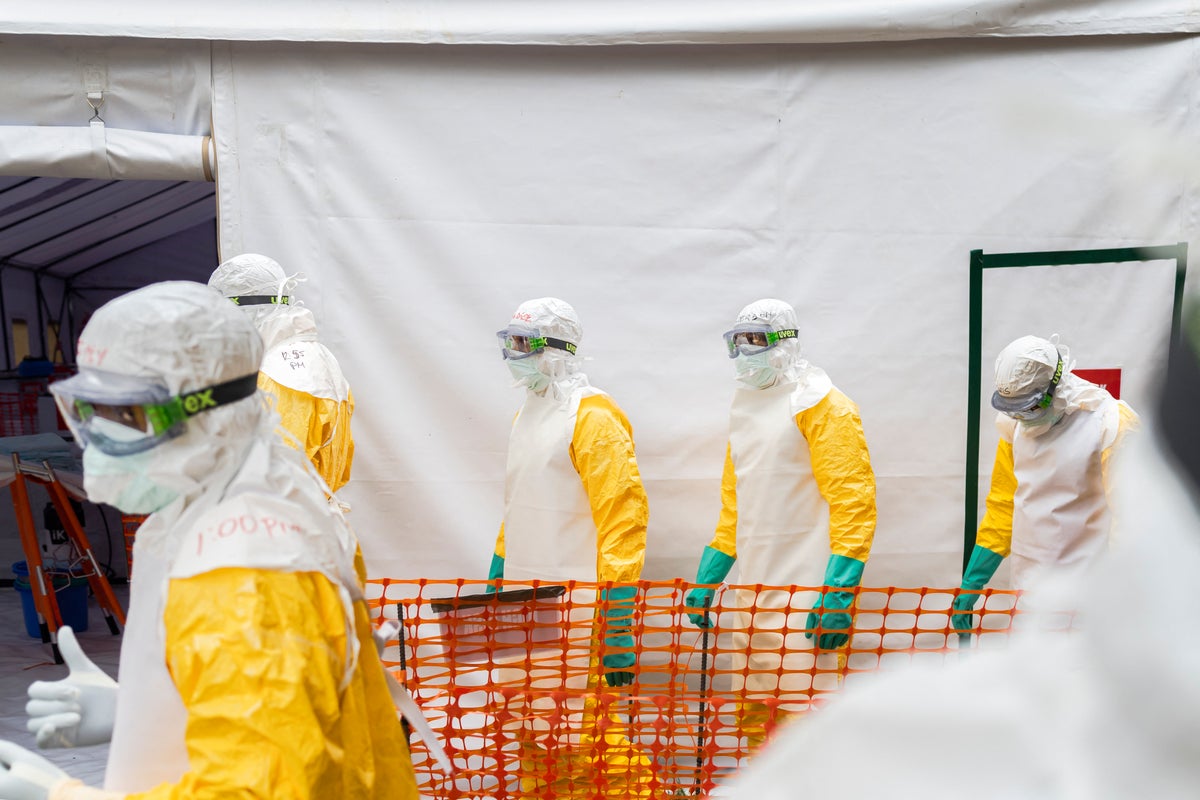
More than 1,000 people have died in the fastest-growing ever Ebola outbreak, currently spreading in the Democratic Republic of Congo (DRC), as misinformation keeps people away from health clinics and fuels attacks on healthcare. At least a dozen attacks on health facilities and workers have been recorded, carried out by angry mobs who have stormed treatment centres or targeted response teams.Some people falsely claim that “nurses are killing patients”, a health worker in Ituri province, the epicentre of the outbreak, told The Independent. “What surprises me most is the considerable drop in the number of patients visiting the health centre,” said Atimnedi Utondu Lucie, an Action Aid nurse in the Ituri city of Bunia. “Before the epidemic, we received a large number of patients every day. Now the number of patients has decreased significantly, which is very worrying.”The number of Ebola deaths has more than doubled since the start of the month, with more than 2,400 confirmed cases and as aid agencies warn its spread is outpacing the response. Local health authorities say 999 people have died in the DRC, with another two deaths and 20 cases in Uganda. The US Centers for Disease Control and Prevention (CDC), which is also monitoring the outbreak has total number of deaths at 969, but updates lag behind the local numbers.The real number of cases is thought to be far higher. Medical staff have also walked off their jobs in protest over lack of payments, while at least 36 health workers infected with the virus have died, further restricting the response. One humanitarian worker is being monitored at a specialist hospital in London after medical evacuation due to potential exposure to the virus.Ms Lucie said one pregnant woman became so frightened by the rumours that she began trembling as staff prepared to help her give birth, telling her that people were claiming that nurses were killing patients.Others believe healthcare workers are transmitting Ebola to patients during their care, she said, adding that, conversely, some do not believe the disease exists at all.Since the outbreak was declared on 15 May, it has become the fastest-growing Ebola outbreak on record. Around 80 per cent of new infections are linked to unknown chains of transmission, while the outbreak has spread beyond Ituri province into North Kivu, South Kivu, Haut-Uele and Tshopo.It has been described as the third-worst outbreak on record by WHO head Dr Tedros Adhanom Ghebreyesus.Violence in eastern Congo, displacement and the impact of global aid cuts have hampered the response. Attacks on health facilities and Ebola response teams have also forced humanitarian organisations to suspend operations in some areas.The outbreak is caused by the Bundibugyo strain of Ebola, for which there are currently no approved vaccines or treatments. It has a lower fatality rate than the more common Zaire strain but remains highly contagious, spreading through contact with infected bodily fluids and causing severe haemorrhagic disease.The WHO said it is expanding rapid response teams and strengthening surveillance. (AFP/Getty)Scientists from Oxford University have launched the first human trial of a vaccine targeting the Bundibugyo strain, while two treatment drugs are being trialed in Ituri province.The World Health Organisation said this week it is expanding rapid response teams in newly affected areas and strengthening surveillance along the Congo River, a major transport route. It is also prioritising safe burials, contact tracing and clinical care.It said there had been encouraging signs in some locations, where transmission appears to be stabilising.Uganda, which previously had a small number of cases, is lobbying countries to lift Ebola-related travel restrictions after discharging its last confirmed patient from hospital last week.This article has been produced as part of The Independent’s Rethinking Global Aid project
Ebola deaths surge to 1,000 as mistrust keeps people from health clinics
Full Article
Original Source
Read the full article at Independent →KhanList aggregates and links to publicly available news content. We do not host full articles from third-party sources. Always verify important information with original sources.