
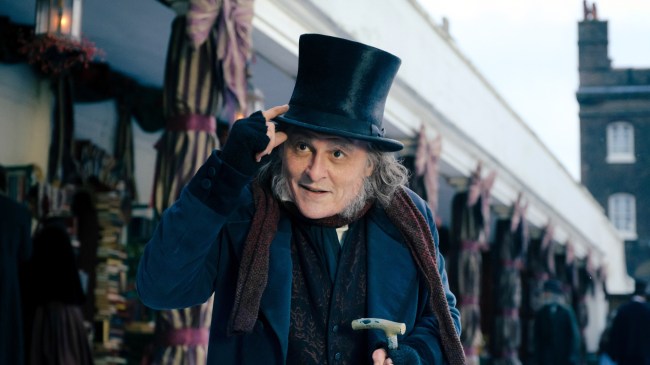
A Sauvage and jowly overactor in dire need of career rehabilitation could hardly ask for a better part to play than Ebenezer Scrooge. He’s a cruel miser of a man who comes to learn the error of his ways over the course of a ghost story that preys upon Christian precepts of redemption and forgiveness (along with the more secular warm and fuzzies of seeing a bad guy discover the joys of being good). Indeed, what is “cancel culture” if not a shackled delusion that visits self-made pariahs in the dead of night, and what is Charles Dickens’ “A Christmas Carol” if not a plea to believe that even the most odious of souls are still capable of being saved? It’s been reported that Johnny Depp accepted the title role of Ti West’s “Ebenezer” at a fraction of his usual rate, but I suspect that he probably would have done this movie for free. While the embattled star earned more than $250 million for his work on the “Pirates of the Caribbean” franchise, even that psychotic number pales in comparison to the pricelessness of starring in a major studio Christmas movie that allows him to look just left of the camera and say lines like “I’m not the man I was!” and “I was once good, and I know I can be again!” before his character saves a cherubic little boy from certain death and invites a freezing beggar inside for a warm cup of tea. If an old crank like Scrooge can make his way back toward grace, why not the convicted star of “Mortdecai,” and the alleged perpetrator of several even more serious crimes? Johnny Depp may prefer for that to be framed as a rhetorical question, but his insufferable turn as literature’s most cantankerous moneylender demands an honest answer. For me, that answer is rather straightforward: While Depp has never been the subtlest of actors, his post-Sparrow pivot away from artistic curiosity has distended his talents into such a grotesque caricature of their former charm that “Ebenezer” left me feeling like I may never be able to empathize with his screen presence again. Scrooge is obviously a scenery-chewer’s dream, but the crescent arc he traces from grinch to Christmas miracle is only believable enough to sustain Dickens’ fable if you believe it on both ends. Depp’s performance — an advent calendar of empty affectations without a soul to anchor them, every shot full of face and bereft of feeling — makes that exceedingly difficult. His offscreen unsavoriness certainly doesn’t help, but there’s a more immediate problem when the lights go down, one that makes him a unique case among Hollywood’s tainted array of mega-star actors: He seems to have become very bad at acting. Whatever my feelings about Depp as a human being, the truth is that I didn’t buy him as a glowering monster any more than I bought him as a beaming man who’s grown “better than his word.” An unengaging Ebenezer is a tough break for a movie called “Ebenezer,” and screenwriter Nathaniel Halpern’s fidelity to the source material doesn’t exactly leave West with a wealth of opportunities to compensate for such fatal miscasting. West’s take on the holiday classic is faithful to the core — no Muppets, no ghosts of girlfriends past, no uncanny mo-capped Jim Carrey. As you might expect from the director of indie genre standouts like “Pearl” and “The House of the Devil,” West’s big idea is to scare the Dickens out of us by turning up the volume on this story’s implicit scariness. Sometimes literally, as this PG-13 carol offers a small handful of gentle jump-scares. “Ebenezer” isn’t a horror movie in the strictest sense, but West does what he can to play up the fear that eventually terrifies Scrooge into giving a shit about his fellow man. Most — or all — of those flourishes are purely cosmetic in nature, and hellbent on sucking every glimmer of life out of Victorian England. Scrooge’s office has never looked more haunted, as Checco Varese’s grimdark cinematography and Eve Stewart’s Yharnam-esque production design combine to create a London that’s in dire need of Christmas cheer (the vibe should go a long way with tweenage audiences eager for a bit of spice with their holiday viewing, though I suspect the whole thing is too staid and oppressive to become any kind of perennial favorite). And since West would sooner die than pass up a chance for death, this version of the story treats us to a musty prologue where we actually get to see Ebenezer’s business partner bite the dust with his mouth wide open (Marley is played by Ian McKellen in what currently stands as the most “remember ‘The Christophers?’” performance of the year). From there, the action skips forward to Christmas Eve 1843, whence Ebenezer is inflicting his usual “Bah, humbug!” routine on poor Bob Cratchit (Rupert Grint), the underpaid clerk he resents for taking the next day off (HR being a decidedly 20th-century invention). But the fates have plans of their own for the bitter-cold businessman, who promptly pisses himself when the ghost of old Marley bursts into his miserable bedchamber later that night. Reaction shots ensue, as Depp curdles his face into a series of the most exaggerated expressions since the death of silent cinema, every one of them betraying his character’s frigidness. This Ebenezer takes an active pleasure in being cruel, which not only makes him more detestable (which is fine), but also endows him with an innate capacity for joy that makes the rest of the movie feel like it’s walking in circles (which is less fine). Given that Depp’s performance is only as wide as his lips and as deep as his pockets, it seems wasteful that we should have to walk through the hollows of Ebenezer’s past, present, and future in order to fix him — it would be easier and equally meaningful to just push the corners of his mouth into a smile. Of course, that would deprive us of the “holy shit, that’s Andrea Riseborough” fun of the “To Leslie” star’s Ghost of Christmas Past, a white-eyed ghoul who looks like a spirit from “The Conjuring” who popped up for a sudden jolt and then forgot to leave the frame. She’s the most amusing part of a familiar tour through the sadness of Ebenezer’s childhood, where he was bullied by the other kids and kept apart from his beloved older sister. Tramell Tillman is equally compelling as the boisterous Ghost of Christmas Present, though his bizarre character design — a round-bellied man whose face appears to be rotting to pieces in real-time — turns out to be reverse-engineered from an unnerving reveal that both honors Dickens’ text and also underlines West’s limited conviction to rejuvenate it with the visceral immediacy of a horror film (his commitment to the bit falls well short of the Robert Eggers-level follow-through that conceit demands). Given the emphasis the director puts on the film’s genre spin, it’s ironic and surprising that “Ebenezer” is at its best when it focuses on the most basic human elements of its story, if only because the supporting characters offer such a welcome contrast to whatever Depp is doing. Sam Claflin and Daisy Ridley don’t have a whole lot to do as Ebenezer’s kind-hearted nephew Fred and his wife Clara (respectively), but the film takes pains to stress how sad it is that Scrooge is Fred’s last connection to his dead mother, and it’s touching to see how much it would mean for him to have a cordial relationship with the old miser. It is considerably less touching to see Ebenezer arrive at a mutual feeling after palling around with the film’s Nazgûl-coded Ghost of Christmas Yet to Come (Robert Strange, cloaked in CGI), who forces the misanthrope to face the emptiness of his own miserable existence. “The flame of humanity still flickers within you,” someone tells Scrooge, but the slapstick pageantry of Depp’s performance sabotages the movie by keeping that flame at a low simmer from the start. I didn’t believe the fire had ever gone out any more than I believed that it was eventually rekindled, as this Ebenezer Scrooge is far too elastic and self-amused to convincingly suggest that he’s experiencing a permanent change of heart. He can’t even sustain a facial expression for more than a few seconds before he starts mugging around in search of another one. There will, of course, be those who insist that I only panned “Ebenezer” because Johnny Depp is in it, and I suppose they’re at least half-right about that, if not quite for the reason they assume. The truth is that it would be a lot more interesting and true to the spirit of Dickens’ classic if I liked this movie in spite of Depp rather than disliking it because of him, as I can’t help but share the author’s opinion that everyone is theoretically capable of redemption, be it measure by measure or miraculously complete. Alas, the actor’s “comeback” performance is just yet another thing that he ought to be sorry for. Grade: C- Paramount Pictures will release “Ebenezer” in theaters on Friday, November 13.
‘Ebenezer’ Review: Johnny Depp Is Absolutely Insufferable in a Dull and Dreary Christmas Carol
Full Article
Original Source
Read the full article at Indiewire →KhanList aggregates and links to publicly available news content. We do not host full articles from third-party sources. Always verify important information with original sources.