
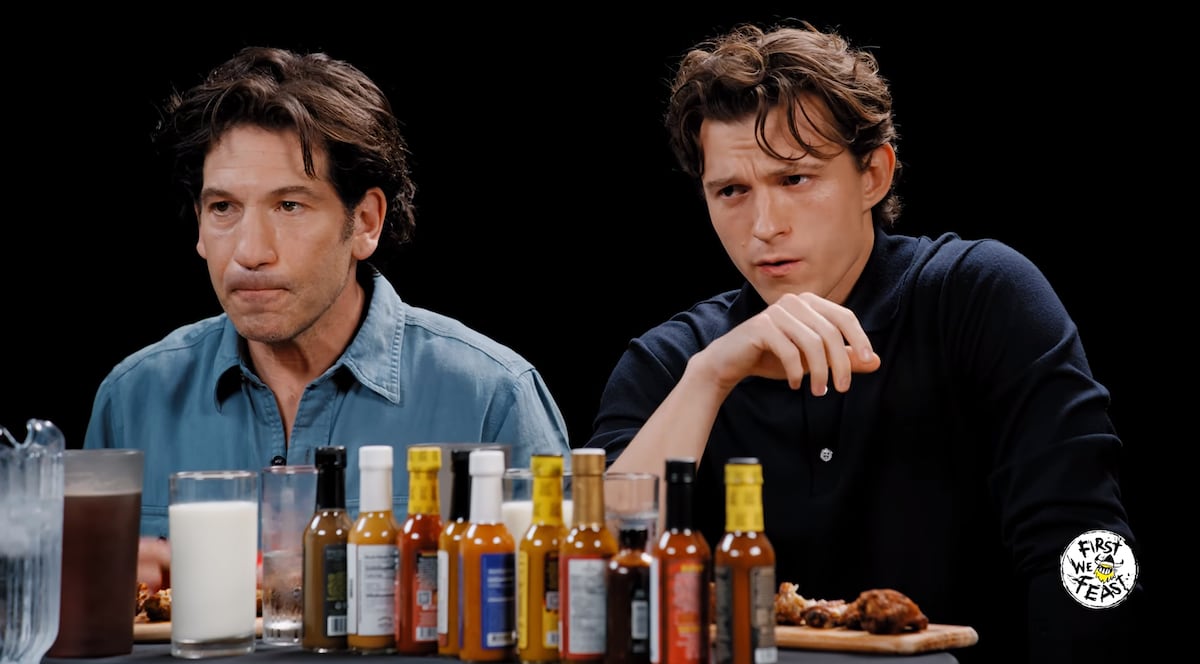
Penélope Cruz eating spicy chicken wings on the interview show Hot Ones, her eyes watering from the heat as she laughs and reproaches her family for persuading her to go on the program. Jennifer Lopez being interviewed aboard a New York City subway car. Jennifer Garner painting at an easel, palette in hand, while answering questions from someone off camera. Jeremy Allen White sitting down to eat while chatting on a podcast hosted by Jessie Ware and her mother, chef Lennie Ware. The star-studded cast of The Odyssey showing off their skills in a guessing game while trying to conceal their boredom with a marathon publicity tour. The new formats for promoting films, born out of social media and designed with the sole aim of achieving that coveted (and increasingly fleeting) viral moment, have pushed some of the biggest names in film, music and entertainment to take on all manner of challenges in pursuit of attention. Sometimes at any cost.In an article published last July, headlined “Acting the fool: why have Hollywood press tours become so gimmicky?”, the British newspaper The Guardian highlighted the juvenile and often downright silly nature of many of these promotional exercises. The piece’s author, Jesse Hassenger, linked the phenomenon to what he calls the “Fallonization” of journalism, a reference to television host Jimmy Fallon, whose trademark style relies on exaggerated enthusiasm and interviews packed with games, skits and banter.If conventional television planted the seed with interview programs that gradually evolved into full-blown entertainment shows packed with games, challenges and activities, social media has capitalized on the appetite for lighter formats in which conversation is often secondary to entertainment. In this kind of content, the film itself tends to take a back seat and, at times, its promotion is overshadowed when the clip that racks up millions of views online focuses on a celebrity’s controversial remark, a witty quip or an apparently spontaneous moment that is endlessly recycled into memes.The views and engagement generated by these videos attest to their popularity. But does this online exposure actually reach a broader audience? Or, in the scramble to capture a sliver of attention, does it merely add another layer of noise?Nicholas Quah, a journalist and critic at Vulture, a website covering film and the entertainment industry, offered his take on the issue in an interview with U.S. public radio network NPR last December: “These days, as a direct result of [...] the monoculture dissolving and there being thousands, if not millions, of social media influencers all having their own little piece of the overall audience, there’s just a lot more to do, and there’s a lot less certainty on how a publicist and a talent’s able to generate a sense of awareness,” he said, describing how the way films are sold to the public has changed in recent years.A similar view is shared by Pablo Muñoz and Sunde J. Sastre, co-directors of the Master’s in Entertainment Marketing at the ECAM School of Cinematography and Audiovisual of the Community of Madrid and founding partners of CØLLAGE.“Today a film or series doesn’t just compete against other releases,” says J. Sastre. “It competes against a sunny day, against TikTok, YouTube, video games, podcasts and absolutely everything that demands our time and attention. So promoting a release only with traditional interviews seems quite limited.”In Muñoz’s view, the problem arises when viral content performs brilliantly, yet nobody remembers which film it was meant to promote. “You can have 10 million views and create a fantastic meme... but not necessarily interest in the release. That’s why I would distinguish between virality and promotional effectiveness,” he says. “A good campaign should achieve attribution and transfer part of that attention to the title.”Standing out, or simply being visible, in today’s fast-moving media ecosystem is no easy task, and in Hollywood, press tours have become an extension of the performance itself. Promotional budgets there often exceed the entire production budget of a feature film in countries such as Spain.Some stars struggle to keep smiling through it all. Kristen Stewart, for example, is often too transparent to disguise her reactions when, for the umpteenth time, she is asked to take part in yet another game related to the Twilight franchise, nearly two decades after its debut. Others embrace the spectacle with gusto. During the promotional campaign for Marty Supreme, Timothée Chalamet even climbed to the top of the Las Vegas Sphere, the spherical venue that rises more than 110 metres above the city. For Marty Supreme, the actor also joined the trend known as “method dressing,” a term coined to describe outfits inspired by the characters or worlds of the films being promoted, a strategy most commonly associated with actresses on the red carpet.As is often the case at public appearances and red-carpet events, it is women who devote hours to crafting their image. Zendaya and Margot Robbie have turned method dressing into a remarkably powerful tool for keeping their films in the public eye. In Zendaya’s case, the actress appears only briefly in blockbusters such as the first Dune film and The Odyssey, yet much of the publicity surrounding both productions focused almost exclusively on her and on the film-inspired looks she wore throughout the promotional campaign.As for Robbie, no fewer than 165 brands were incorporated into the outfits she wore during the Barbie press tour. The looks were later collected in a book created with her stylist, Andrew Mukamal, and published by Rizzoli.Although actors such as Alexander Skarsgård, Jacob Elordi and Pedro Pascal have also embraced this way of extending a film’s universe through clothing, Muñoz points to a certain “asymmetry” in what is expected of women and men on the red carpet during promotional campaigns.“It is hard to deny that, historically, an actress’s look generates headlines, photo galleries, social-media conversation, fashion content and editorial coverage in its own right. And from a marketing perspective, that ultimately becomes another promotional layer for the film,” he argues.In the view of Gabi Plaza, a content creator specializing in film and television, these formats help strengthen the bond with audiences, and their viral appeal goes beyond merely generating amusing soundbites. “Buzz always makes people more interested in something, for better or worse. Thanks to social media, audiences feel much more connected to actors, actresses and public figures in general, which makes it easier for them to form personal opinions about them.”In that sense, she argues that even when a celebrity is “canceled,” that doesn’t always have a negative effect at the box office. “It may happen that a film gains more exposure because, following social media promotion, the lead was canceled, as happened in the case of Karla Sofía Gascón,” she recalls, in reference to the scandal over the Spanish actress’s controversial posts on Twitter.Or the opposite: “Someone might see a film just because its promotion went viral online or because a particular actor has come across especially well.”Judging by the sheer number of formats now in circulation, it may seem that nobody has yet found the magic formula that directly links creative, innovative promotion to box-office success, and that the industry is still operating largely through trial and error.One of the pioneers of this approach was London-born Amelia Dimoldenberg, who built a following with irreverent interviews staged as first dates and conducted over fried chicken. Over the course of almost a decade, her YouTube series Chicken Shop Date has featured guests including Paul McCartney, Idris Elba and Rosalía. Yet last September, Dimoldenberg announced that Chicken Shop Date would be coming to an end and that the current season would be its last.When Dimoldenberg launched the project, there was nothing quite like it with any significant reach. But over the past decade, the landscape has changed, and interview shows built around food have gone from being an innovative idea to becoming a genre in their own right. And if the algorithm has identified an interest in this kind of content, endlessly sliced into reels and TikToks, it will keep serving up similar videos ad infinitum, to the point where audiences may grow tired of a film’s promotional campaign before the movie has even been released.This saturation of marketing has also become part of the conversation surrounding some of the most high-profile releases of recent years. Barbie, for example, reportedly had a marketing budget of $150 million, exceeding the film’s $145 million production budget. Something similar happened with The Devil Wears Prada 2, which was being promoted from the moment the project received the green light. During filming, scenes shot on location were photographed by the press, the actresses fuelled anticipation through their social-media posts, the trailer was unveiled with great fanfare and, by the time the film reached cinemas, some audience members were already showing signs of promotional fatigue.“For me, there’s a fairly simple rule: promoting earlier does not mean revealing earlier. You can build anticipation for a long time while preserving mystery,” says Sastre. “In fact, I increasingly believe that audiovisual marketing should begin well before release, even during development or filming. But not necessarily to communicate more, rather to better plan what to reveal, when to reveal it and what to reserve for when the theater lights finally go down.”Sign up for our weekly newsletter to get more English-language news coverage from EL PAÍS USA Edition
Eating spicy wings and guessing games: When selling the movie becomes the show
Full Article
Original Source
Read the full article at English →KhanList aggregates and links to publicly available news content. We do not host full articles from third-party sources. Always verify important information with original sources.