
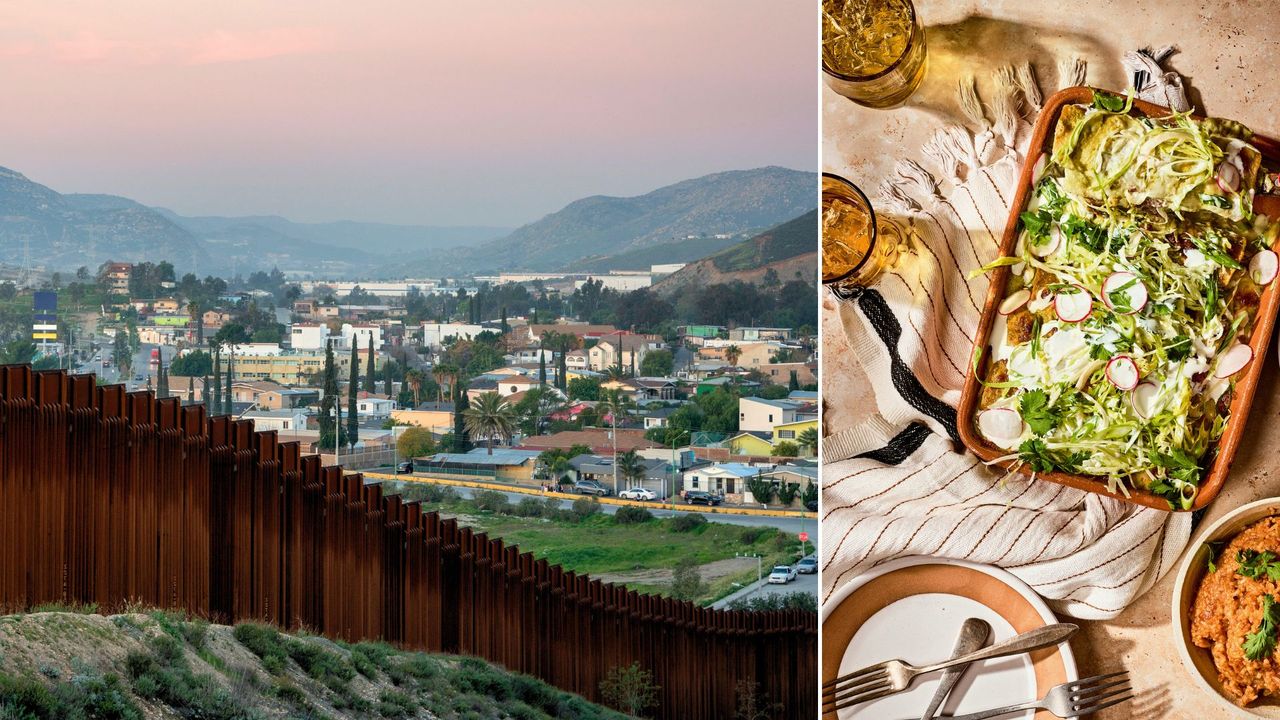
This is part of a series that celebrates border towns: the world's most vibrant cultural crossroads—and its most contested frontiers.I’ve watched a seagull illegally cross the international border five times now. First, he flew onto the American side. Then, oblivious to the armed Border Patrol vehicle just a few feet away, he waddled back into Mexico through the narrow spaces between 15-foot pillars that make up the border wall. The barrier doesn’t stop when it hits the Pacific, but continues into it, waves crashing indiscriminately on both sides.Along the US-Mexico border, the man-made fence continues into the Pacific Ocean. GettyNature does not adhere to the border in Tijuana, a man-made divide that is simultaneously heartbreaking, world-dividing, inconvenient, and a fact of daily life. On the Mexican side, people live right up to the fence: I watch a jogger, headphones in, run along the shore, touching the pole before turning around to continue; families sit in beach chairs less than 50 feet away, ordering Micheladas and grilled seafood under flapping umbrellas. But there are also names painted along the steel poles, of US army veterans who were deported to a Mexico they didn’t know, and notes to separated loved ones, “Here on the border was Alejandro, thinking of his wife (Mary) and baby”. On the US side, the now-closed Friendship Park sits empty, the beaches of San Diego visible beyond.Despite the fence’s formidability, if you follow it about 12 miles inland, you’ll find a behemoth tangle of highways, concrete overpasses, and 16-car lanes that make up what is the busiest land border crossing in the Western Hemisphere. Every day, some 200,000 people cross the US-Mexico border here by car, bus, and foot at the San Ysidro Port of Entry. Many Mexico residents make this trek daily to work or study in the US, spending up to several hours in line. Then there are the southbound travelers, who are often passing through Tijuana en route to other destinations like the surfable beaches of Rosarito and vineyards of the Valle de Guadalupe.Yesterday, I was one of a smaller subsection of Americans coming to Tijuana for Tijuana: I parked my car in San Diego, and walked through the West port of entry without even pausing, my suitcase rolling behind me all the way down Avenida Revolución until I arrived at Hotel Lafayette.In Tijuana, al pastor-style tacos, known as “adobada” here, can be found on many a street corner and inside casual eat-first-pay-later restaurants. Jason Thomas Fritz/Club Tengo HambreTo be in Tijuana means you are never far from the border—literally, mentally, emotionally. I meet Tijuana-raised Antonio Díaz de Sandi the next morning, at his suggested meeting point of Farmacias Roma, which sits about 100 feet from the crossing. Díaz de Sandi is a co-founder of Club Tengo Hambre and leads food tours in Tijuana, Valle de Guadalupe, and Mexico City. He identifies as “a border kid”: Born in California but raised in Tijuana, he grew up crossing the border daily to go to school in San Diego, and would return home to Mexico for dinner. His family’s Tijuana roots reach back to his grandparents, who used to cross the border northbound to work in a La Jolla hotel. Now, he calls Chula Vista home—a San Diego neighborhood abutting the divide—but moves fluidly back and forth for work.In a transient city like Tijuana, through which so many residents and most tourists pass en route to somewhere else, few people are truly “from TJ,” Díaz de Sandi explains. Nearly half of Baja California’s population was born in another Mexican state, with Tijuana the primary destination for 60% of those internal migrants. “We're at the northernmost edge of Latin America, and people from all over Mexico, from all over the world, come to Tijuana, and that's our secret,” he says. “No one is from here but everyone is welcomed, and they become part of the fabric of Tijuana and its food.”Despite the tired stereotypes of cheap prescriptions and never-ending tequila shots that lure Americans south, today’s Tijuana day-trippers also come for something more innocent: the food. Club Tengo Hambre can be credited with showing a generation of Instagram-users how to sink their teeth into the flavors of this hustling city. Today, Díaz de Sandi is giving me a private version of the CTH half-day tour—we’ll hit seven spots over even fewer hours.Seafood tostadas get piled high at El Concha'a Del Paisa in Tijuana Antonio Díaz de Sandi/Club Tengo HambreWithin Mercado Hidalgo, sliced fruit is among the myriad of snacks on offer Antonio Díaz de Sandi/Club Tengo HambreWe begin walking to a burrito truck, parked within eyesight of the border. “The Prohibition era was a founding moment for Tijuana, when people from the states crossed into Mexico in search of fun,” Díaz de Sandi says, pausing to order for us. “There is still that spirit of going into Tijuana, in search of great food, great drinks.”Now, though, he tells me that pleasures like smoky carne asada tacos and birria heaped onto oil-slicked tortillas are outpacing the draw of rambunctious nights. Because here, eating is not only the most beloved of pastimes, but a snapshot of the entire country’s culinary traditions.Two egg and machaca (spiced dried meat) burritos land in front of us, compact and tidy enough to hold in a single hand. As we bite into the dusted flour tortillas, the stick-to-your-bones filling doused in hot sauce warms us from the inside. This burrito joint, Don Polo, has stood here since 1916, kept alive by multiple generations of the same family from Sonora, one state over, he explains. It’s a world away from the heaving, everything-but-the-kitchen-sink burritos that San Diego is so known for—it’s the kind of meal you want on hand for a long day of work, perhaps at a ranch, of which Mexico’s north has many. Looking at the border, Díaz de Sandi smiles and nods: “Can’t get more Norteño than this.”El Concha'a Del Paisa is a destination-worthy tostada cart near the Mercado Hidalgo Megan SpurrellPapel picado blows in the wind at the Mercado Hidalgo Megan SpurrellIt’s a short walk to our next stop, where fish broth is ladled out from a small aquamarine-painted cart. The smell is rich, oceanic, and bursting with notes of lime and cilantro. To our left, a pickup truck has been converted into a display of plump watermelons, sold by the half or behemoth whole; taxis beep past us, and yet everyone is slowly, even serenely, sipping their soup at 10 a.m. in the morning. On the horizon, I notice an antenna that Díaz de Sandi tells me transmits cross-border radio shows.This operation has been on the same street corner for 43 years, Díaz de Sandi tells me, serving another family recipe from Sonora. “No one's really cooking a local grandmother’s recipe,” he says, the salty steam rising around us. “They're cooking their grandma's recipes from miles away. Think of Tijuana as a living archive of Mexican regional cuisine.”The city of Tijuana is only 135 years old, young compared to other Mexican cities like Oaxaca, which was established somewhere around 500 BC, or even Mexico City, founded in 1325. (Though, as in much of North America, there was an Indigenous presence well before the city was built, dating back some 2,000 years with the Kumeyaay, whose ancestral lands and present-day population were effectively divided by the US-Mexico border.)Writer Megan Spurrell reporting in Tijuana Megan SpurrellThe thing about being relatively young as a city—rather than bearing the weight of continuing long-lasting traditions—is that "we can make our own,” Díaz de Sandi says before he rolls the edge of a tortilla on one palm, then slides his hands across one another to wind it into the perfect submersible for our soup. “A family from Sonora can make a Jalisco-style birria and serve it alongside mariscos from Baja California, and, here, no one's gonna question that.”It’s an apt precursor to what comes next: Our tour continues, past high-rise apartment buildings springing from the earth like shiny metallic weeds, to a seafood packing district. On one street alone, there are pop-up tents covering burbling vats of beef birria and tacos varias (for which you pick from about a dozen meat or veggie toppings, like chile relleno), and seafood restaurants serving manta ray tacos and decadently shrimp-and-cheese-filled tacos gobernadores, just steps from fishmongers working in rubber boots. We stop for all of the above, my lips slick with red oil and my brain happily hazy from all the meat by the time we reach La Cahua de Yeyo.“If there were a quintessentially Tijuana dish…” Díaz de Sandi ponders while arranging the 15 hot sauces on our table, “...it would probably be carne asada tacos.” Made over charcoal, never a flat top (“sacriligous”), he says, and always with a dollop of guacamole, a signature of a TJ taco. “You used to find them at almost every corner in the city, and you would roll down the car window and smell the smoke and the mesquite grilling away. It also reminds me of doing a carne asada every Sunday, which is when families get together to barbecue and unwind together.”It’s hard to imagine slowing down in a place like this. The city is built on not just cross-border transit but also a manufacturing industry with people who work “sunrise to sunset,” Díaz de Sandi tells me. The city has a grit to it; everyone moves with a sense of urgency and purpose.Many families have only been here for a generation or two, as they chase dreams that then take them elsewhere, with new arrivals at the ready to take their place. Tijuana—and the people who call it home—is in a constant state of evolution. With that, there’s a fleeting feeling here that anything I see today could be gone tomorrow. Anything left uneaten is a potential regret I will remember vividly once I’m back across the border.Getty“We are so used to picking up [and leaving], here in Tijuana, that we live in the moment,” says Díaz de Sandi, waving to a friend at the El Concha'al del Paisa cart, who quickly begins building a tower of cold sliced shrimp, octopus, and scallops on a tostada for us. And so, moving to undo a button on my pants and then remembering I am wearing a dress, I decide to live in the moment as well, giving a thumbs up when the cook asks if I want it “con todo.”***The line to cross into San Diego is long the next morning. I’m back at the border, standing beside people bound for the States, but I don’t have my passport. Once again, this is simply the best meeting point. I scan the crowds for Chef Claudette Zepeda, of Top Chef and Iron Chef: Mexico fame and quickly spot her signature curled hair and bold eyeglasses glinting in the sun. Once she bobs through the chaos, we exchange hurried hellos before shuffling into a taxi headed for a restaurant called Erizo.Chef Claudette Zepeda has studied the recipes of towns along the US-Mexico border. Johnny MillerZepeda's new cookbook features emblematic Norteño dishes like cowboy beans. David AlvaradoZepeda is from Tijuana, but she too now lives al otro lado (“on the other side”) in San Diego.Cooking the Borderlands by Claudette Zepeda was released June 2026 David Alvarado“It’s never, Let’s go to the other country,” says Zepeda. “It’s, Let’s go to the other side. For people who grew up in Tijuana, [crossing the border] doesn’t have the context of changing worlds.” A lifetime spent straddling these cultures—culinarily and otherwise—has fueled Zepeda’s new cookbook, “Cooking the Borderlands: Spice and Smoke Between Mexico and the States”, published in June 2026 by Penguin Random House. It’s a 288-page festival of recipes that capture the culinary exchange that happens along the US-Mexico border.Which is why I am prepared to, once again, push my appetite to the limits for the joy of eating with a Tijuanense who knows this food better than anyone. I accept my fate as we take a seat on the patio at Erizo: a breezy, marine-inspired bistro where the light fixtures are in the shape of its namesake sea urchin.It’s fun to eat with Zepeda, not only because she gets visibly excited by the fresh aguachile that lands on our table, or because the servers know she is a friend of Javier Plasencia, the Baja California culinary king who owns this restaurant among several others. But she is just as voracious when it comes to espousing the values of overlooked, underrated, singular Tijuana.“In the rest of the country, if I say that I grew up in Tijuana, there's immediately a negative connotation,” says Zepeda. “We speak differently because we're at the border: We already have the sopa revuelta (mixed soup) of Spanglish. It’s a little bit more aggressive than other accents. The rest of the country will make fun of us, but our superpower is being so proud of being a Norteño, so proud of being Tijuanenses, that we don't fucking care.”Chef Claudette Zepeda at Erizo in Tijuana Megan SpurrellAguachile is made with callo de hacho at Erizo Megan SpurrellThis translates to the food, Zepeda tells me, as we take turns spooning the mouth-puckering broth of aguachile and its raw slices of shrimp and callo de hacha (a special scallop found in massive hatchet-shaped shells in nearby waters) onto tostadas. “In TJ we don't ask for forgiveness on properly seasoning your food. There’s a bold sensibility,” she continues, “so if a dish has chiltepín, which is the spiciest pepper in Mexico, we're just gonna give it to you the way the chef intended. Same thing with salt, with acid. Why would we take it any lower?” After pausing for a moment to enjoy the explosion of lime, chili, and salt that is the aguachile, she nods appreciatively. “For me [that’s what defines the flavor] of Tijuana and Baja Norte—Tijuana is más turned up.”The recipes in her cookbook, which we flip through at the table, build on years of traveling to various towns along the US-Mexico border, she tells me, and digging deep into the origins of their emblematic flavors. There are the smoked meat-studded frijoles rancheros from states like Coahuila, on the Texas border, and the crema-laced Sonora dogs that have become so beloved in neighboring Arizona. There’s the Caesar salad, famously invented right here in Tijuana at Caesar’s Restaurante (now operated by the Plasencia family)—and still prepared tableside, whole leaves of romaine dragged through the decadent dressing to order. (I took myself the night prior; it was fantastic.)Now run by the Plasencia family, Caesar's Restaurante has maintained its classic charm Megan SpurrellThe original Caesar salad is prepared tableside at Caesar's in Tijuana Megan SpurrellAs we move the pristine new cookbook to make way for a serving of pulpo a la parrilla (octopus grilled with the smoky flavor of mesquite seeped into its delicate meat), Zepeda pauses to appreciate what she deems to be a very “Javier Plasencia” dish. Everything we’ve ordered has been emblematic of “Baja Med” cuisine—an approach first coined by Tijuana chef Miguel Ángel Guerrero somewhere around 2000 and well-popularized by Plasencia. Despite what the name implies, this style of cooking fuses not just two but three parts of the world, combining the marine bounty of Baja with Mediterranean ingredients like olive oil and Asian aromatics like soy sauce and lemongrass. It’s a lively medley of flavors that feels perfectly of Tijuana.Zepeda flips to a page in her book that shows char siu pork from Mexicali, the border town some 110 miles away and famously home to La Chinesca, the largest Chinatown in all of Mexico, which has the greatest concentration of Chinese restaurants in the country. She then illuminates me to the role of Japanese immigrants in Ensenada, who are to thank for the tempura-like coating on Baja-style fish tacos. Both communities first came to Mexico in the early 1900s for work opportunities—today, the hope of a better life continues to draw many others to Tijuana. Several thousand Haitians and what is estimated to be nearly as many Venezuelans represent more recent groups of people who have come here in hopes of gaining asylum across the border in the States. Many find themselves still waiting, years—and sometimes, generations—later. Tijuana is a “bottleneck” in that way, Zepeda tells me.Yet it is this rich blend of influences that, above all, makes Tijuana’s food so unique. “I don’t like the word fusion, because for border towns it means so much more,” Zepeda says. “It's the marriages of entire families.”It’s a fitting note to marinate on, as we decide to make a quick stop at a pottery shop (Matiz Estudio), where local clays are harvested for handmade dishware, before Ubering to one last meal at Chan's Bistro, a modern, casual Chinese restaurant in the trendy Colonia Cacho neighborhood.“The abundance culture of eating Cantonese food feels very familiar to me as a Tijuanense,” Zepeda says as we walk into a sunlit dining room. “It resonates a lot with Mexicans and our love for hospitality. We want to feed people until they explode, and the Chinese are like, Hold my beer.”In Claudette Zepeda's new cookbook, Chinese dishes beloved in border towns like Mexicali and Tijuana get a spotlight. David AlvaradoAs we bite into shatteringly crisp egg rolls and pass a Mun Shou plate topped with chop suey (a dish Zepeda says her own grandmother used to make every Sunday in Tijuana), Chan, the restaurant's owner, points to a mural on one red wall of the restaurant that traces her family history, charting three generations of Chinese restaurateurs in Tijuana. “My grandfather was born in Canton in 1910, and he came on a boat not knowing which port he would arrive in,” she says, sliding a plate of puffy bao buns to me. “He created the first Chinese restaurant in Tijuana and ran it for 55 years.” Her dad decided to follow in his father’s footsteps, and started his own restaurant that lasted for 28 years. Just 15 years ago, she began Chan’s Bistro, she says. “When I see that [mural],” Chan says wistfully, “I remember where I come from.” The flavors of soy sauce and sesame, so perfectly balanced with hints of acid and chile, could be simplified as Chinese-Mexican fusion, but I know better than that after all the eating we’ve done. This unique union of cultures and flavors didn’t just collide in the kitchen one day—these dishes required long, arduous, life-changing journeys in order to land before me.“When you’re from Tijuana, you’re a kid of the world,” Zepeda adds, her chopsticks finally coming to rest on the plate.***That evening, I roll my suitcase down Avenida Republica toward the border, which I will once again cross on foot to return to Southern California.As I walk down the main drag, passing shops selling Mexican leather satchels, knockoff soccer jerseys, and piñatas, ready to be scooped up and taken back to San Diego, I can’t help but think of what a privilege it is to be able to walk myself home, to be able to move between worlds so freely.Soon, in just the space of a mile, I will no longer have access to such a plethora of seafood tostadas and oozing birria tacos. If there is a cantina in San Diego that serves Tecates on a 24/7 schedule like Tropic’s Bar in Tijuana does, I don’t know it. Then, the wheels of my suitcase harmonizing with my footsteps, I hear a song replaying in my head that I listened to on the drive down: “La Línea”, by Mexican singer Julieta Venegas (a fellow border kid, born in San Diego and raised in Tijuana, as Zepeda noted earlier), featuring Yahritza Y Su Esencia. It’s from her new album, Norteña, and through piano keys and yearning accordion notes, tells the story of two people separated by the very line I’m about to walk across.Una línea nos separa desde hace tanto tiempoUna línea que me impide poder llegar a tiEsa línea caprichosa que divide nuestro mundoTe deja a ti de un lado que no es para míA line has separated us for so longA line that keeps me from reaching youThat capricious line dividing our worldLeaves you on a side that isn't for meTo coexist with this border, either as a passing traveler or a resident of either side, is to live with this duality. La línea can be a mere inconvenience, or a life-altering divide. It might depend on who you are, or it might depend on the day. But there’s a reason so much art, literature, food, and music is inspired by the feeling of being caught between two worlds.“It's very different when you have the possibility of crossing the border versus when you don't,” Venegas herself will tell me over the phone a few weeks later. “If you have that possibility, there are things you choose to take from both sides.”The beauty of Tijuana is using this to its benefit. “All border towns have their own special thing, but what I love about Tijuana is this exchange,” she continues, savoring the richness of this fact with pride. “There is so much exchange.”The US-Mexico border as seen from the San Diego side. GettyHow to plan a Tijuana tripIf you’re driving, make sure you have Global Entry or Sentry as car lines returning to the US can get long, especially on Sundays. (Global Entry also makes walking across much faster.)If you’re walking, park at the PedEast or PedWest lots. (PedWest has limited hours for crossing, so plan accordingly.)Allow a night or two in Tijuana—and if you're continuing to Valle de Guadelupe or Rosarito, another couple of nights there.Book a food tour with Club Tengo Hambre at the start of the trip, then use their tips for navigating the food scene during the rest of your trip.There are plenty of hotels within walking distance or a short Uber of the border. I recommend the well-appointed and fairly priced Hotel Lafayette.
Eating My Way Through Tijuana, Where Food Tells the Story of the Border
Full Article
Original Source
Read the full article at Cntraveler →KhanList aggregates and links to publicly available news content. We do not host full articles from third-party sources. Always verify important information with original sources.