
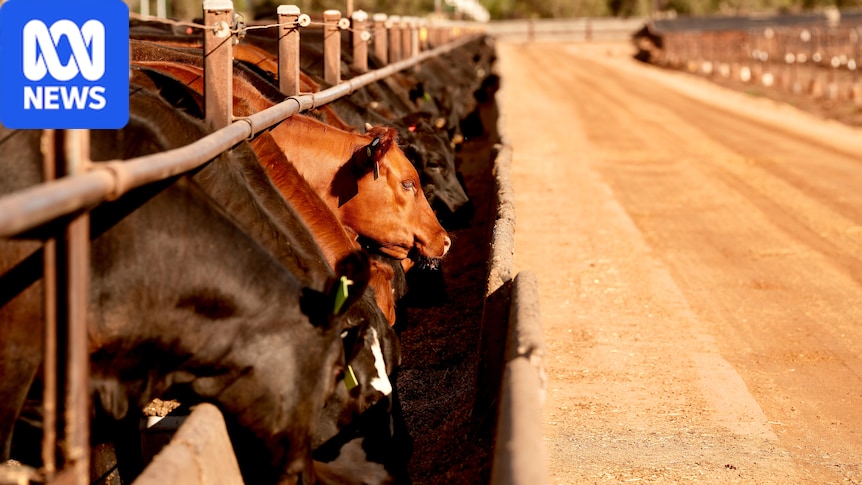
Almost half the beef processed in Australia now comes from a feedlot, where cattle are penned in mobs and fed a grain diet before slaughter.The latest data, provided by Meat & Livestock Australia and industry group Australian Lot Feeders' Association, shows more than 1.6 million cattle are now in feedlots, a record for Australia.Lot feeding has grown exponentially in Australia, with the sector now valued at $4.5 billion.StoneX analyst Ripley Atkinson says the number of cattle in Australian feedlots has exploded in recent years. (ABC Landline: Floss Adams)Sydney-based analyst Ripley Atkinson said the growth of the industry has been remarkable."What we've seen in the last five to six years has been an explosion in terms of growth. "Numbers [of cattle] on feed have lifted 60 per cent in four years or 600,000 head," Mr Atkinson said.He said demand for grain-fed beef has been driven out of Asia, with China, Japan and Korea, the largest markets by volume and value, where consumers seek a consistent product."The consumer, you and I, when we go to the retail shelf or the supermarket shelf, we know we're going to get the same type of eating experience, same portion size, week in, week out. And that's what grain fed beef provides," he said.Farmers expand feedlot capacityThe Herbert family began lot feeding cattle in the central west of New South Wales 25 years ago and next year will double the capacity of its feedlot to 12,000 cattle.Caitlin Herbert said there's a lot of confidence in the sector.Caitlin Herbert from Gundamain Pastoral says cattle spend only a small portion of their lives in feedlots and need to be well cared for while they are there. (ABC Landline: Simon Beardsell)"At the moment cattle prices are good, the [cattle] producers are winning, the feedlots are winning and the [meat] processors are winning too. That's where we generally like those cattle prices to see it."Her father, Andrew Herbert, is the fifth-generation of his family to farm at Eugowra and oversees a ration of wheat starch, cottonseed and silage that is fed to cattle twice a day."We're probably putting on 25 or 30 kilos more on those cattle [than 25 years ago]," he said."Some of that through diet, but some, a lot of that improved genetics as well, with the [cattle] producers being so much better [at breeding]," he said of the cattle that are bought in to the feedlot.Andrew Herbert expects to double the capacity of his feedlot at Eugowra in 2027. (ABC Landline: Simon Beardsell)Industry growth expected to continuePresident of the Australian Lot Feeders' Association Grant Garey said there was expansion happening across the country."It's been a good time in the feedlot industry," Mr Garey said.Cattle in feedlots are typically fed a grain-based diet for 100 days before slaughter. (ABC Landline)"We do think that growth will continue perhaps at a slower rate than what it has the last five years, but we do think the growth will continue."There are an estimated 400 feedlots in Australia, most in Queensland and New South Wales.The average feedlot could hold up to 10,000 head of cattle, while the largest, Mort & Co's Grassdale lot at Dalby in Queensland can hold up to 79,000 head of cattle.Grant Garey says the lot feeding sector directly and indirectly employs 24,000 people. (ABC Landline: Simon Beardsell)Mr Garey said lot-fed cattle would typically spend 100 days on grain, consuming one to one and a half tonnes of grain gaining 200 kilograms of weight before slaughter."It's quite efficient when you think about how much weight they're putting on. So you know, they're putting on 2 kilos a day and eating 15 kilos a day," Mr Garey said.About 15 per cent of cattle in feedlots are fed grain for more than 200 days.Animal welfare and shade requirementsAnimal welfare expert, Associate Professor David Beggs, said cattle could be kept in feedlots without having their welfare compromised."Provided that there's enough shade and that their thermal temperature is OK and that the feeding is appropriately managed so that they don't get acidosis and things like that and that they, that the flooring isn't wet and muddy and horrible. Yes. It is perfectly possible to keep an animal in a pen for a hundred days without compromising its animal welfare badly, if at all," Dr Beggs said.More than 1.6 million cattle are being held in feedlots across Australia. (ABC Landline: Simon Beardsell)The associate professor at the University of Melbourne said accredited Australian feedlots set a minimum requirement for 9 square metres per 600kg cow."So that's 3 metres by 3 metres, which is the size of someone's typical bedroom," he said.The Australian feedlot industry made a commitment to have 100 per cent of cattle pens provide some shade by 2025, however it missed the target and currently 78 per cent of pens have some shade.Watch ABC TV's Landline at 12:30pm AEST on Sunday or stream anytime on ABC iview.
Eat beef? There's a high chance it has come from an Australian feedlot
Full Article
Original Source
Read the full article at Abc →KhanList aggregates and links to publicly available news content. We do not host full articles from third-party sources. Always verify important information with original sources.