
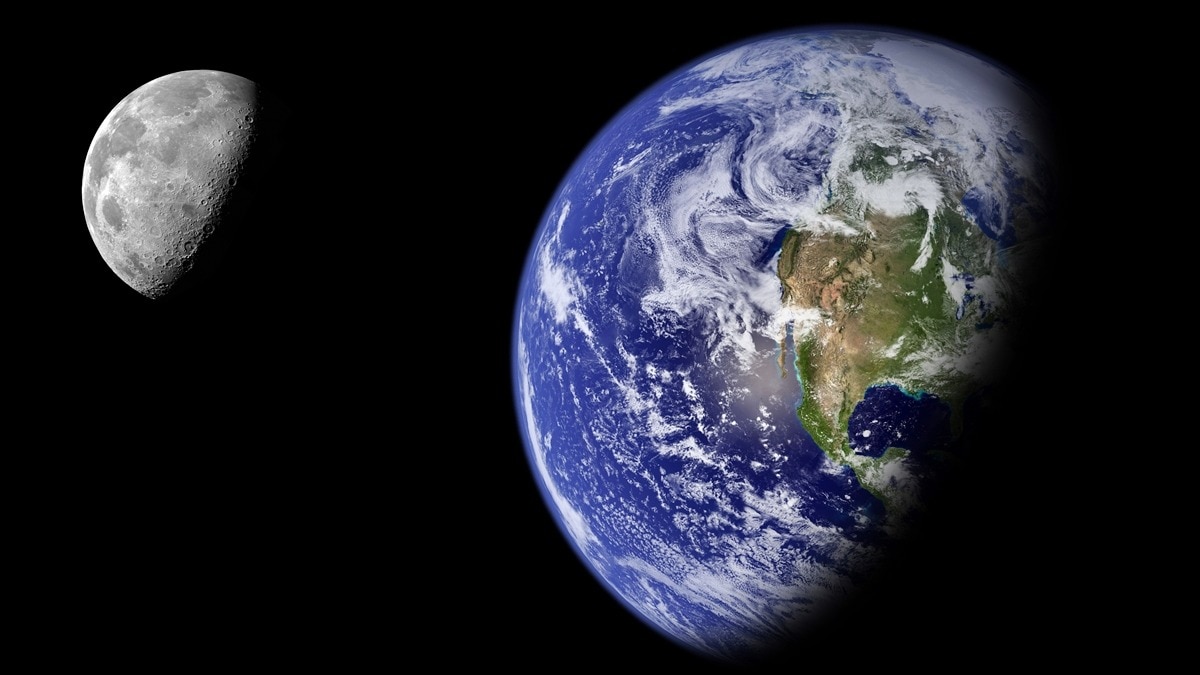
Scientists say the Moon's tidal pull and melting ice are lengthening Earth's day by tiny fractions. The shift is minuscule for people but matters for precise timekeeping and rotation forecasts.Earth's average long-term rotation has been slowing because of tidal friction. (Photo: Getty)The length of an Earth day is changing, and you probably haven't noticed. Not by minutes or even seconds, but by tiny fractions of a second. The main reason is the Moon, whose gravity raises tides in Earth's oceans, and the friction associated with those tides gradually slows Earth's rotation.The Moon moves farther away as Earth loses some rotational energy. Nasa's lunar measurements put that recession at about 3.8 centimetres a year.That process has been running for billions of years, but there is another factor now entering the picture: melting ice. Water is redistributed towards the equator as glaciers and polar ice sheets lose mass, which changes how Earth's mass is spread and slightly slows the planet's rotation. MOON HAS BEEN SLOWING DOWN EARTH FOR BILLIONS OF YEARSThe Moon is moving away from Earth by about 3.8 centimetres each year, which is tied to the same tidal interaction that gradually slows Earth's rotation. Earth's oceans form tidal bulges under the Moon's gravitational pull, but because the planet rotates faster than the Moon orbits, those bulges are carried slightly ahead of the Moon.That offset allows energy and angular momentum to move from Earth's rotation into the Earth-Moon system, causing Earth to spin a little more slowly, while the Moon gains energy and moves into a slightly higher orbit. Nasa describes this as an ongoing process, with lunar laser measurements providing precise data on the Moon's gradual recession. So, how much longer is a day becoming?The change is extremely small and is measured in milliseconds per century, not in seconds that anyone would notice during a normal day. Earth's rotation does not change at one fixed rate. Tidal friction is a major long-term influence, while the atmosphere, oceans, Earth's core and changes in the distribution of mass on the surface can also alter the length of a day.A 2024 PNAS study found that lunar tidal friction currently contributes about 2.40 milliseconds per century to the long-term increase in day length, while several other processes can push the rotation in the opposite direction. The long-term trend is real, but Earth's rotation also speeds up and slows down over shorter periods.HOW IS CLIMATE CHANGE LEADING TO IT?When glaciers and ice sheets lose mass, that water eventually moves through the oceans and becomes more widely distributed towards lower latitudes, which changes Earth's moment of inertia, much like a spinning skater changes their rotation by moving their arms.A 2024 PNAS study found that climate-related changes in surface mass distribution increased the length of the day at an average rate of 1.33 milliseconds per century from 2000 onward, compared with a range of 0.3 to 1.0 milliseconds per century during different periods of the 20th century. The researchers found that melting glaciers and the Greenland Ice Sheet were major contributors to this change, with Antarctica also contributing.The change is tiny when measured against the length of an ordinary day, but the rate is scientifically significant. The PNAS study found that climate-related mass redistribution has become a larger contributor to changes in Earth's rotation than it was during much of the 20th century, which matters because modern timekeeping systems measure Earth's rotation with extraordinary precision.WHY DO ATOMIC CLOCKS CARE ABOUT EARTH'S ROTATION?Coordinated Universal Time, or UTC, is maintained with the help of atomic clocks, while astronomers also track Earth's actual rotation through a separate time scale known as UT1. The two do not stay perfectly aligned because Earth's rotation is irregular. Leap seconds have historically been used to keep them close enough for practical purposes.In a 2024 Nature study, geophysicist Duncan Agnew calculated that melting ice in Greenland and Antarctica was slowing Earth's rotation enough to delay the possible need for a negative leap second by about three years.The study put the potential adjustment around 2029 under the conditions it examined, but that date was never a fixed deadline. By 2026, international timekeeping authorities were considering whether the leap-second system itself should be changed, while researchers continued to assess the possibility of a negative leap second later in the 2030s.EARTH'S ROTATION IS MORE COMPLICATED THAN THE MOONEarth's liquid outer core exchanges angular momentum with the mantle, while the atmosphere and oceans also influence the planet's rotation. These effects can make individual days slightly shorter or longer, even while the long-term tidal trend continues to slow Earth down.The 2024 PNAS study notes that core flows can produce changes of several milliseconds over decadal periods, which is much larger than the tiny changes people would experience from the long-term trend on any single day.Earth's average long-term rotation has been slowing because of tidal friction, but the actual rotation rate fluctuates constantly. Scientists have to separate these different influences when predicting how Earth's rotation will behave.THE CHANGE IS TINY, BUT THE SCIENCE IS NOTThe change is far too small for a person to feel, and ordinary clocks do not need to be adjusted because the length of a day has shifted by a tiny fraction of a second. But what makes the story unusual is the number of processes involved.The Moon has been transferring energy from Earth's rotation for billions of years, while modern ice loss is now producing another measurable effect on the planet's rotation.Nasa's lunar laser measurements and modern geophysical observations allow scientists to separate these influences with remarkable precision.The Moon is still moving away from Earth, Earth's rotation is still changing, and human-driven changes to the planet's ice are now part of that calculation too- EndsPublished By: Sibu Kumar TripathiPublished On: Sep 17, 2026 13:05 IST
Earth's day is changing: How the Moon and melting ice are slowing its spin
Full Article
Original Source
Read the full article at Indiatoday →KhanList aggregates and links to publicly available news content. We do not host full articles from third-party sources. Always verify important information with original sources.