
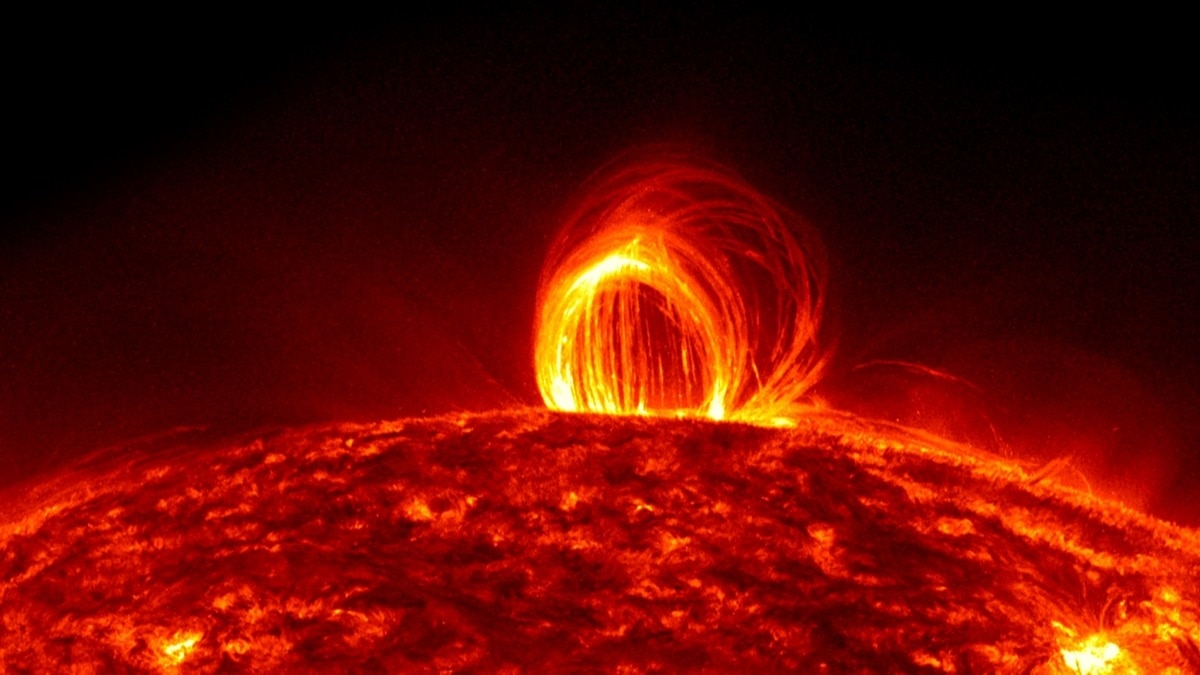
The Sun has unleashed two eruptions that could disturb Earth's magnetic field and bring auroras to parts of the world. Here's all you need to know.A solar explosion is seen on the Sun's surface. (Photo: Getty)New Delhi,Oct 10, 2026 11:33 ISTEarth is bracing for a solar storm on October 11, after two eruptions from the Sun sent clouds of charged material towards our planet.The US National Oceanic and Atmospheric Administration, or Noaa, has issued a watch for a moderate G2 geomagnetic storm, which could affect some satellites, radio communications and navigation systems.The actual impact, however, will depend on how the material interacts with Earth’s magnetic field. An image of the solar activity on the Sun's surface is captured by a satellite. (Photo: Noaa) WHAT IS A SOLAR STORM?A solar storm occurs when activity on the Sun sends energy and material into space. One major trigger is a coronal mass ejection, which is a huge cloud of electrically charged particles and magnetic material released from the Sun.Multiple solar storms have launched from the Sun over the last few days, and the first #spaceweather impacts have begun here at 1 AU as more waves of plasma are soon to arrive. NOAA expects minor to moderate (G1-G2) geomagnetic storming, and it's possible it goes higher... https://t.co/tcZs8bCmZo— Stefan Burns (@StefanBurnsGeo) October 9, 2026When such a cloud reaches Earth, it can disturb the planet’s magnetic field and trigger a geomagnetic storm. Noaa classifies geomagnetic storms on a five-level scale, from G1, or minor, to G5, or extreme.The higher the number, the greater the potential disruption.Separate scales measure solar radiation storms, rated S1 to S5, and radio blackouts, rated R1 to R5. These describe different types of space-weather events rather than a single measure of storm strength.The Sun just fired off a powerful M6.7 flare, blasting plasma into space and destabilizing a nearby filament. And another solar storm is already heading our way, while effects from an earlier CME are expected today, Oct. 9. The Sun is seriously active right now. https://t.co/gVSQFUiUra— Mindbeast (@mindbeast) October 9, 2026WHAT WILL HAPPEN ON OCTOBER 11?Noaa’s Space Weather Prediction Center said the G2 watch covers the expected arrival of two solar eruptions that left the Sun on October 7 and 8.The second is moving faster and is expected to merge with the first before reaching Earth.The forecast warns of a possible moderate disturbance, but the final intensity will become clearer as the material approaches and its properties are measured.At G2 levels, the effects are generally more significant at higher latitudes. The Aurora Borealis, also known as the Northern Lights, illuminates the sky over Greenland. (Photo: Reuters) Power systems in those regions could experience voltage fluctuations, while satellite operators may need to make adjustments. Radio signals can also weaken in some areas, and changes to satellite navigation accuracy are possible during geomagnetic storms.Auroras, the colourful displays created when charged particles interact with gases in Earth’s upper atmosphere, may become visible farther from the polar regions than usual.For India, the forecast does not indicate a major direct threat to everyday life.For the country specifically, the predicted G2 level does not mean widespread power cuts or communications failures, neither will auroras become a sight to behold across the country.The current watch remains a forecast, as conditions could still change as the solar material reaches Earth.- Ends
Earth to be hit by powerful solar storm tomorrow. Here's what to expect
Full Article
Original Source
Read the full article at Indiatoday →KhanList aggregates and links to publicly available news content. We do not host full articles from third-party sources. Always verify important information with original sources.