
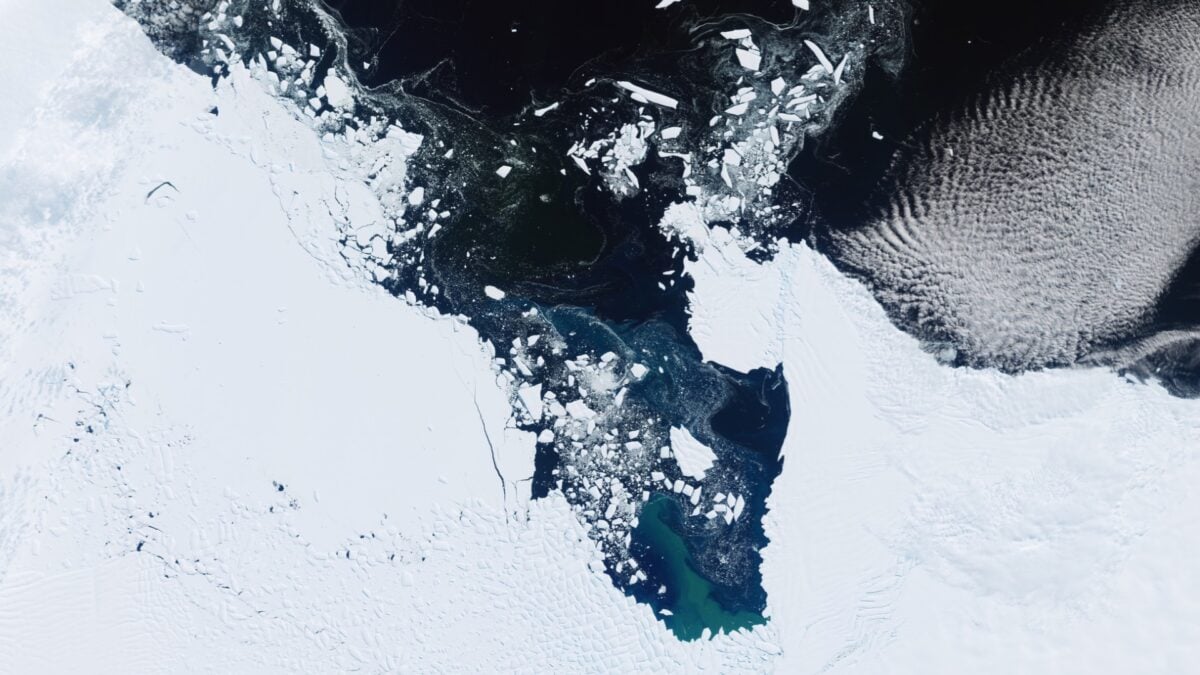
As global temperatures rise, the West Antarctic Ice Sheet is disappearing at an alarming rate. Scientists have grown increasingly concerned that its outlet glaciers—including Thwaites, also known as the “doomsday glacier”—are going to collapse. A deeper look at the ice sheet’s climate history has only heightened their alarm. A study published Monday in the journal Nature Communications presents direct evidence that West Antarctica’s most vulnerable ice streams repeatedly collapsed and retreated far inland during natural periods of global warming over the last 800,000 years. That includes Thwaites and the neighboring Pine Island Glacier, two massive, fast-flowing outlet glaciers that discharge ice into the Amundsen Sea. During those past warm periods, global average temperatures were only 1.8 to 2.7 degrees Fahrenheit (1 to 1.5 degrees Celsius) warmer than pre-industrial levels, meaning they were about the same as they are today. Even so, water temperatures in front of the West Antarctic Ice Sheet rose between 1.8 and 5.4 degrees F (1 and 3 degrees C) above the current, near-freezing baseline. While previous collapses took place over several thousand years, global temperatures are rising at an unprecedented rate today. United Nations’ scientists recently determined that Earth’s average temperature is set to rise more than 2.7 degrees F (1.5 degrees C) above pre-industrial levels within the next few years, overshooting the Paris Agreement target. At the 31st annual UN climate conference this week, negotiators are discussing a pathway to reverse that overshoot, but doing so will require a global commitment to rapidly phase out fossil fuels. “I’m personally convinced that future generations will see substantial sea level rise,” study co-author Rob Larter, a marine geophysicist at the British Antarctic Survey, said in a statement. “How fast we’ll see that rise is really difficult to say. This study shows that even in past natural warm periods we had a lot of ice loss, but what we’re living in now is an interglacial on steroids.” History repeats itself To piece together how the West Antarctic Ice Sheet responded to past interglacial periods—natural warm phases of Earth’s climate—Larter and his colleagues analyzed mud cores drilled from the surrounding ocean floor. They were looking for a mineral called kaolinite that typically forms in wet, tropical climates. Believe it or not, that’s what the Antarctic continent looked like more than 34 million years ago. The enormous weight of glaciers like Thwaites and Pine Island can grind out ancient kaolinite stored inside the bedrock beneath the ice sheet. Icebergs and water currents then carry it offshore, where it eventually settles into the ocean sediment. This mineral therefore serves as a marker of active glacial outflow. But when the researchers looked for it in sediment cores dating back to interglacial periods over the past 800,000 years, kaolinite concentrations were near-zero in every single one. “When the kaolinite signal at our drill-core sites suddenly collapses, it tells us the marine-based ice in the Amundsen Sea sector of the West Antarctic—including Thwaites and Pine Island glaciers—must have melted and retreated far back into the continent’s interior,” lead author Claus-Dieter Hillenbrand, a marine geologist at the British Antarctic Survey, said in a statement. Finding smectite in the mud cores allowed the researchers to attribute this retreat to increased ocean temperatures. This magnesium-rich clay carries a chemical signature unique to the deep Pacific Ocean floor far north of Antarctica, so it must have been carried there by warm deep-water currents intruding onto the West Antarctic continental shelf and melting the grounded ice that released the kaolinite. Analyzing marine algae in the mud cores then confirmed that waters around the ice sheet were significantly warmer when glaciers retreated. “What we found, to my surprise, is that even under natural conditions we had at least a partial collapse of the West Antarctic Ice Sheet,” Hillenbrand said. “What we are doing now is making it much worse.” The complete collapse of Thwaites Glacier would raise global sea levels by more than 2 feet (65 centimeters). These findings suggest that it is no longer a remote possibility. Human-driven warming is rapidly pushing the West Antarctic Ice Sheet toward its thermal tipping point, and the world is running out of time to reverse course.
Earth Has Been This Warm Before. Here’s What Happened to the ‘Doomsday Glacier’
Full Article
Original Source
Read the full article at Gizmodo →KhanList aggregates and links to publicly available news content. We do not host full articles from third-party sources. Always verify important information with original sources.