
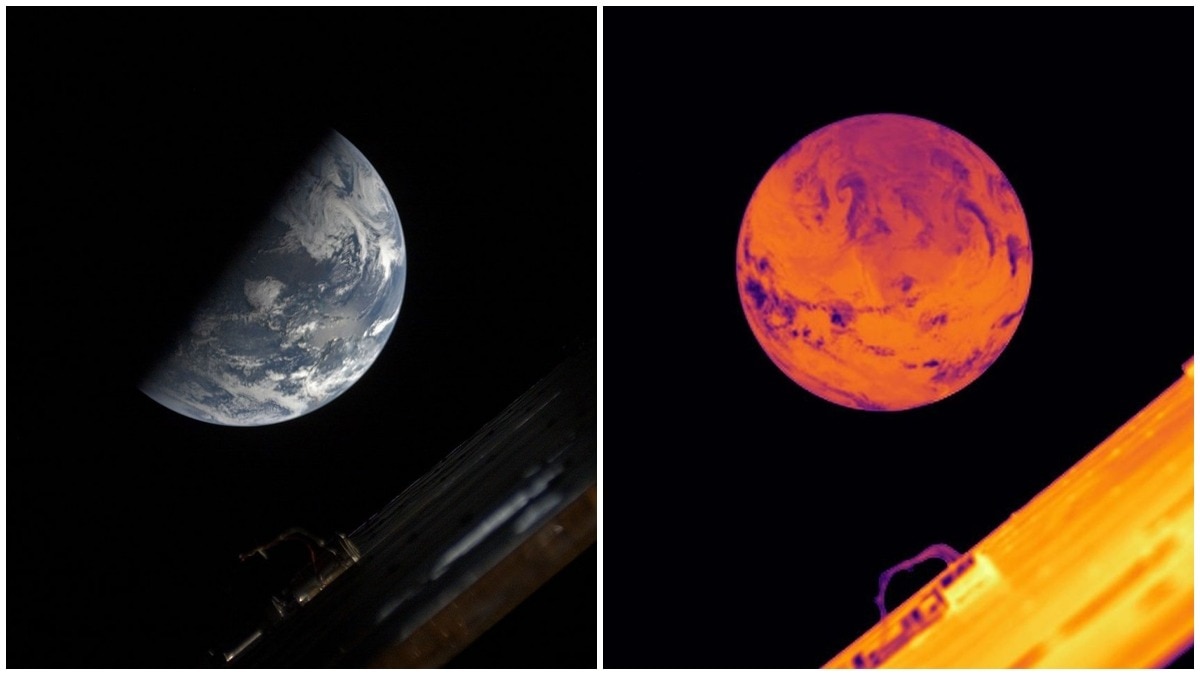
Nasa's twin Escapade spacecraft photographed Earth after using a powered flyby to begin their journey towards Mars. The mission will examine how solar wind contributes to the gradual loss of the Martian atmosphere.Unlike Earth, Mars does not have a strong global magnetic field to shield its atmosphere from the solar wind. (Photo: Nasa)New Delhi,Nov 26, 2026 13:08 ISTEarth has bid farewell to two of its newest robotic explorers, and the spacecraft have returned a stunning glimpse of their home planet before beginning their journey to Mars.Nasa's twin Escapade spacecraft have captured new images of Earth in visible and infrared light after using a close flyby of the planet to propel themselves towards the Red Planet.One of the spacecraft captured the images on November 9, 2026, approximately three hours after completing its closest approach to Earth. At the time, it was around 61,960 kilometres away, offering a view of the Western Hemisphere against the darkness of space.In the visible-light image, Earth appears as a half-lit blue and white globe, with swirling cloud formations visible across its surface. One of the spacecraft's solar panels can also be seen in the foreground, creating a striking perspective of the planet from the departing explorer. One of NASA’s ESCAPADE spacecraft captured this visible-light image of Earth from about 38,500 miles away on Nov. 9, 2026, about 3 hours after making a close approach and performing a powered flyby. (Photo: Nasa) But the spacecraft did not just photograph Earth in visible light. It also captured infrared images that reveal variations in the planet's temperature.In these images, warmer regions appear in shades of white, yellow and orange, while cooler areas show up in blue and purple. These observations demonstrate how the spacecraft's Visible and Infrared Observation System, developed by Northern Arizona University, can capture different characteristics of planetary environments. The images were taken after both Escapade spacecraft successfully completed powered flybys of Earth earlier in November. During these manoeuvres, the spacecraft combined an engine burn with Earth's gravitational pull to gain the momentum needed for their journey to Mars.The twin spacecraft are now beginning a roughly 10-month cruise towards the Red Planet. The spacecraft's farewell pictures show the planet they have left behind. (Photo: Nasa) WHY IS NASA SENDING TWO SPACECRAFT TO MARS?Escapade, short for Escape and Plasma Acceleration and Dynamics Explorers, is designed to investigate how Mars interacts with the solar wind, a stream of charged particles continuously released by the Sun that travels at speeds of around a million miles per hour.Scientists want to understand how this constant bombardment of solar particles interacts with the Martian magnetic environment and contributes to the gradual loss of its atmosphere into space.Unlike Earth, Mars does not have a strong global magnetic field to shield its atmosphere from the solar wind. Understanding this interaction could help scientists explain how the planet evolved from a potentially warmer, wetter world into the cold and largely dry environment seen today. Escapade is designed to investigate how Mars interacts with the solar wind. (Photo: Nasa) The mission is led by the University of California, Berkeley's Space Sciences Laboratory, with key partners including Rocket Lab, Nasa's Goddard Space Flight Center, Embry-Riddle Aeronautical University, Advanced Space and Blue Origin.Funded by Nasa's Heliophysics Division, Escapade is part of the agency's Small Innovative Missions for Planetary Exploration programme.For now, the spacecraft's farewell pictures offer a beautiful reminder of the planet they have left behind, as they begin a mission to understand how another world lost much of its atmosphere to space.- Ends
Earth glows in latest pictures taken by Escapade as it leaves for Mars
Full Article
Original Source
Read the full article at Indiatoday →KhanList aggregates and links to publicly available news content. We do not host full articles from third-party sources. Always verify important information with original sources.