
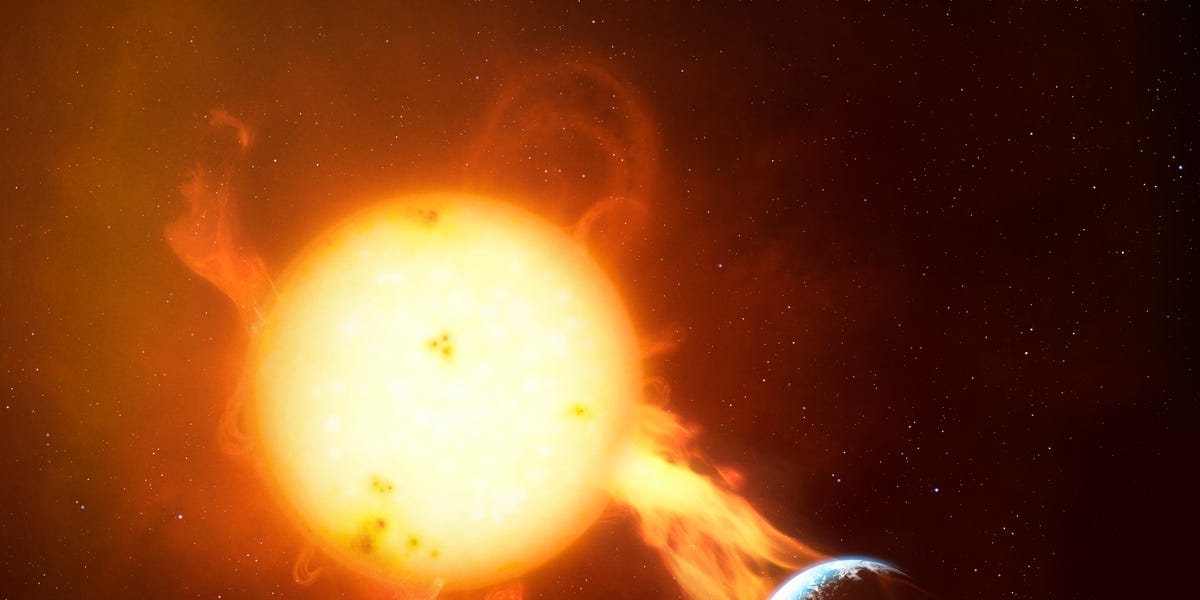
4 min readHere’s what you’ll learn when you read this story:Previous studies of thousands of sun-like stars suggest they produce a “superflare”—100 to 10,000 times more powerful than a normal solar flare—roughly once a century.Our sun has never flung such a massive spike of electromagnetic radiation at Earth, so a new study asked a harder question: whether it could. By correlating active region and flare ribbon size with flare strength, the team found that the Great Sunspot of 1947 carried the prerequisites for a superflare—putting the capability inside our star’s range, even if the timing is rare.When it comes to all the stars in the galaxy, Earth got pretty lucky to get paired up with our G-type main-sequence star—for more reasons than one. The most obvious is that the sun’s warmth and distance helped develop our chunky rock into a life-hosting planet. That combination of light, heat, and energy also drives Earth’s weather and possibly provided the necessary “oomph” to kickstart life as we know it. However, there’s another key aspect of the Sun that makes it such a great celestial partner: It’s uncommonly quiet.This is a very good thing, especially considering our technologically-powered society. Even a more modest solar storm would severely damage high-voltage transformers due to increased magnetic field strengths, leading to massive power outages.“One failure could have a cascading effect across many of these networks,” the United States Geological Survey (USGS) reports. “Automated electronic functions could falter. Blackouts could affect not just neighborhoods, but entire regions.”Scientists have long puzzled why our sun doesn’t seem to be as magnetically active as similar, sun-like stars observed by NASA’s Kepler space telescope or the European Space Agency’s Gaia star-mapping mission. Some of these stars can deliver a collective force of a trillion hydrogen bombs in “superflare” explosions. A study as recent as December 2024 analyzed 56,450 sun-like stars using data from the Kepler space telescope and found that 20 percent of them had produced these superflares within the measured timeframe. Of that 20 percent, superflares occurred on average every century. Critics called the once-a-century rate too frequent to believe. Nobody could explain the stranger part: our Sun appears to be the only quiet one in the crowd.Now a new study, led by scientists at the Max Planck Institute and the University of Boulder Colorado and published in the journal Philosophical Transactions A, reports that our Sun likely does contain this deadly potential. In fact, Earth almost succumbed to one such “superflare” back in the 1940s.Solar flares form when magnetic fields twist and reorganize over complex “active regions,” which contain the Sun’s most active sunspots. Each eruption leaves behind a flare ribbon: a residual glow in the chromosphere, the second layer of the Sun’s atmosphere. Because bigger ribbons mean bigger flares, scientists use ribbon area to gauge a flare’s energy. First, the team tested how reliably sunspot area predicts ribbon size, and also whether ribbon size predicts flare energy. To do that, they used data from the Atmospheric Imaging Assembly collected from the Atmospheric Imaging Assembly (AIA) onboard NASA’s space-based Solar Dynamics Observatory from 2010 until 2016. As you might intuitively expect, the researchers found that a larger Active Region produced larger ribbon areas, and that flare energy scaled with the size of that ribbon area.Then it was time for the researchers to apply this data to past, well-known solar events. With a historical record of sunspots stretching back 400 years, the scientists could infer the size of active regions and then the strength of the eruption itself. According to their analysis, two major events stood out: the Carrington Event in 1859 and the Great Sunspot of 1947.“Of course, we knew that no superflares had occurred during the observation period,” Max Planck’s Natalie Krivova, lead author of the study, said in a press statement. “But the statistical relationship we found between the released energy and the size of the active region should hold true for more powerful events as well.”The Carrington Event is often called “history’s greatest solar storm,” and for good reason. The storm reportedly set fire to telegraph wires and generated aurorae visible all the way to the equator. However, after analyzing the data, the closest call actually occurred in 1947. According to the study, the Great Sunspot of 1947 covered 0.6 percent of the solar disk, or roughly 40 times the diameter of the Earth. The magnetic energy coiled in a region that size reached the low end of what qualifies as a superflare, but the Sun simply didn’t pull the trigger. It’s worth asking what happens when something like that does happen.“The 1947 spot, the largest in the last century, yields the highest possible flare energy within our framework,” the authors write. “This range overlaps with the lower limit of the superflare regime inferred from stellar statistics, suggesting that the Sun could, in principle, reach this level—albeit extremely rarely.”While the Sun has nurtured us from single-celled amoebas into the complex, technological animals of today, that giant ball of nuclear fusion still holds the incredible power to destroy us at a moment’s notice.Darren lives in Portland, has a cat, and writes/edits about sci-fi and how our world works. You can find his previous stuff at Gizmodo and Paste if you look hard enough.
Earth Dodged a Trillion Hydrogen Bombs in 1947—but a Sun Superflare Could Unleash That Power Soon
Full Article
Original Source
Read the full article at Popularmechanics →KhanList aggregates and links to publicly available news content. We do not host full articles from third-party sources. Always verify important information with original sources.