
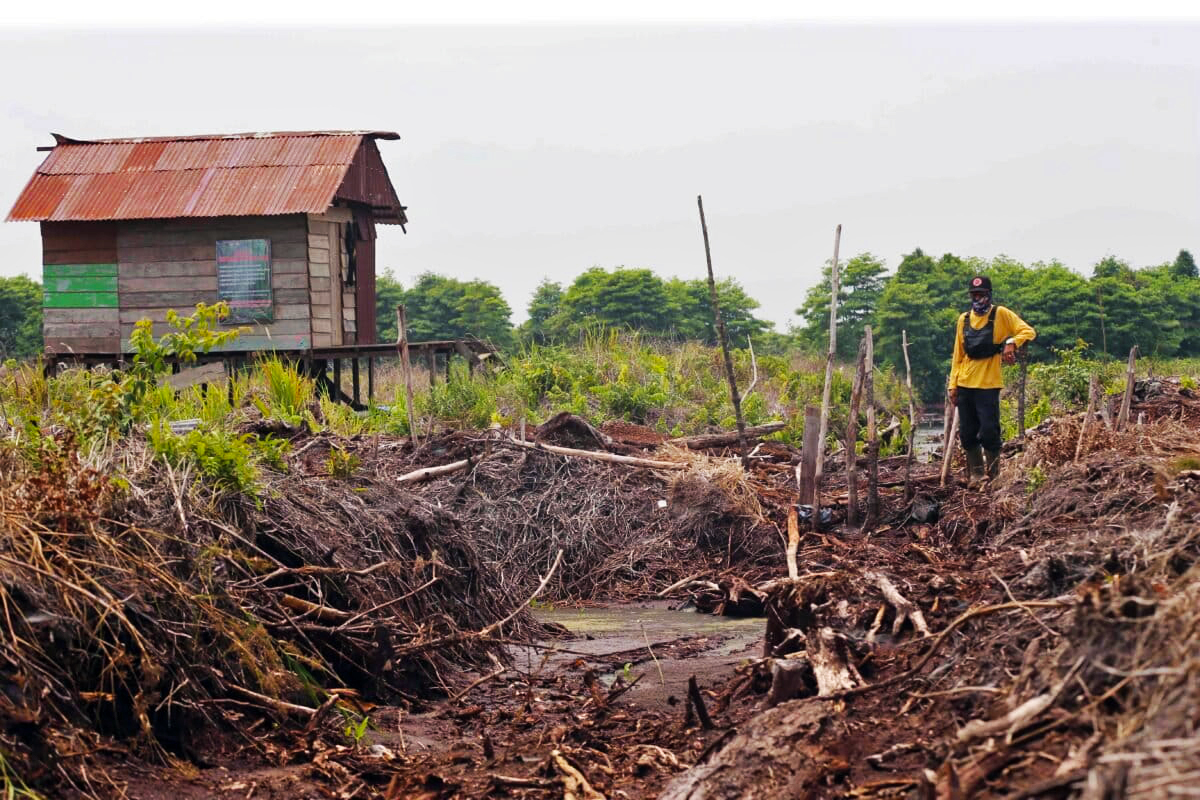
Indonesia is experiencing its worse wildfires in years as a strong El Niño delays the onset of the archipelago’s main rainy seasons after months of drought across much of Borneo and Sumatra.In the Sumatran district of Muaro Jambi, a fire in a community-managed forest spotlights an in-tervention backed by Canada’s overseas office and the University of Waterloo.The early-warning system detects increases in temperature and declining water levels, among other readings.Designed to be simple to both install and maintain, it can publish data collected in the public domain, and could give communities and civil servants working on fire prevention more infor-mation in real time. MUARO JAMBI, Indonesia — Pineapples rattled around in the basket on the back of Tahang’s motorcycle as he drove through the cracked and dried out peatland in eastern Sumatra’s Muaro Jambi district. Tahang later pulled up beside local residents Ali and Haidir, as smoke drifted in the distance over a grove of areca palms, which are grown for their betel nuts. “Did you see that fire earlier?” Tahang asked. “Yes, but it was only small,” Haidir replied. A few hours later, as Tahang rested in Muara Medak village and Ali returned to collect pineapples, the fire spread through dry grass and reached the carbon-rich peat. “It exploded,” Tahang said. Tahang picked up his water pump and raced to the field by motorcycle. By the time he arrived, he told Mongabay Indonesia, state firefighters and disaster agency staff were already battling the blaze, with little water available. A dry canal in the Air Merah community forest area. Image by Teguh Suprayitno/Mongabay Indonesia. Wildfire crisis across Indonesia Indonesia is facing its worst wildfire crisis in years, as months of drought across much of Borneo and Sumatra are compounded by a strong El Niño, which is delaying the onset of the archipelago’s main rainy season. In Sumatra’s Jambi province, fires have burned in Bukit Tigapuluh National Park and across extensive peatland areas in Berbak-Sembilang National Park, a major wetland adjacent to the subdistrict of Sungai Gelam designated as a UNESCO biosphere reserve. Peat in Jambi’s Sungai Gelam reaches depths of up to 11 meters (36 feet), forming a carbon-rich ecosystem that supports at least 22 recorded bird species and provides range for the critically endangered Sumatran tiger (Panthera tigris sumatrae). But decades of human activity have altered the peatland’s hydrology, explained Sri Wilarso Budi, a forestry professor at Indonesia’s IPB University. Much of the area was once a logging concession, while today canals dissect the landscape to drain excess water off oil palm plantations. The loss of vegetation and disruption of natural drainage have upset the peatland’s water balance, contributing to recurring fires that further degrade the landscape and threaten local livelihoods. The 2026 fires were predictable, Wilarso said: Warnings of a strong El Niño were issued months in advance. “This should have been anticipated,” he added. The community manages the 1,764-hectare (4,359-acre) Air Merah village’s cooperative under Indonesia’s community forestry scheme, which has devolved more than 8 million hectares (19.8 million acres) of forest to community management over more than a decade. However, the forest here burned during the El Niño-driven fire seasons of both 2015 and 2019. “In 2026 it’s burned down again,” Tahang said. A collaborative project supported by Fincapes has installed an early warning system on the Gelam River. Image by Teguh Suprayitno/Mongabay Indonesia. Asmadi Sa’ad at the University of Jambi said recurring fires in the province were fueled by large-scale peatland clearing and canal construction, while efforts to block canals often came too late. “Canal blocks should be built before the land dries out, not afterwards,” he said. Water levels have fallen to up to 2 m (around 6 ft) below ground. Stabilizing water levels would likely require as long as four years of consistent canal blocking, he said. While restoring peatlands takes years, detecting dangerous conditions early could give residents more time to contain a fire before it spreads. Early warning In late August 2026, a project funded by Global Affairs Canada installed two do-it-yourself, fire early-warning systems in the Air Merah community forest in Sungai Gelam. The project is part of Fincapes, which is a joint venture by the Canadian University of Waterloo’s faculties of Mathematics and Environment. The system is designed for easy installation and maintenance in an environment that is unforgiving for electronic components and wiring. When up and running the system combines a number of environmental readings, such as temperature and the water level, and will sound an alarm if these exceed safe levels. “The siren will sound if the sensors indicate dangerous conditions,” Mawardi Muhammad, a Fincapes programme officer, told Mongabay Indonesia. Data on peat conditions in Sungai Gelam can also be accessed online, allowing the public to monitor them. Direct alerts via instant messaging platforms or other notification systems could enable greater access to real-time information. A collaborative project supported by Fincapes has installed an early warning system on the Gelam River. Image by Teguh Suprayitno/Mongabay Indonesia. The early warning is part of a broader reforestation project across 47 hectares (116 acres), combining local crops with native peatland tree species to restore ecosystems while prioritizing livelihoods. Smart solutions using new technology are not new in Indonesia’s forests, where nonprofits have sought to apply everything from bioacoustics to detect illegal logging to AI wildlife tracking to achieve conservation outcomes. In communities at risk of recurring fires, earlier notice of danger could buy valuable time. But the effectiveness of this new system will depend on whether it can reliably identify dangerous conditions early enough for communities to act. In 2026, Tahang and dozens of other local residents joined the group effort to contain a blaze overnight as the fire passed three dried out canals, which are typically dug around the boundary of plantations on peatland. Tahang estimated the fire had burned more than a square kilometer of land. In the days that followed around 300 people fought the fire on the ground, as helicopters dropped thousands of liters of water from from the air. All together, it took 10 days to put out the fire, he said. “We couldn’t cope any longer,” Tahang said. “We had no water.” Banner image: A dry canal in the Air Merah community forest area. Image by Teguh Suprayitno/Mongabay Indonesia. This story was first published here in Indonesian on Sept. 15, 2026. Indonesia’s new peatland agency faces questions over what it will do differently ‘There could be local extinction’: The fight to protect Indonesia’s orangutans as El Niño fuels fires Cite this articleTeguh Suprayitno (2026). Early tech warning hopes to give Sumatra’s peat community a head start on fires. Mongabay Conservation news. DOI: https://doi.org/10.66709/news-334356 Credits Topics
Early tech warning hopes to give Sumatra’s peat community a head start on fires
Full Article
Original Source
Read the full article at News →KhanList aggregates and links to publicly available news content. We do not host full articles from third-party sources. Always verify important information with original sources.