
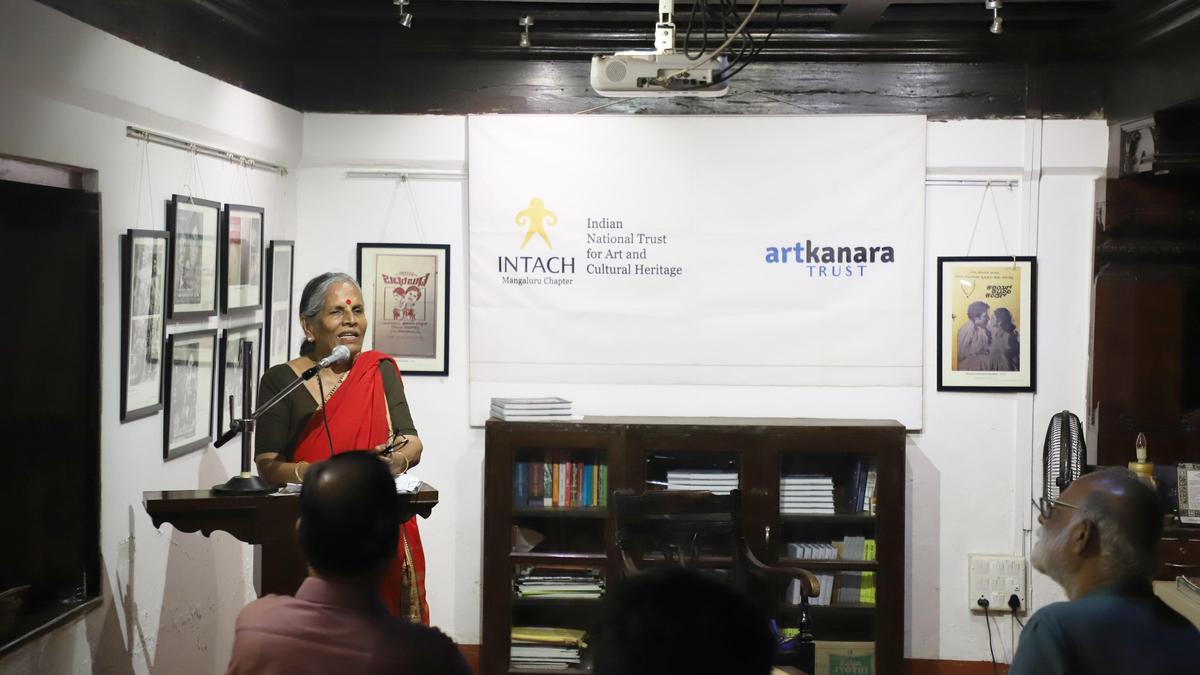
Author and researcher Indira Hegde speaks on ‘The Traditional Kambala of Tulunadu’ at the World Heritage Week celebrations on Tuesday at Kodialguthu Centre for Art and Culture in Mangaluru. | Photo Credit: SPECIAL ARRANGEMENT Stating that Kambala might have evolved alongside settled agricultural practices in Tulunadu, author and researcher Indira Hegde said the earliest documented evidence of Kambala dates back to 1232 AD inscription.She was speaking on ‘The Traditional Kambala of Tulunadu’ at the ongoing World Heritage Week celebrations organised by Indian National Trust for Art and Cultural Heritage (INTACH), Mangaluru Chapter, and Art Kanara Trust on November 24.While there was no definitive evidence of when the tradition began, Ms. Hegde said references in older paddanas (oral epics) offer insights into Kambala’s antiquity. She cited a 1232 AD inscription of Balla Mahadevi of the Alupa dynasty, found at the Neelavara Bhagavathi Temple, now known as the Mahishamardini Temple, as the earliest documented evidence of Kambala. The reference indicated that the tradition was already well established by that time.Inclusive traditionHighlighting the close relationship between Kambala, Bhoota Kola and the land and communities of Tulunadu, Ms. Hegde described Kambala as one of the region’s most inclusive traditions. “Kambala transcended barriers of caste and religion. Communities across religious groups maintained Kambala buffaloes, while Christian and Beary Muslim communities also conducted Kambalas. Even today, Dalit communities possess a deep knowledge of its rituals. It is one of the most inclusive traditions of Tulunadu,” she said.However, she pointed out that the inclusiveness did not extend to women, who were traditionally restricted even from watching Kambala, let alone participating in it.Ms. Hegde also explained the distinction between Kambala conducted as a traditional practice and as a sport. She discussed variations in customs and rituals across different parts of Tulunadu and their cultural significance to local communities.The talk was followed by an interaction with the audience on the commercialisation of Kambala, its history among different communities, gender-based restrictions and its future. Published - November 25, 2026 08:14 pm IST
Earliest documented evidence on Kambala dates back to 1232 AD, says researcher
Full Article
Original Source
Read the full article at Thehindu →KhanList aggregates and links to publicly available news content. We do not host full articles from third-party sources. Always verify important information with original sources.