
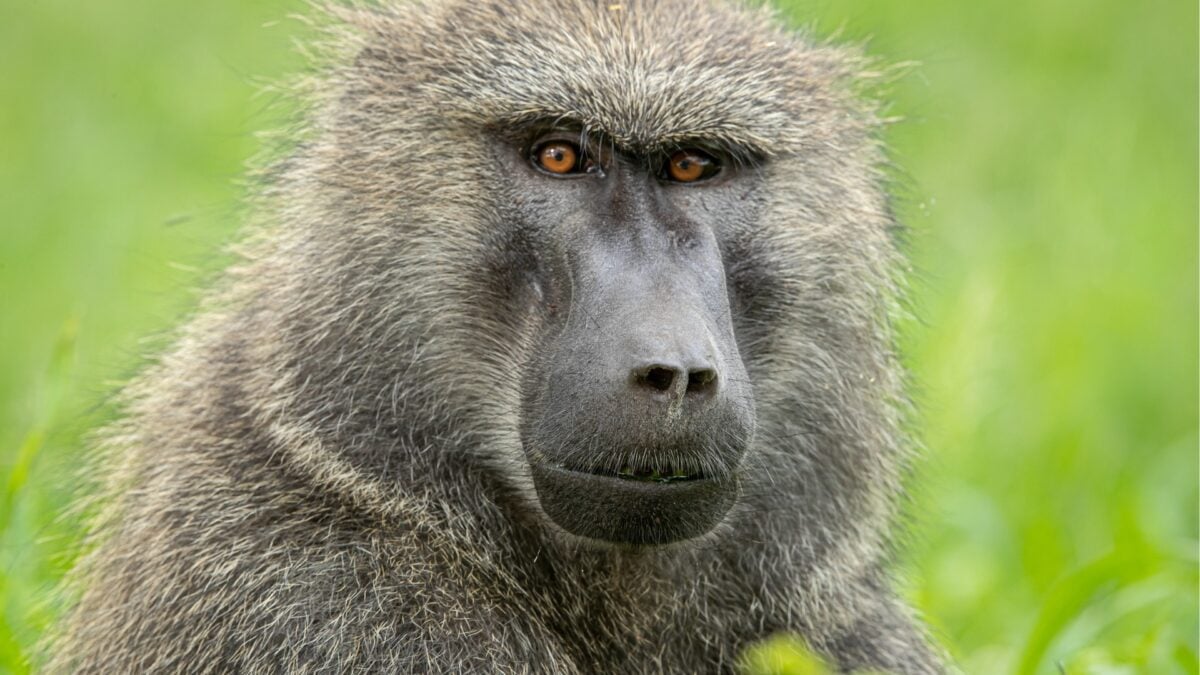
For tens of millions of years, eagles have ruled the skies among the strongest and most formidable birds of prey. These skilled hunters have been known to attack surprisingly large animals, including primates weighing up to 29 pounds (13 kilograms). But a new study shows that eagles are actually capable of taking down even bigger prey, and the findings have interesting implications for human evolution. Researchers working in the sandstone cliffs of northern Chad discovered skulls and bones of adult male baboons with clear signs of eagle predation: talon punctures to the skull and scrapes across the shoulder bones. After calculating the baboons’ weights, they found that the largest came in at over 57 pounds (26 kilograms). That’s well within the size range of some early hominin species. If confirmed, the findings—published today in the American Journal of Biological Anthropology—would indicate that some of our ancient ancestors may have been more vulnerable to avian predation than previously thought. This pressure could have played an important role in the evolution of our species. “At first, the idea of eagles hunting adult male baboons seemed to exist on the thin edge of possibility, until it didn’t,” senior author Nathaniel Dominy, an anthropologist and evolutionary biologist at Dartmouth College, said in a statement. “Our skepticism slowly gave way to acceptance. The evidence was convincing.” Punctured primates During an expedition in February and March 2025, Dominy and his colleagues observed Verreaux’s eagles (Aquila verreauxii) while searching for olive baboons (Papio anubis) in the Ennedi Plateau. The researchers never imagined that these large raptors would pose a threat to baboons. “Then we found the first skull with a puncture mark, and then another, and another,” lead author Catherine Hobaiter, a primatologist at the University of St Andrews, said in a statement. They initially recovered remains from nine baboons, including eight adult males. Two of the skulls had punctured eye sockets, and the researchers also found a shoulder blade that appeared to have been raked by talons. Using a femur associated with one of the males, they estimated its body mass to be roughly 48 pounds (21.8 kg). Then, during another round of fieldwork in June of this year, the researchers found the cranium and partial skeleton of another adult male, for a total of 10 baboons. This one was much larger, with an estimated body mass of 57.8 pounds (26.2 kg). Once again, they observed evidence of talon punctures and severe raking of the shoulder blades. Eagles have long hunted primates, but this marks the first time scientists have found evidence to suggest they are capable of killing individuals this big. Prior to this discovery, even our smallest human ancestors were considered too large for these birds of prey to hunt. But adults of different Australopithecus species, bipedal hominins that roamed Africa between 4 million and 2 million years ago, were about the size of these unfortunate baboons. Previous studies have found evidence to suggest that raptors hunted Australopithecine juveniles, as seen in the Taung Child skull. The study therefore raises new questions about the evolution of key human behaviors. Primate defense strategies against land predators differ significantly from those against aerial predators. They tend to respond to eagle attacks by “mobbing,” when multiple individuals—particularly large adult males—charge the predator in an attempt to drive it off. If early humans were threatened by eagles or other birds of prey, this may have influenced early humans’ communication, group cooperation, or other behaviors, opening up a new avenue for research into the evolution of our species.
Eagles Are Killing Baboons the Size of Our Early Ancestors. That Wasn’t Supposed to Be Possible
Full Article
Original Source
Read the full article at Gizmodo →KhanList aggregates and links to publicly available news content. We do not host full articles from third-party sources. Always verify important information with original sources.