
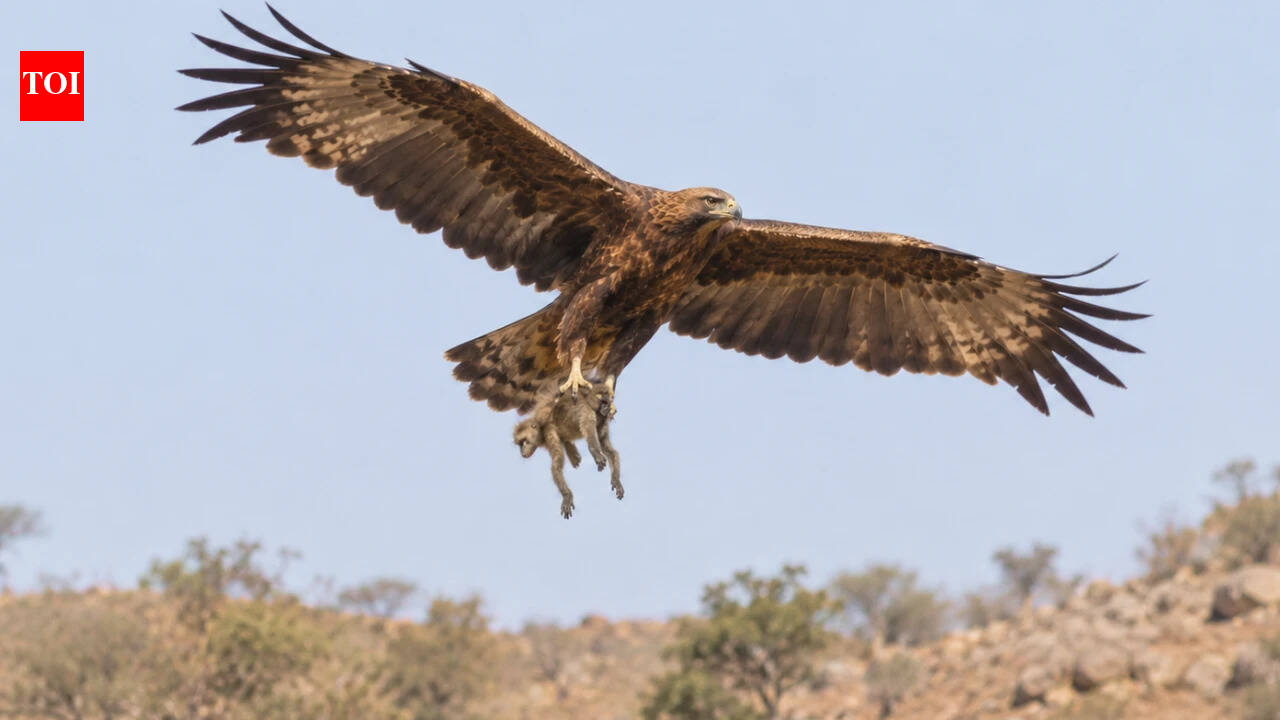
An AI generated representationEagles, with their sharp talons, can be incredibly feisty avians, ones that we perhaps imagine as predators of fairly small animals, such as rabbits or rodents. But we might not imagine an animal weighing more than 20 kilograms being attacked by their sharp claws. However, a discovery in the rocky landscapes of Chad has nudged researchers to reconsider just how vulnerable some of our primate relatives might have been to these predators in the sky.According to a study published in the American Journal of Biological Anthropology on November 18, 2026, researchers examining baboon remains from the Ennedi region of northeastern Chad discovered puncture marks on two adult baboon skulls, suggestive of damage caused by eagle talons. Further fieldwork in June 2026 revealed a third skull bearing similar marks.The study, titled Signs of Eagle Predation on a 22-kg Adult Primate, was led by Catherine Hobaiter, alongside Tewogbade J. D. Akpona, Gisela H. Kopp and Nathaniel J. Dominy, with researchers affiliated with the University of St Andrews, African Parks, the Max Planck Institute of Animal Behavior, the University of Konstanz, Dartmouth College and other institutions. The findings have also raised questions about the possibility that even fairly large primates could have been vulnerable to attacks from birds of prey.The research findings in ChadThe fieldwork took place in the Ennedi Natural and Cultural Reserve in northeastern Chad, where researchers surveyed sandstone cliffs and the rocky deposits at their bases. This region is home to distinct species, such as olive baboons (Papio anubis), as well as several species of birds of prey, including Verreaux's eagles (Aquila verreauxii).During their surveys, the team retrieved skeletal remains of baboons, including skulls and fragments of other bones. Some of these remains carried particularly interesting signs of damage. Two adult male baboon skulls had conspicuous punctures around the eye sockets, also known as the orbits. Additionally, researchers documented damage to a shoulder blade, or scapula, of one of the animals. The punctures and scraping marks resembled damage that had previously been documented on primate remains recovered from beneath eagle nests.Further fieldwork in June 2026 brought another important discovery. Researchers recovered the skull and partial skeleton of an adult male baboon, estimated to have weighed approximately 26.2 kg, which also carried puncture marks near the eye socket and severe scraping on its shoulder blades. Together, these findings strengthened the possibility that the animals had encountered large eagles.Why are the marks significant?The location and appearance of the punctures are particularly important because they resemble injuries associated with the way large eagles grip their prey. Their talons can inflict deep wounds, and the shoulder blade damage observed in one of the baboons was also consistent with patterns documented in eagle feeding activity.The researchers considered other possible explanations for the injuries rather than immediately attributing them to an aerial predator. Gunshot wounds, for instance, could produce punctures, but the skulls did not show the additional damage that would ordinarily be expected. Injuries sustained during fights between male baboons, when canine teeth can cause serious wounds, were another plausible consideration. However, the researchers did not find the crushing damage or additional tooth marks that would support this explanation.Scavenging could not be completely ruled out either, since Verreaux's eagles sometimes feed on animals that have already died. Nevertheless, the severity of the punctures suggested that the birds might have used their talons in a potentially lethal grip rather than simply handling a carcass.The researchers therefore consider eagle predation a plausible explanation, although the available remains cannot establish exactly how the baboons died.Could large eagles have hunted adult primates?One of the more interesting aspects of this discovery is the size of the animals involved. Researchers estimated the body mass of the baboons by measuring the heads of their femur bones, the upper leg bones that connect to the hip. Using established equations for estimating body mass in monkeys, they found that the recovered sample eventually included eight adult males with an average estimated weight of 22.2 kg.Until now, researchers have generally considered primates weighing more than 13 kg to be beyond the confirmed range of avian predation. Although large eagles are known to hunt monkeys and smaller baboons, evidence of attacks on adult primates of this size has been extremely limited.Verreaux's eagles, which inhabit mountainous and rocky landscapes across parts of Africa, are particularly interesting in this context. Their preferred prey includes rock hyraxes, small mammals that weigh around 4 kg, but they are also capable of hunting larger animals, including certain antelopes.The study also highlights how the landscape itself may have played an important role. For instance, the Ennedi region has steep sandstone cliffs and narrow valleys, where baboons often spend time resting, feeding and moving along vertical rock faces. These locations provide protection from ground predators such as lions and leopards. However, they may also expose the animals to eagles that can attack from the surrounding cliffs.A look at human ancestorsThe findings point towards a fascinating aspect of human evolutionary history that researchers are now examining. Discussions about predators faced by early hominins, a group that includes modern humans, have often paid heed to larger mammals such as the big cats.But if large eagles were capable of attacking adult baboons of considerable weight, it changes the way we understand the history of predators and their possible prey. It also opens up a range of insights into the way of life during those periods and how encounters with threats may have influenced the evolution of certain behaviours and physical attributes.
Eagle talon marks on 3 baboon skulls raise questions about early human predators
Full Article
Original Source
Read the full article at Timesofindia →KhanList aggregates and links to publicly available news content. We do not host full articles from third-party sources. Always verify important information with original sources.