
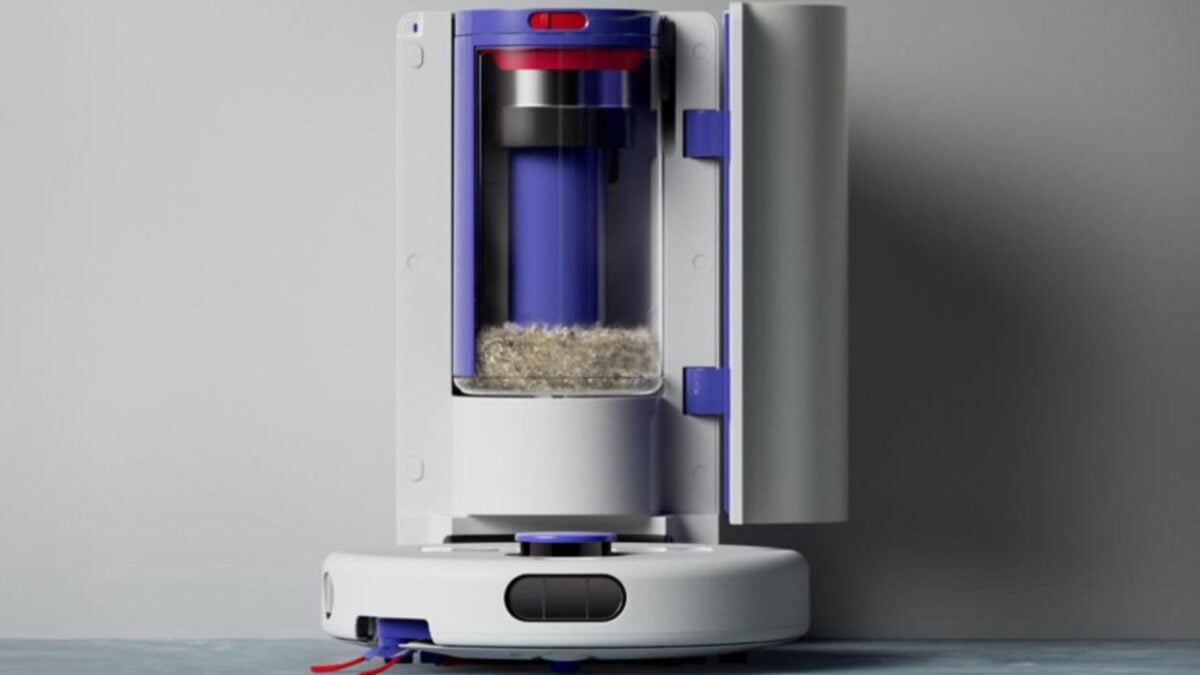
Dyson has released three new robot vacuums this week: the $550 R1 Nurovi Dry, the $700 R2 Nurovi Wash+Dry, and the $1,200 R3 Nurovi Spot+Scrub. And it’s actually the cheapest of those that caught my eye the most. Robot vacuums can be a very nice thing to have around the house, but high-end floor bot pricing has ballooned out of control lately, with some encroaching on the $2,000 marker. At the same time, some of these robots—I’m looking at you, Dreame Aqua10 Ultra Roller—can whiff so hard on the basics that it’s impossible to justify spending that cash. I don’t know about you, but I long for a cheaper, simpler robot vacuum that can still map my home, navigate well, and has good obstacle avoidance. That seems to sum up the R1 Nurovi Dry. © Dyson The R1 features 21,000Pa suction, a mid-tier spec compared to some other robovacs that reach into the 30,000s and higher. But as Dyson chief engineer Jake Dyson is quoted as saying in a press release emailed to me this week, “Robotic cleaning isn’t just about suction power.” I’m inclined to agree, based on all of the various robot vacuums I’ve tested. For example, the best model I’ve tested for picking up dust and dirt remains the Matic robot vacuum, which only sucks air at 3,200Pa in its standard cleaning mode. So what does the R1 do instead? A cross-section render on the Dyson site (check it out below) shows a smaller channel that brings fine debris into one chamber, while a larger channel above it collects bigger chunks in another. The company also says it can “intelligently detect dust levels and floor types in real time” to adjust its suction power and cleaning behavior, and its self-emptying dock uses a cyclonic canister instead of a dust bag you’d have to replace every few months. © Dyson The R1 has other premium-style features, including a side sweeping brush that reaches out to get into tight spaces the robot otherwise wouldn’t be able to reach. The company says in its press release that this brush has been “engineered at a precise angle” with a connector that “actively controls the pressure and direction of the brushes” to keep from flicking debris away from the robot, instead directing it into the robot’s path. I’ve seen similar claims from other robot vacuum makers, and I’d be interested to see how this plays out in real-world testing. Furthermore, Dyson says the R1 can climb up to 0.79-inch floor transitions and is fairly squat at 3.78 inches tall, meaning it can get under very low furniture. That’s not the shortest, but it’s pretty good—for comparison, the Dreame X60 Max Ultra Complete stands at 3.12 inches tall when its periscope-like sensor cluster sinks into its body. But that’s a $1,700 vac-bot; I’ll take the extra half an inch to save $1,100. The R1 uses LiDAR for mapping and navigation, as well as “line lasers and edge sensors” for object avoidance. © Dyson © Dyson All of the above can be said for the R2 as well, which also features dual triangular mop pads that the company says can better get into edges and corners, while its dock washes the pads using 167-degree water. Meanwhile, the R3 adds AI vision cameras and uses UV light for “forensic checks” after cleaning “for full proof of a hygenic clean.” It also features 30,000Pa suction and a roller mop that extends to reach edges but lacks the articulating side brush of the other bots. The R1 Nurovi Dry and R3 Nurovi Spot+Scrub are each available now on Dyson’s website. The R2 Nurovi Wash+Dry is exclusively available at Costco.
Dyson’s Latest Robovac Is Ideal for People Who Don’t Care About Mop-Bots
Full Article
Original Source
Read the full article at Gizmodo →KhanList aggregates and links to publicly available news content. We do not host full articles from third-party sources. Always verify important information with original sources.