
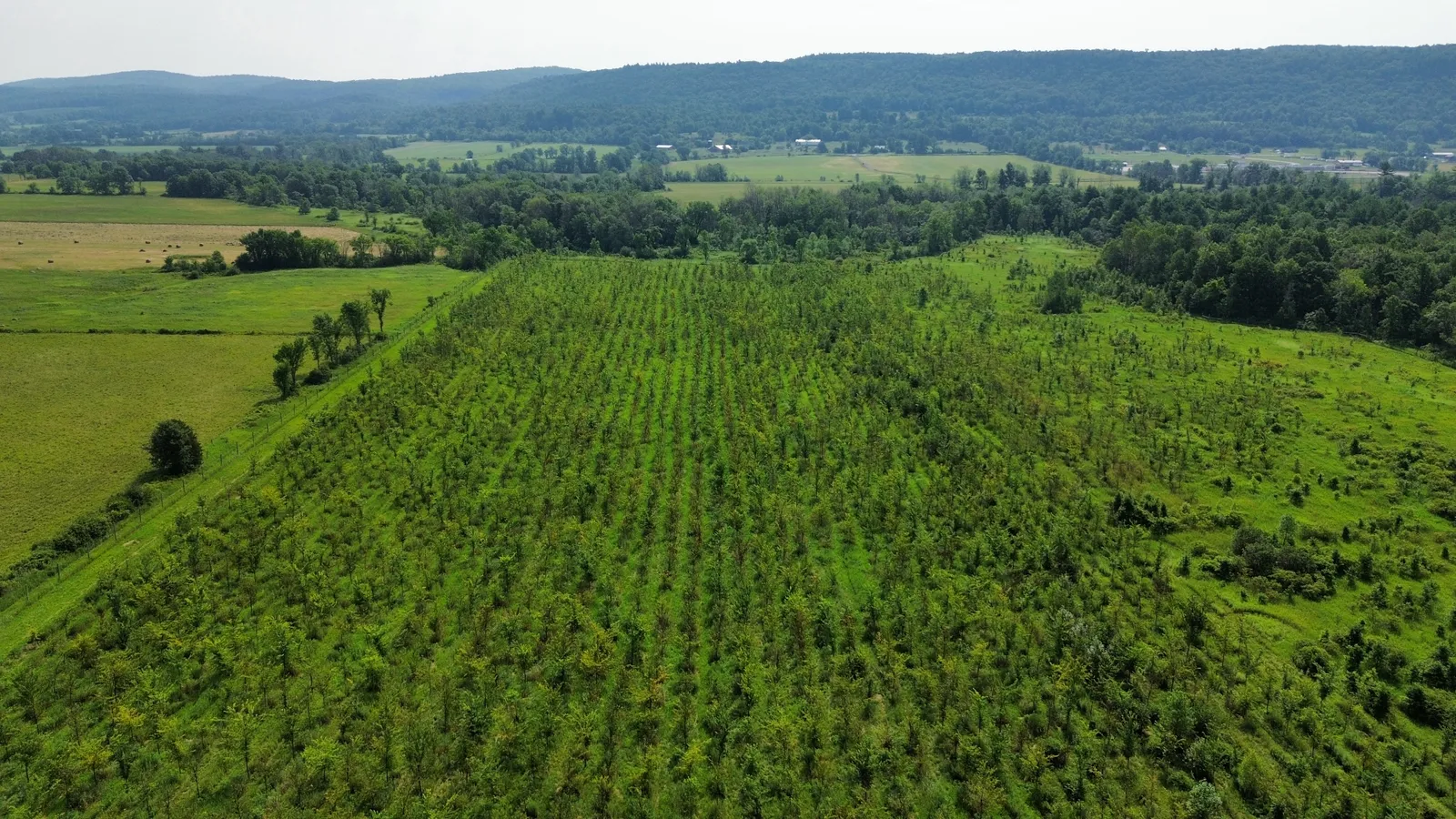
Researchers are working to restore the American elm to the natural landscape—and eventually your front yard November 20, 2026 8:30 a.m. Researchers are testing 5,000 elms in Benson, Vermont, near the New York border, and 700 in Lemington, about eight miles south of Canada, deliberately infecting trees that range in age from six to 12 years old to identify the most disease-resistant survivors. Bernadette Osborn/The Nature Conservancy Vermont In some ways, Leila Wilson’s idyllic relationship with the American elm is a familiar story. “We had a big elm on the hill of our driveway that we put a tire swing on when I was a kid,” says the U.S. Forest Service research ecologist, recalling her childhood home outside of New Haven, which is known as Elm City. Countless grandparents have a similar story to tell. What’s unique about Wilson’s recollection is the timing. Her childhood memories date back to the 1980s, and by then millions of American elms were gone—already felled by a fungus. Wilson’s father, a forester, understood the significance of the family tree, which still stands. When she was in high school, he told her about the U.S. Department of Agriculture’s elm program in central Ohio, where researchers still fight Dutch elm disease—the office where she now works. Leila Wilson is a U.S. Forest Service research ecologist. David Middleton This summer, Wilson and her team, armed with vials of the fungus, laid the groundwork for significant breakthroughs by killing healthy elms. If the science holds—and with a little luck—researchers could identify more than two dozen genetically diverse American elms in the next few years to help restore forests. The USDA has been working toward this goal since it began screening elms for disease resistance around 1937; a genetically diverse population could better withstand Dutch elm disease and other future threats. Most homeowners don’t realize disease-resistant elms are already available, but this research could give the USDA its widest selection yet for restoring forests. Some of the trees may eventually reach nurseries for homeowners to plant. How the American elm became symbolic From the mid-1800s into the early 1900s, Americans planted millions of elms along streets and throughout public spaces, in part because the trees tolerated a wide range of conditions, including poor soil, compaction and urban pollution. “The village improvers, the first and most significant thing they do, project they undertake, is the planting of these elm trees,” said Thomas J. Campanella, a historian of city planning and the urban built environment at Cornell University, during an October 2022 appearance on the podcast “This Old Tree.” Unlike oak or maple, elms have interlocking grain that makes their wood difficult to split, so loggers saw little value in them. Their appeal lay instead in their graceful, architectural form: a vase- or umbrella-shaped crown with limbs that arch up and outward. When elms grow on opposite sides of a road, their sweeping branches create the cathedral-like canopy over the street that became their hallmark. That branching is why Frederick Law Olmsted and Calvert Vaux wanted rows of elms lining Central Park’s Mall. “Other trees can do that, but to me, the elm has this movement that is really beautiful and almost like a dancer,” Wilson says. Beginning around 1840, American elms shaded—and gave their name to—streets across the country. The USDA estimated that, at their peak, elms numbered 77 million in the urban landscape, a figure that excluded those in yards, like Wilson’s. Then by the 1950s, Dutch elm disease brought a real-life nightmare to Elm Street, killing the trees on a national scale. American elms line Central Park's Mall in New York City. Diana Robinson Photography/Getty Images The unwelcome arrival of Dutch elm disease Dutch elm disease likely originated in Asia and was first studied in the Netherlands in 1919. The disease probably reached the United States in 1930 through the port of New York in European elm logs destined for furniture veneer. Bark beetles and connections between neighboring trees’ roots spread the fungus, triggering blockages in an elm’s water-conducting vessels, severing the supply to the canopy. Leaves yellow, wilt and fall, and branches die back as the infection spreads, eventually killing the tree. The most common way to protect an elm is to inject it with a preventive fungicide every one to three years—not exactly a DIY task. In 1930, Curtis May, a research technician at the Ohio Agricultural Experiment Station, first identified the disease after receiving samples of trees from Ohio, collected by plant pathologist Paul Tilford in Cleveland and Cincinnati. Christine Buisman, a visiting Dutch scientist, confirmed the diagnosis. Beetles spreading Dutch elm disease chew tunnel patterns beneath the bark of an elm tree in Benson, Vermont. Jessica Rinaldi/The Boston Globe via Getty Images The disease traveled longer distances when people transported infested elm logs for firewood. Because the American elm’s native range is vast—stretching from Canada south to Texas, and from the East Coast across the Appalachian Mountains to Wyoming—the environmental loss has reached well beyond Main Street. The blight has killed more than 55 percent of the elm trees in the U.S. Scientists have been trying to understand and outsmart Dutch elm disease since Franklin D. Roosevelt was in office. Those who went to school, walked their town’s main street, played in a local park or visited a government building in the 1960s may remember a big, old elm that got sick and had to be cut down—whether in one of those public spaces or in their own backyard. The research into restoring elms isn’t really about returning front yards and boulevards to prewar glory, though both places have benefited from the work. American elm is a foundation species in river floodplain forests, stabilizing streambanks and feeding native insects, birds and small mammals. Dutch elm disease—which is still active—has left floodplains vulnerable to invasive species. “Elms tolerate these floodplains, and that’s a tough ecosystem that a lot of trees can’t tolerate,” says Benjamin Held, a researcher in the University of Minnesota’s plant pathology department who has been working to reintroduce elms. “A number of tree species grow in floodplains, but relatively few are well adapted to the periodic flooding and saturated soils that characterize that environment—elm is one of those species.” These large, long-lived trees helped shape the canopy, the conditions beneath it, and ecosystem processes like water use and nutrient cycling. The decline has become especially consequential in recent years, as the emerald ash borer, an invasive beetle, kills ash trees, one of the elm’s closest ecological substitutes. A promising experiment This summer, scientists from the USDA and the Nature Conservancy walked through tidy rows of elms in Vermont fields. Carrying cordless drills and pipettes—essentially syringes—filled with the Dutch elm disease fungus, Wilson, fellow research ecologist Kathleen Knight, plant pathologist John Butnor, Nature Conservancy scientist Gus Goodwin and their teams went to work. The task was repetitive: bore a small hole in the trunk, squeeze in some fungus goop and move on. Researchers are testing 5,000 elms in Benson, near the New York border, and 700 in Lemington, about eight miles south of Canada, deliberately infecting trees that range in age from 6 to 12 years old to identify the most disease-resistant survivors. This summer, scientists from the USDA and the Nature Conservancy walked through tidy rows of elms in Vermont fields. David Middleton And now comes the waiting. There is always a lot of waiting when dealing with plant pathology. The trees in these test fields took years to grow from seed. Now, Wilson and her team await the fallout. “We rate them for two years, so about summer 2028, we’ll dive into the data we collect early that summer and that’s when we make decisions,” Wilson says. The USDA also has elm stock at two sites in Ohio, closer to Wilson’s office. Researchers infected those trees last year. “So we are already actively looking at the data, but it’s about two to two and a half years until we decide which trees will end up in seed orchards and serve as parents for progeny that can be used for reforestation,” she says. Wilson and her colleagues at the U.S. Forest Service’s Northern Research Station are working to restore American elms across New England. “For New England, ideally we’d have 30 [trees], which is the gold standard for tree species restoration,” Wilson says. With 30 or more trees, the team has enough genetic diversity to help repopulate the region. “Capturing a large amount of genetic diversity is important to enable the population to adapt to future challenges, including changes to the Dutch elm disease fungus, and other changes, like new invasive species or changes in temperature.” For each elm in the test fields in Vermont, researchers bore a small hole in the trunk, squeezed in some fungus goop, and moved on. David Middleton Once researchers identify the ideal specimens, they will plant clones of the parent species in seed orchards in Shelburne, Vermont, and elsewhere in New England for further study. The trees will grow there for about 15 years before producing seeds to plant across the region. “It’s hard work, it’s hard science, it’s really slow, and the wins do not come easily or quickly,” Wilson says. Nursery growers, researchers and scientists have identified about 20 disease-resistant American elms since the early 1920s. Homeowners can buy several of these Dutch elm disease-resistant cultivars, or cultivated varieties bred and selected for specific traits, though tracking them down usually requires going beyond a local garden center. These deliberately bred elms share similar growth traits and can grow two or more feet a year, reaching up to 70 feet tall and wide. Their trunks split into broad, arching branches that form a classic crown. “Princeton” is the classic American elm: vase-shaped, with glossy green leaves. Found in a New Jersey cemetery in 1922, it was selected for its looks long before Dutch elm disease became widespread. “Jefferson,” descended from a survivor of the National Mall’s 1930s plantings, leafs out earlier and holds its foliage later than most elms. Sold as Prairie Expedition, “Lewis & Clark” thrives in the country’s coldest regions. And “St. Croix,” which the fifth-generation family-owned Bailey Nurseries introduced in 2015, traces its roots to a century-old elm in Afton, Minnesota. Beyond their similar shapes and sizes, these elms share a common origin: each cultivar is a naturally occurring genetic variation. Each tree sold under one of these names is a genetic clone of an original. Did you know? Smithsonian Witness Elm An American elm, in a garden at the corner of Constitution Avenue and Ninth Street on the grounds of the National Museum of Natural HIstory in Washington, D.C., has witnessed about 175 years of history. The Smithsonian Gardens cares for the 80-foot-tall tree—the first entry catalogued in its official tree collection. The Vermont test plots contain stock drawn from American elms that are adapted to climates across New England and have shown resistance to the fungus. “Dutch elm disease is killing the trees that are most susceptible, leaving trees that are less susceptible to breed,” Wilson says, adding that the progeny of those trees should have better disease resistance. Researchers produced the trees in the plots through controlled pollination, using four selections with proven Dutch elm disease resistance, including “Princeton” and “Valley Forge,” as mother trees and regional survivors as pollen donors. “That’s an advantage that science in the ’30s, ’40s and ’50s just didn’t have,” she adds. But if scientists already have a handful of proven, Dutch elm disease-resistant cultivars, why not cross those? “We want as much of the genetic diversity that’s in the elm population to come forward with disease tolerance,” says Goodwin. “The idea of a super tree isn’t really what we’re after, because the idea is a population of trees that are adapted to our area that have higher-than-average disease tolerance.” Tinkering with the genetics also carries a risk of losing the very trait you’re trying to preserve. “I haven’t seen as many of the American elms be crossbred, and it could be that when you breed two together, the disease resistance falls out,” says Eric North, program manager of urban forestry at the Arbor Day Foundation. The goal, after injecting thousands of trees, is to find the hardiest among them. The Nature Conservancy of VT Finding new disease resistance from as many different cultivars as possible takes more time than breeding from a small pool of reliably resistant trees, but it also gives future plantings, both in the forest and your neighborhood, a better genetic chance at fighting Dutch elm disease. That emphasis on variety marks a shift from the old practice of lining streets with genetically similar trees. “Modern urban and community forestry is moving towards a diversified planting palette, because we don’t know what the next insect or pathogen that’s out there is going to be. So we need to hedge our bets environmentally and economically, because it’s a massive blow when you have huge percentages of your community forest dying in a very short amount of time,” says Ryan Murphy, a University of Minnesota researcher working on elms alongside Held. The USDA’s Vermont trials may be decades from restoring elms, but for Wilson, the work already brings her full circle, from that elm in New Haven that she swung from. “I think the elm is just beautiful, but the fact that it’s a workhorse and has such a large range that it can grow in almost any environment—it’s just so flexible, and for conservation, that’s a very useful tool,” she says. While the aim of the work in Vermont is to restore forests and floodplains with disease-resistant elms, the benefits will eventually reach town squares and front yards. “We are interested in elms as an urban tree because of the historical legacy,” Wilson says. “I grew up right outside of ‘Elm City’…. It’s part of the city’s identity, and that resonates with me.” You Might Also Like Get the latest stories in your inbox every weekday. More about: Conservation Disease Ecology Forests Fungus Genetics New England Trees Vermont
Dutch Elm Disease Virtually Wiped Out America's Most Iconic Tree. Now, Scientists Are Engineering a Comeback for the Beloved Species
Full Article
Original Source
Read the full article at Smithsonianmag →KhanList aggregates and links to publicly available news content. We do not host full articles from third-party sources. Always verify important information with original sources.