
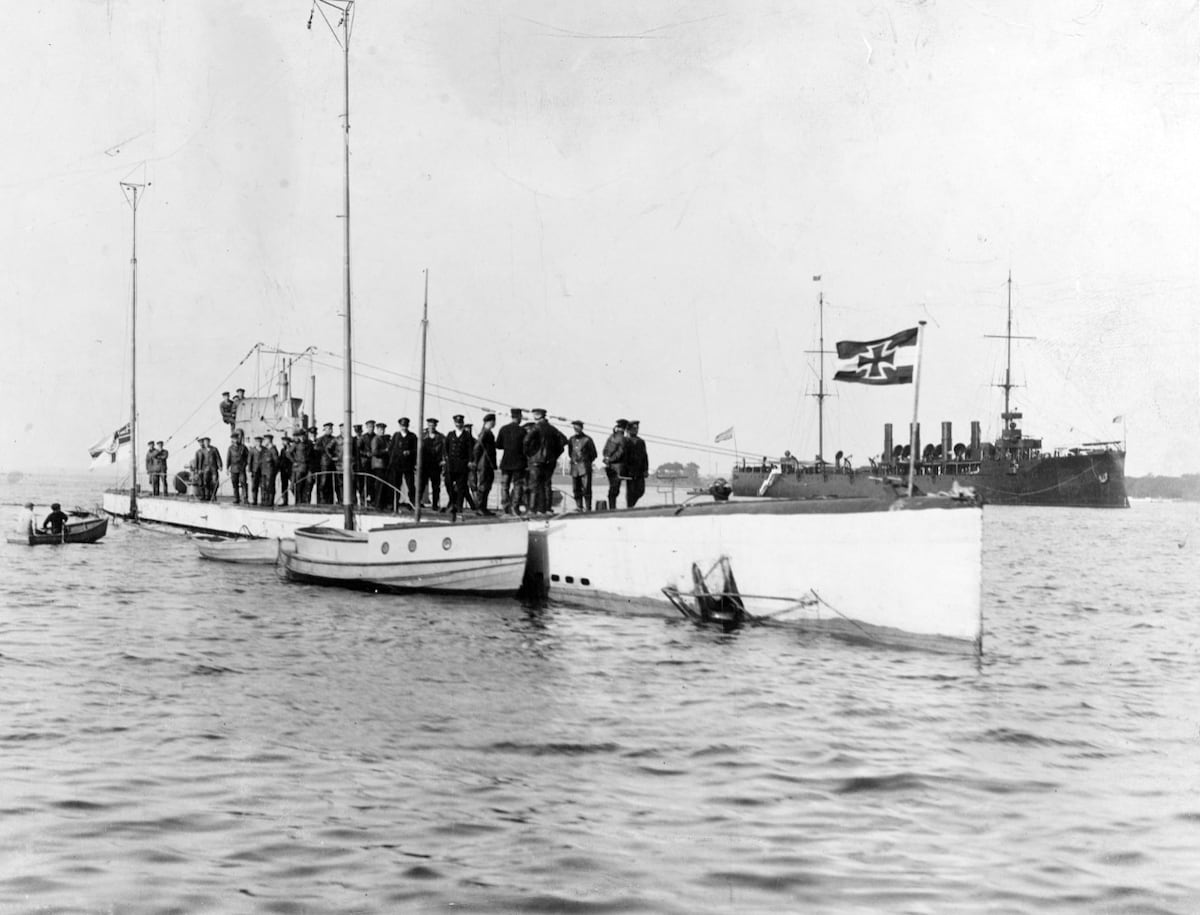
Sailors lined the railings of American destroyers in Newport Harbor, staring in disbelief at the sight before them. Under a bright blue sky, a large gray submarine floated gently on the placid waters of Rhode Island’s Narragansett Bay, within hailing distance of Naval Station Newport, then known as Newport Training Station. The U.S. Naval War College sat on the far side of tiny Coasters Harbor Island.On board the submarine, the crew had assembled on the deck in dress uniforms, which were starkly different than what American sailors were wearing. A dashing figure in officer’s regalia bearing a row of medals across his chest stood at the conning tower. Suddenly, the larger vessel was bumped by a small motor launch with a reporter on board.“Have you come here to be interned?” asked the curious newspaperman. “No,” answered the distinguished officer. “But I’ve brought a letter for the German ambassador. Will you mail it for me?”The submarine’s commander was Kapitänleutnant Hans Rose of the Imperial German Navy. On Oct. 7, 1916, while World War I raged across Europe, he boldly sailed his submarine, U-53, into the neutral port under the incredulous gaze of the U.S. Navy in an attempt to rattle the American public and convince the country to stay out of the conflict.“Audacity,” says Ret. Rear Admiral Samuel J. Cox, director of naval history and curator for the Navy at the Naval History and Heritage Command. “That’s the only word I can think of to describe Rose cruising into Newport. The U.S. was still neutral then, but he did not know how the Navy would react to his arrival.”That event 110 years ago made banner headlines in newspapers across the country and around the globe. Planned months in advance, Rose was under strict orders to sail across the Atlantic Ocean and show up at the Rhode Island naval base to introduce himself to American officers as a “goodwill” gesture. In reality, his courtesy call was a propaganda move designed to shock the United States into fearing the far-reaching dangers of German submarine warfare.“Rose was basically trying to say, ‘My U-boat can reach your shores and you should be aware if you decide to get involved in the First World War,’” said David Kohnen, Naval War College professor, in a video posted on C-Span ClassroomAt the time, millions of lives were being sacrificed on the killing fields of Europe as the Central Powers of Germany, Austria and Turkey tried to deliver a knockout blow to the Entente allies: France, England and Russia. With an impartial stance, the United States looked on as both sides became mired in the mud of trench warfare.Though officially neutral, American factories were churning out armaments — mostly for Entente armies, but also for the Central Powers. Cargo ships of all registries transported this matériel from U.S. ports to the battlefront, prompting the Imperial German Navy to begin hunting freighters carrying “contraband” on the open sea.Early in the war, Germany declared unrestricted submarine warfare — meaning its unterseeboots would attack ships without warning if they believed they were transporting munitions. That changed in 1915 with the sinking of the RMS Lusitania, a British luxury ocean liner. Some 128 American citizens were killed in the attack, prompting calls for U.S. intercession in the war. To calm nerves across the Atlantic, Germany then intercepted ships and checked manifests for wartime supplies. If carrying such a cargo, the ship would be sunk after passengers and crew were offloaded onto lifeboats.“Americans were concerned by the sub threat,” Cox says. “Newspapers carried stories of how freighters were being sunk, some not far off U.S. shores. There was a great deal of tension since ships were the way most people traveled distances then.” Rose received his orders from Cmdr. Hermann Bauer, who was in charge of the German U-Boat fleet. Bauer had cleared the plan with German leader Kaiser Wilhelm II, who believed it would shock the United States into staying out of the war.Hans Rose (Naval Heritage and History Command)“Convinced the Americans were essentially spineless, [the Kaiser] reasoned that a German U-boat sally into a U.S. naval harbor would be so intimidating as to keep the United States out of the war,” wrote journalist Wellington Long in a 1966 article.On the mission, U-53 was supposed to escort the Bremen, an unarmed merchant submarine designed to carry cargo under the British blockade of Germany. However, the two vessels failed to rendezvous, so U-53 crossed the Atlantic on its own (the Bremen was later presumed lost at sea, possibly sunk by a British mine or torpedo).It took U-53 three weeks to make the trip. On Oct. 7, Rose and his crew surfaced in American territorial waters just off the coast of Rhode Island. According to neutrality laws, belligerent warships were allowed into neutral ports for 24 hours, usually for food, water, fuel, repairs or to surrender. Rose needed none of those things, but was concerned how he would be received in the American port, home of the Navy’s Atlantic destroyer fleet.“There I was, a 31-year-old German naval officer… heading my submarine for Newport naval harbor, and no one really knew how neutral those American destroyers would be,” the U-53 commander told Long in an interview.Uncertainty was prevalent that day. Telegrams flew between Newport and Washington, D.C., as local commanders sought guidance on how to respond to the unusual situation. Eventually, the commander of the Second Naval District arrived to find out what was going on in his homeport.A confused Rear Admiral Austin M. Knight asked if Rose required repairs, fuel or anything else, only to be told no. Finally, the American officer stammered, “Well, then, what the devil do you want here?”“I only wanted to visit you, Admiral,” Rose responded.U-53 became a spectacle in Newport Harbor. Yachts and pleasure craft tied up next to the German submarine for a closer look. Citizens and reporters walked her deck and were greeted by friendly German sailors. Officers of anchored American destroyers, including USS Jacob Jones, stopped by to see the U-Boat. Even Rear Admiral Albert Gleaves, commander of the destroyer flotilla at Newport, came aboard — along with his wife and daughter. They were given a tour below decks of the submarine.That afternoon, Rose left the U-53 by water taxi and visited Coasters Harbor Island. He strolled up the steps to the Naval War College and knocked on the door, according to Kohnen. When greeted, Rose answered, “I’m here to mail a postcard.” It was addressed to his mother back in Germany.Eventually, Rose sensed his welcome was wearing thin, so he bid farewell to his hosts and left the harbor. He anchored off of Nantucket Lightship that evening. At first light the next day, he was underway and cruised past the U.S. 3-mile territorial limit. Then it was back to war as he began hunting for cargo ships carrying contraband. U.S. Navy destroyers left Newport and stayed a short distance away as U-53 intercepted, inspected and sank five freighters. The American ships rescued 216 survivors from British, Canadian, Dutch, Norwegian and U.S. freighters.Before the mission, Rose said he was informed by Cmdr. Bauer that the Kaiser planned to announce a return to unrestricted submarine warfare — something Rose believed was necessary if Germany was to win the war. That didn’t happen until 1917. The Kaiser was reticent to do so, fearing it would provoke the Americans into joining the war, which it did. A year later, the United States declared war on Germany.The USS Jacob Jones (Naval Heritage and History Command)Rose would go on to become one of Germany’s most successful U-boat captains, sinking 81 merchant ships with a gross weight in excess of 200,000 tons. He was also credited with sinking the USS Jacob Jones, whose officers toured his submarine in Newport Harbor. It was the only U.S. destroyer to be lost in enemy action in World War I.Designed to strike fear into the American public, the arrival of U-53 in Newport had the reverse effect. If anything, it confirmed U.S. suspicions that Germany was dangerous and forced many isolationists to reconsider their neutral stance. It also proved to the United States just what was at stake in the Atlantic with German submarines on the prowl. “U-53 demonstrated that the U-boat commanders were audacious and a foe that deserved to be treated with respect,” Cox says.
During WWI, this German sub sailed into a US harbor — uninvited
Full Article
Original Source
Read the full article at Militarytimes →KhanList aggregates and links to publicly available news content. We do not host full articles from third-party sources. Always verify important information with original sources.