
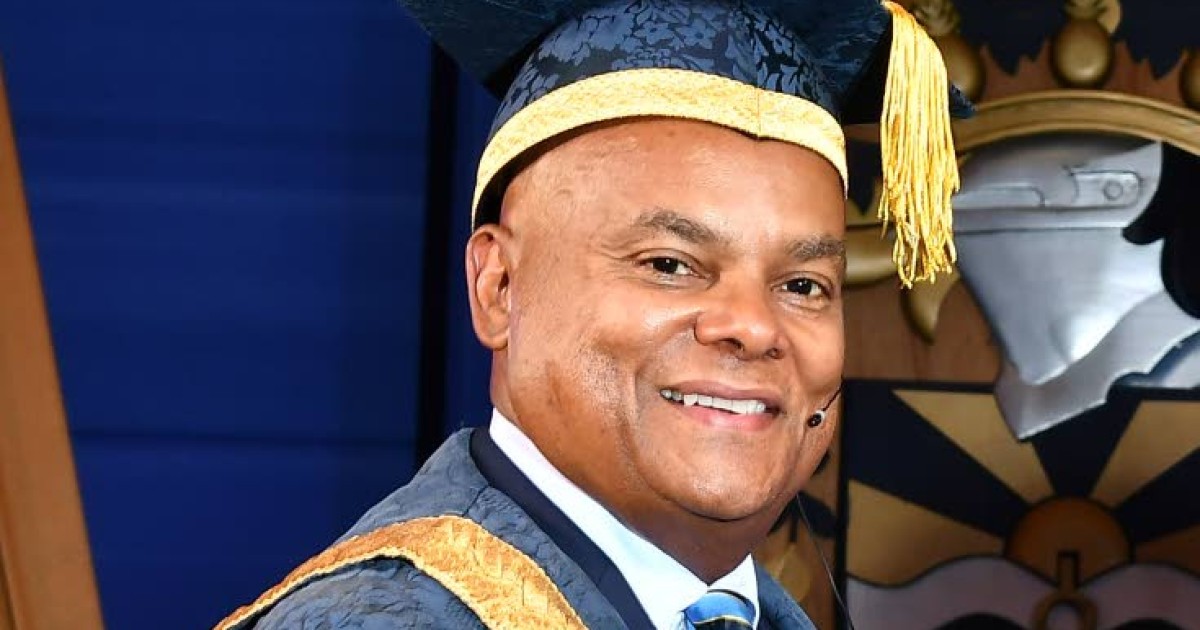
CARNEY... these devices we walk around with in our hands, we become so dependent on these devices to answer questions, tell us what to do, how to think, that we’re thinking less (Photo: Karl Mclarty) University of Technology (UTech), Jamaica chancellor, Ambassador Lloyd Carney has warned youngsters that increasing dependence on smartphones and other modern communication devices is doing more than wasting their time — it is making them dumber. Carney issued the warning at all three of the university’s graduation ceremonies at Alfred Sangster Auditorium on the Papine, St Andrew campus over the weekend. He urged graduates to reduce their social media use, citing studies which, he said, showed that high school students worldwide had experienced two consecutive years of declining thinking and problem-solving abilities. According to Carney, the reported decline in thinking and problem-solving abilities marked a change from the pattern in previous years when each group of students leaving high school was expected to have stronger thinking skills than the one before. “It’s the second year now in a row international studies have shown that students graduating high school from all over the globe, they have less cognitive skills, less logical thinking capability than students from two years ago. Two years in a row, our students are leaving high school not as smart as they used to be. Before there was always a progression every year, they’re a little bit smarter than the group before,” he said. Carney said the findings had been linked to people’s growing reliance on devices, which, he believes, is reducing the amount of independent thought and analysis they exercise. “These devices we walk around with in our hands, we become so dependent on these devices to answer questions, tell us what to do, how to think, that we’re thinking less. We’re not being as analytical in our way of thinking, and it is actually debilitating to us,” said Carney, who did not identify the studies he was pointing to, or provide details about the countries, number of students and methods used to reach those findings. However, a study published in the Journal of Adolescence in 2025, which examined the academic performance of more than 1.78 million students aged 15 and 16 across 36 countries, found that results in mathematics, reading, and science had declined in many countries, particularly between 2012 and 2022. The research, which analysed data from the Organisation for Economic Co-operation and Development’s Programme for International Student Assessment, also found that declines were greater in countries where young people’s access to smartphones and use of electronic devices for leisure during school hours had increased. At Sunday’s ceremony, Carney delivered the warning in even more blunt terms. “These smart devices we walk around with, these phones, they are sapping your intellectual capacity because they want to think for you. So it’s to their benefit that you get dumber, and that’s exactly what’s happening,” Carney said. The University of Technology, Jamaica chancellor encouraged parents to lead by example if they want their children to spend less time on social media.“If you want to curtail what your children are doing on social media, when you come home from work, read with them, play a board game, talk to them. If they see you on social media, spending your time talking to your friends on social media, posting on social media, your children are going to imitate what you are doing,” he said. He pointed to China and Singapore as the only two countries which, according to the studies he referenced, had not experienced decline in young people’s thinking skills over the two-year period. The chancellor attributed this to restrictions in those countries on young people’s access to social media. Carney also took aim at the pressure to create an image of wealth and success on social media. “There are people borrowing money to rent a car to look like they have money so they can show on Facebook, or whatever, that they have money. They are going into debt to pretend they have money, so that the billionaires in Silicon Valley can make money off of your foolishness. It is time to stop doing that,” he said. Carney also warned that artificial intelligence (AI) could make it easier for people to misrepresent themselves and urged graduates to be careful about the information they share with such tools. He said people should also avoid becoming so dependent on AI that they use it for every decision or task, arguing that technology companies had a financial interest in encouraging people to rely heavily on their products. Drawing on his experience in business and technology, Carney said most everyday tasks in industry and business did not require expensive large language models, such as ChatGPT, Claude or Google’s Gemini. He estimated that about 90 per cent of the work could be done using cheaper models. Carney also shared a story of an engineer at one of his companies who left an AI model running for a month and generated a US$200,000 bill. The chancellor also encouraged parents to lead by example if they wanted their children to spend less time on social media. “If you want to curtail what your children are doing on social media, when you come home from work, read with them, play a board game, talk to them; imagine that, talk to them. If they see you on social media, spending your time talking to your friends on social media, posting on social media, your children are going to imitate what you are doing,” he said.
Dumb and dumber!
Full Article
Original Source
Read the full article at Jamaicaobserver →KhanList aggregates and links to publicly available news content. We do not host full articles from third-party sources. Always verify important information with original sources.