
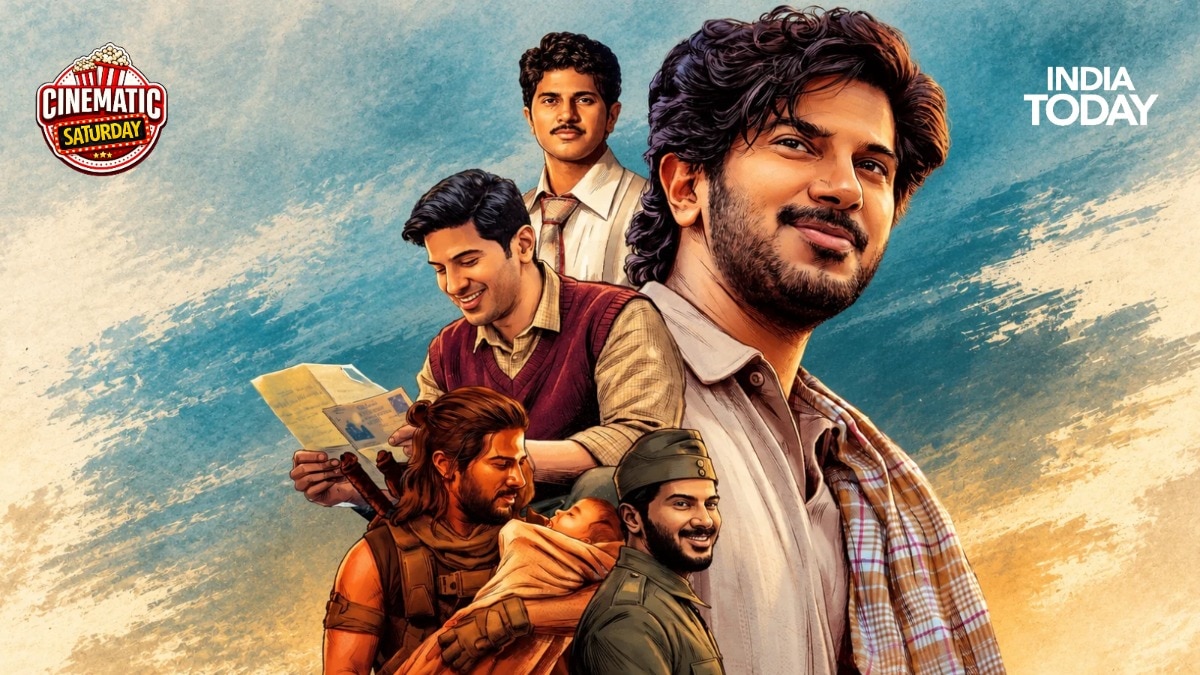
There's something rather delightful about Dulquer Salmaan's Telugu journey. A popular contemporary star in Malayalam cinema, actor-producer and son of megastar Mammootty, he hardly needs an introduction to South Indian audiences. Yet, he doesn't need thunderous punch dialogues, gravity-defying stunts or a dozen baddies to beat up in his introduction scene to win over Telugu audiences. Neither has he played the conventional larger-than-life Telugu hero. And yet, every time he arrives on the big screen, Telugu audiences welcome him with open arms, often sending him right back with a blockbuster. Somewhere along the way, Dulquer has earned a rather special place in Telugu cinema – almost like that favourite cousin who doesn't visit often but, whenever he does, is welcomed with the warmth reserved for family.Look at his Telugu filmography. He began with Mahanati, playing Tamil cinema legend Gemini Ganesan, a charming but deeply flawed man in a film that wasn't even centred on him. Then came Sita Ramam, where he made an entire generation fall in love with a fictional soldier named Ram. In Lucky Baskhar, he traded the uniform for a banker's shirt and showed us just how entertaining a morally questionable man could be. And now, with Aakasamlo Oka Tara, he has added another shade to his Telugu screen persona.Four films, four very different characters, and an audience that keeps showing up. So, what exactly is Dulquer doing right?He didn't arrive asking to be a Telugu heroOne of the smartest things about Dulquer's Telugu journey is that he never seemed particularly interested in fitting into a ready-made hero template. His first major Telugu outing, Mahanati starring Keerthy Suresh, was hardly the conventional launchpad one would imagine for an actor entering a new industry. He played Gemini Ganesan, a character whose complicated relationship with Savitri invited strong opinions in real life. He wasn't the centre of the story, and the film didn't require him to be a flawless hero. It required him to be convincing. He was and how. But if Mahanati introduced him to Telugu audiences, Sita Ramam made them fall for him. Hanu Raghavapudi's beautiful period romance gave Dulquer the kind of character that seemed tailor-made for his screen presence. As Lieutenant Ram, he was charming without trying too hard, romantic without becoming cheesy, and vulnerable without losing his dignity. It was the sort of performance that made audiences want to root for the character long after the film ended. And then came Lucky Baskhar. Just when everyone thought Dulquer had found his comfort zone as the charming romantic hero, he turned up as a middle-class bank employee with questionable ethics and a rather impressive talent for getting into trouble. The film proved that his appeal wasn't limited to romance. Give him a good character and an engaging story, and he could take audiences along for quite a ride. With Aakasamlo Oka Tara, he has once again chosen a part that doesn't demand the spotlight at every turn. There's a pattern here: Dulquer seems comfortable letting the story lead, even when he is the star.A little help from the right friendsIt would be unfair to discuss Dulquer's Telugu success without mentioning Swapna Cinema. The production house played an important role in bringing him to Telugu audiences through Mahanati and Sita Ramam. More importantly, these collaborations introduced him to filmmakers and stories that understood what worked for him.That relationship also highlights something interesting about his choices. He hasn't simply walked into Telugu cinema expecting his existing popularity due to Malayalam and Tamil cinema to do the heavy lifting. He has worked with local filmmakers, embraced stories rooted in Telugu sensibilities and made the effort to connect with the audience. Dubbing his own lines also helps. It may not sound like a grand marketing strategy, but audiences notice when an actor makes that effort.Of course, Telugu audiences have always welcomed good cinema from outside the industry. Rajinikanth built a special place for himself here, and Suriya has enjoyed enormous affection through his dubbed films. Dulquer's route is slightly different. Rather than relying primarily on dubbed releases, he has built his Telugu identity through films made directly for the market.The timing couldn't have been betterThere is also a little bit of timing involved. The pan-India wave has changed the way Telugu cinema operates. Many of its biggest stars are now committing years to large-scale action spectacles, with massive budgets and even bigger ambitions. This has gradually created more room for actors who can headline smaller, more intimate stories.It isn't that Telugu cinema has stopped making romances, thrillers or family dramas. Those films are still being made, but the number of young stars choosing to lead them seems to have reduced. Even actors such as Nani and Vijay Deverakonda, who once represented a more content-driven wave of Telugu cinema that appealed to a wide audience, have increasingly explored mass-oriented films in recent times. That's a perfectly valid career choice, but it has also opened up space for actors who can headline these stories without carrying the baggage of a conventional mass-hero image.Dulquer seems to have found his sweet spot right there. He can walk into a romance, a family drama or a quirky thriller without having to carry the expectations of a conventional mass hero. And Telugu audiences, who have always had room for good cinema regardless of where it comes from, have embraced that.But is everything really rosy back home?Interestingly, Dulquer's journey in Malayalam cinema tells a slightly different story. He has delivered memorable performances in films such as Ustad Hotel, Bangalore Days and Charlie, establishing himself as one of the industry's popular contemporary stars. But his attempts to move into larger-scale mass cinema, just like the young actors in Telugu, haven't always produced the same results.That contrast is worth looking at. In Telugu, audiences have largely embraced the variety he brings. At home, expectations are different, and comparisons with his father, Mammootty, are never too far away. Meanwhile, Dulquer has also expanded his role as a producer through Wayfarer Films, backing projects such as Lokah Chapter 1: Chandra. His career across Tamil and Hindi cinema has been more selective, too. OK Kanmani and Kannum Kannum Kollaiyadithaal found their audiences, while films such as Karwaan and Chup introduced him to different sections of viewers. He may not have replicated his Telugu theatrical run everywhere, but he has certainly built a career that refuses to stay within one industry's boundaries.Perhaps that is the real secret. Dulquer doesn't seem to be in a hurry to become the biggest star in every industry he visits. He picks a story, finds a character and lets the film do the talking. Sometimes that character is a soldier who writes letters, sometimes a banker who gets a little too ambitious, and sometimes simply a man standing beside his wife's dream.And Telugu audiences, it seems, are quite happy to see what he does next. That's a pretty lovely place for an actor to be.- Ends
Dulquer Salmaan, Telugu cinema's favourite cousin who always comes home to a hit
Full Article
Original Source
Read the full article at Indiatoday →KhanList aggregates and links to publicly available news content. We do not host full articles from third-party sources. Always verify important information with original sources.