
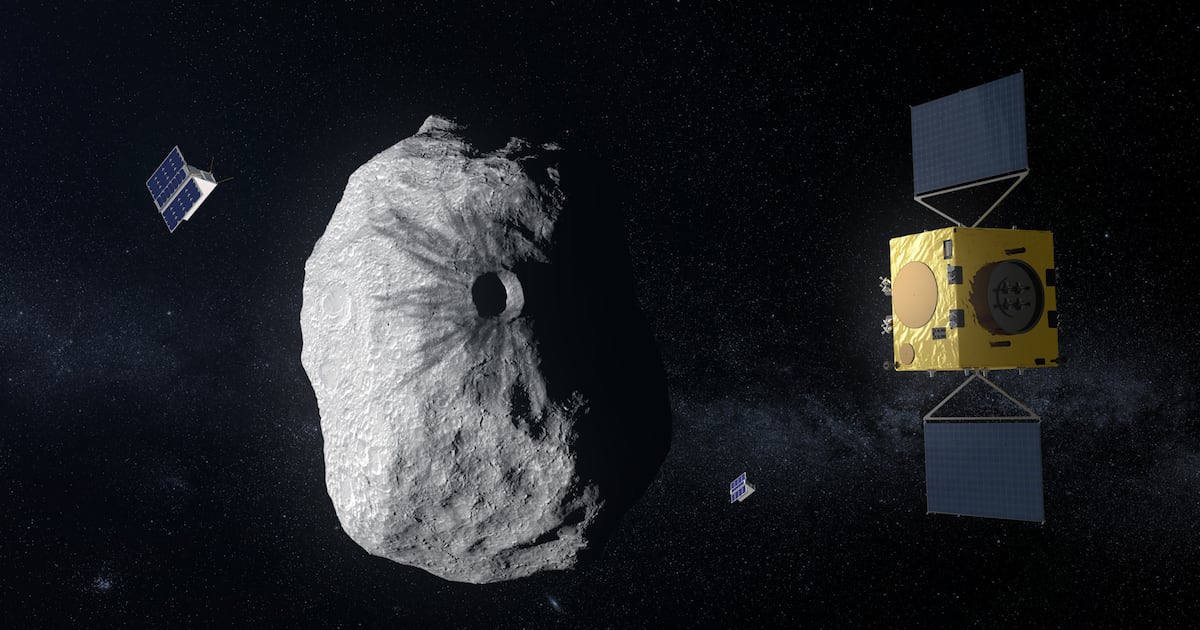
Irish technology is being used to help capture new images that provide scientific proof for how “planet-killing” asteroids can be stopped from colliding with the Earth.A Dublin company designed a gyroscope that directed the European Space Agency’s Hera spacecraft close to the asteroids in a study to understand how to deflect them.On September 26th, 2022, US space agency Nasa deliberately crashed a spacecraft called Dart into an asteroid named Dimorphos in what was called a “planetary defence test”. The goal was to determine whether an asteroid, albeit a small one, on a collision course with Earth could be deflected. READ MOREThe asteroids chosen for the test were a pair, orbiting each other 193 million km from us, called Dimorphos, the smaller one, and Didymos. Telescopes on Earth later confirmed Dart’s collision with the asteroid had occurred and that the orbit of Didymos around Dimorphos had been affected.On Wednesday, new information provided by the ESA, which is studying the aftermath of Dart’s impact, was released. The ESA’s Hera spacecraft navigated to within 25-30 km of the asteroids, guided by an Irish gyroscope built by InnaLabs, which is based in Blanchardstown, west Dublin. On a spacecraft, a gyroscope measures rotation and, working with an accelerometer that tracks changes in motion, enables the on-board systems to work out how the craft is moving and where it’s pointing. Hera launched in October 2024 from Cape Canaveral, Florida, and flew past Mars in March 2025 on the way to the asteroids. It has arrived at its destination, where it is conducting a close-up scientific analysis of the 2022 Dart impact with Dimorphos. After that impact, scientists debated whether Dimorphos had sustained an impact crater, changed shape or stayed the same. “Much to our surprise the answer turns out to be all three at once,” said Hera principal investigator Patrick Michel after viewing the images. “The face struck by Dart has been flattened into an impact crater the size of a sports stadium, which extends across the asteroid’s entire width.” Details such as Dimorphos’s mass, shape, surface and structure “will help scientists explain the deflection and improve predictions for other asteroids”, said Alberto Torasso, Innalabs’s vice-president of space programmes.The sharp images and video taken by Hera would not have been possible without the ARIETIS-NS gyroscope made by InnaLabs, which also developed gyroscopes for other ESA missions and Earth-observation space satellites. “To see something we designed and built in Blanchardstown helping scientists study an asteroid nearly 200 million kilometres away is incredibly satisfying,” said InnaLabs chief executive John O’Leary. “The science matters to everyone and Ireland has made a practical contribution to it.” The Dublin company had identified a gap in the market for a compact, cost-effective European gyroscope that would rival US competitors and it developed a gyroscope to withstand rocket vibrations, extreme temperatures and deep-space radiation. In December, Hera is to move even closer, within 13km, to the asteroids. From there, two shoebox-sized CubeSats will be released that will probe the interior and mass of Dimorphos.
Dublin company helps guide spacecraft in study to deflect ‘planet-killing’ asteroids
Full Article
Original Source
Read the full article at Irishtimes →KhanList aggregates and links to publicly available news content. We do not host full articles from third-party sources. Always verify important information with original sources.